
Guide
A Christian Homeschool Reading Scope and Sequence for K–5
The full K–5 Faith Schooling reading scope and sequence: what each grade teaches, in what order, over thirty-five teaching weeks, how the week carries Scripture, and how reading fits the larger school day.
Updated 4 October 2026
What is a reading scope and sequence?
A reading scope and sequence is the list of skills a child is taught and the order they are taught in. Scope is what is covered; sequence is when. For K–5 reading it runs from letter sounds, through blending, digraphs, blends, vowel teams, and syllables, to prefixes, suffixes, and Latin and Greek roots.
It matters because reading skills are cumulative in a way that few other subjects are. A child can meet the states of the union in any order. He cannot read vowel teams before he can blend. Every scope and sequence worth using is really an argument about dependency: this before that, because that is impossible without this.
The K–5 sequence at a glance
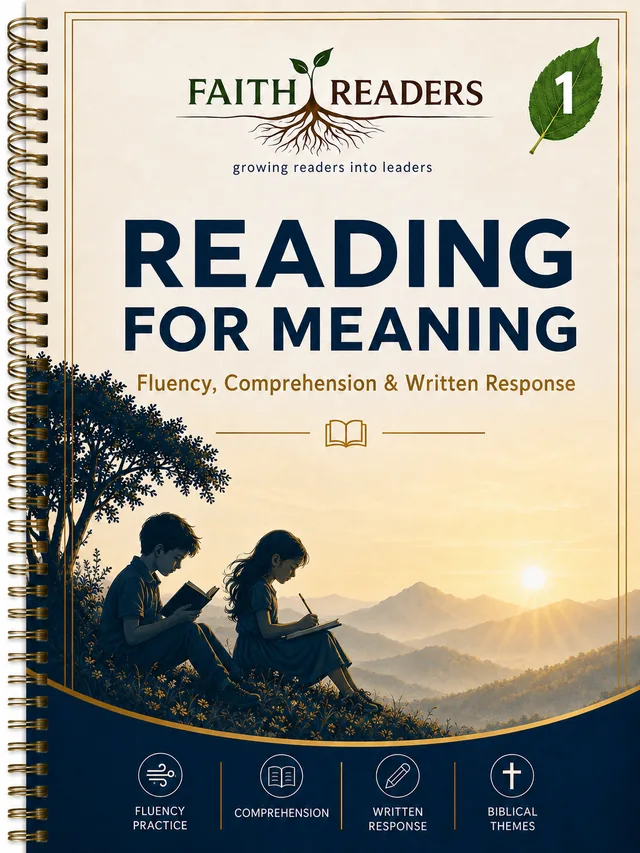
The table below is the sequence used in the Faith Readers student textbooks. Each grade runs thirty-five teaching weeks, numbered from week 2 to week 36, and each week names one skill, one hero story, one virtue, one Scripture, and its focus and sight words.
Read it as a dependency chain rather than a set of grade requirements. A child reaches the Grade 3 root work when the Grade 2 syllable work is secure, whatever his age when that happens.
| Grade | Focus of the year | Examples from the sequence | Teaching weeks |
|---|---|---|---|
| Kindergarten | The single letter sounds, then digraphs, vowel teams, r-controlled vowels, and blends | Ss, Aa, Tt, Pp, Nn, Ii … sh, ch, th, wh … ai/ay, ee/ea, oa/ow, oo/ue … ar, or/er … bl, cl, fl; br, cr, dr; -nd, -nt | 35 |
| Grade 1 | Long vowels, blends, vowel teams, high-frequency words, suffixes, fluency | long i, o, u; s-, l-, r-blends; -nd; ai or ay, ee or ea, oa or ow, ie or igh; -s, -ed, -ing, -er, -est, -ful, -less | 35 |
| Grade 2 | Advanced vowel teams, soft c and g, silent letters, syllables, prefixes and suffixes | oo, ou/ow, oi/oy; soft c and g; kn-, wr-, -mb; open and closed syllables; -tion, -sion, -ture; un-, re-, pre-, dis-; compounds and contractions | 35 |
| Grade 3 | Syllable division, then the first Latin and Greek roots | port, rupt, struct, dict, vis, aud, scrib; bio, geo, graph, logy; sub-, pre-, pro-, ex-; -ous, -ate, -ify, -ize | 35 |
| Grade 4 | Greek and Latin roots at volume, with advanced prefixes and suffixes | dem, chron, astro, path, phon, scope, meter, therm, micro; mal, ben, omni, multi, semi, circum, inter, trans, contra | 35 |
| Grade 5 | Roots that carry meaning across subjects, then morphological analysis | nat, corp, vert/vers, reg, civ, pop, jur/just, lib, nomen, terra, spec, ced, sanctus, grat, pac, fid | 35 |
What Kindergarten covers, week by week
Kindergarten spends its first half on single letters and their primary sounds, in an order chosen so that real words can be built early: s, a, t, p, n, i, d, o, then h, f, l, e, r, u, c, b, g. Eight letters in, a child can already read and write short words. The alphabet finishes early in the third quarter with k, w, j, v.
The third quarter then introduces the consonant digraphs — sh, ch, th, wh — the first time the child meets two letters making one sound, and the first genuine conceptual jump of the year. Vowel teams open at the end of that quarter with ai and ay, and the final quarter works through ee and ea, oa and ow, oo and ue, the r-controlled vowels ar, or and er, and the blend families bl, cl, fl; br, cr, dr; and -nd and -nt.
A child who finishes that year can decode most short regular words, read a simple connected story unaided, and write words from dictation. That is the honest goal of Kindergarten reading. Anything past it is a bonus, not a requirement, and treating it as a requirement is how families manufacture a struggling reader out of a normal one.
Letter sounds Consonant digraphs Kindergarten phonics practice
What Grades 1 and 2 add
Grade 1 opens on long vowels — the silent e in time, home, and cube — then contrasts them against the short vowels already known, which is where most early-reading confusion lives. It moves into blends, then the vowel-team pairs, then a quarter of high-frequency words and decodable text, and closes on suffixes and fluency: -s and -es, -ed, -ing, -er and -est, -ful and -less.
Grade 2 is the year a child stops reading one syllable at a time. It teaches open and closed syllables, then splitting VCV and VCCV words, then the endings that make long words readable: -tion, -sion, -ture. Prefixes (un-, re-, pre-, dis-) and suffixes (-ful, -less, -ness, -ment) follow, then compounds, contractions, and homophones.
By the end of Grade 2 the mechanics of reading are largely finished. What remains is meaning.
Why Grades 3 to 5 turn to roots and morphology
From Grade 3 onward, the words a child meets are mostly long, and long words in English are built from parts. Teaching port, rupt, struct, dict, vis, aud, and scrib gives a child a way into transport, interrupt, construct, predict, visible, audience, and manuscript without meeting any of those words individually.
Grade 4 widens that to the Greek stock — dem, chron, astro, path, phon, scope, meter, therm, micro — and the Latin quantity and direction words: mal, ben, omni, multi, semi, circum, inter, trans, contra. Grade 5 works the roots that carry meaning across every subject a child will later study: nat, corp, civ, pop, jur, lib, terra, spec, and the roots behind the vocabulary of Scripture itself — sanctus, grat, pac, fid.
This is vocabulary instruction wearing the clothes of word study, and it is the highest-leverage reading work available in the upper elementary years.
Vocabulary Vocabulary, morphology, and word study practice Phonics Lab worksheets with answer keys
Where Scripture sits in the sequence
In this sequence faith is not a separate subject bolted to the end of the reading lesson. Each week carries a hero, a virtue, and a Scripture that the reading itself is built from: Samuel and obedience with 1 Samuel 3:9, Adam and stewardship with Genesis 2:15, Timothy and faithfulness with 2 Timothy 1:7, Peter and faith with Matthew 14:29. The decodable story for the week is that account, told inside the phonics patterns taught so far.
That arrangement follows the plain instruction of Deuteronomy 6:7, which describes teaching as something woven through ordinary hours rather than reserved for a set time: “You shall teach them diligently to your children, and shall talk of them when you sit in your house, when you walk by the way, when you lie down, and when you rise up.” (NKJV)
The practical effect is that the reading lesson and the discipleship of the day stop competing for the same twenty minutes.
A real sample week The Hidden Word — a free Scripture memory curriculum
How the reading scope and sequence fits the full day
The reading sequence handles reading while Building Number Sense provides its own complete K–5 student-text progression for mathematics. Families arrange their chosen complementary subjects around those core Faith Schooling sequences.
Handwriting runs alongside rather than inside the reading sequence, in its own ten-workbook progression, because forming a letter and reading a letter reinforce each other while progressing at different rates.
Two further limits are worth naming. A scope and sequence gives you the order; it cannot give you the pace, which belongs to your child. And it says nothing about the books you read aloud, which is where background knowledge and the appetite for reading actually come from.
Building Number Sense — the sequenced K–5 math series Learning Cursive The benefits of reading aloud
How to use a sequence you did not write
Place the child, then enter the sequence where he actually is rather than where his age suggests. HARVEST does this free in about twenty minutes and produces a printable report naming a starting point.
Then hold the order and let the pace move. Skipping ahead creates gaps you will pay for later; moving slowly through the order costs nothing but time. If a grade takes fourteen months, it took fourteen months.
Finally, keep the reading practice matched to the point in the sequence you have reached. That is what decodable readers are for, and it is the largest single difference between a sequence that works on paper and one that works in a home.
HARVEST reading placement Decodable readers explained Helping a child who is behind in reading
Common questions
- Does my child have to follow a grade-level sequence exactly?
- The order matters; the grade labels do not. A Grade 3 student missing vowel teams should be taught vowel teams. Foundations to Fluency exists for that case — its six levels are labeled by pattern rather than grade, so an older child can close a specific gap without being handed a book that looks too young.
- How many weeks does each grade take?
- Each Faith Readers grade covers thirty-five teaching weeks. Families who school four days a week, or who take longer breaks, routinely spread that across more calendar weeks. The sequence does not mind, because it is paced by mastery rather than by date.
- What if my child is ahead in reading but behind in spelling?
- That is common and it is not a contradiction. Reading is decoding, spelling is encoding, and encoding lags. Keep him moving forward in the reading sequence while practicing the spelling side of patterns already taught — the Phonics Lab worksheets come with answer keys for exactly that.
- Where does comprehension fit into this sequence?
- Throughout, but it is not driven by the phonics order. In K–2 it comes mostly from what you read aloud, because a child's own decoding limits what he can read for himself. From Grade 3 the fluency passages carry longer connected text and comprehension becomes the main event.
- Can I see the sequence for a grade before joining?
- Yes. Every reading grade page lists its scope and sequence in text, week by week, and the complete teaching guide for each grade is readable in the browser without a membership.
- Is this scope and sequence the same as the weekly lesson sets?
- Yes. Faith Readers Weekly Lessons is the same K–5 sequence issued a week at a time — 210 weekly sets of five short daily lessons with a preceptor guide — for families and co-ops who would rather print one week than a full-year book.