
Guide
What Are Decodable Readers, and When Should My Child Use Them?
A plain explanation of decodable readers: what makes a book decodable, how they differ from leveled and predictable books, when a child should start and when controlled text has done its job, how to run one sitting, and what the 300 Faith Readers decodable readers actually contain.
Updated 4 October 2026
What is a decodable reader?
A decodable reader is a short book written using only the phonics patterns a child has already been taught, plus a small number of high-frequency words introduced on purpose. Because nothing in it is unteachable, the child can read every sentence by sounding it out.
The word decodable describes a relationship, not a reading level. A book is decodable for your child, at this point in his sequence. The same book is not decodable for a child two months behind him, and it is unnecessarily restricted for a child two months ahead. That is why decodable readers come in a sequence matched to a phonics sequence rather than in an age band.
It also explains the most common disappointment with them. A parent buys a set, hands over book one, and finds it either trivial or impossible. Neither is a fault in the book. The set was written against somebody's phonics order, and the child is somewhere else in it.
How is a decodable reader different from a leveled or predictable book?
The three kinds of early book are built on different assumptions about how a child gets the word off the page. Most frustration in early reading comes from handing a child the wrong one.
A predictable book teaches a child that reading means predicting. That works until the sentences stop repeating, usually somewhere in Grade 1 or 2, and then a child who has been rewarded for prediction has a habit to unlearn on top of a code he never learned. Decodable text does the opposite: every sentence is one more piece of evidence that the letters tell you the word.
| Kind of book | How the child is meant to read it | What it builds |
|---|---|---|
| Decodable | Sounds out every word using patterns already taught | Decoding, blending, and confidence that the code works |
| Predictable or patterned | Learns a repeated sentence frame and swaps the picture word | Memory of the pattern; often rewards guessing |
| Leveled reader | Reads by whatever mixture of decoding, memory, and context the level assumes | Varies, and may contain patterns never taught |
When should a child start reading decodable books?
As soon as he can blend three sounds into a word in print. That is usually only a few weeks into a phonics sequence, once a handful of consonants and one short vowel are secure. He does not need to know the whole alphabet first.
Start earlier than feels natural. The first decodable book a child reads is often ten words long, and reading it may be the most important thing that happens that month, because it is the first time reading was something he did rather than something done to him.
In the Faith Schooling Kindergarten sequence a reader arrives with the very first letters. The teaching week for Ss carries a Samuel story built from those sounds; the week for Aa carries Adam; Tt carries Timothy. The book is never ahead of the lesson.
CVC blending — the readiness skill Kindergarten reading, week by week
How do you use one in a sitting?
Five to eight minutes, and reread rather than always moving on. Rereading the same short book across three days is what turns accurate reading into fluent reading, and it is the step most often skipped.
- Preview the two or three new words that carry the week's pattern. Read them in a list first, off the page.
- Let him read it once through, aloud. Do not supply words. Wait, then point at the part he skipped and let him try again.
- Ask one question about what happened. Reading is for meaning even when the book is nine sentences long.
- Reread the same book the next day, and the day after. Time it only if your child enjoys that; some do not.
- Move on when he reads it correctly and comfortably on a cold first try.
Short-vowel fluency Kindergarten fluency phrases in the practice library
When should a child stop using decodable readers?
When decoding is no longer the bottleneck. Practically, that is when he can read unfamiliar multisyllable words accurately and it is his speed rather than his accuracy that limits him. For many children that arrives during Grade 2 or Grade 3.
At that point controlled text has done its job, and holding on to it begins to cost him, because ordinary books carry the vocabulary and sentence variety he now needs. The change is gradual: keep decodable text for the newest patterns while real books carry the reading he does for pleasure and for content.
In the Faith Schooling sequence that shift is built in. Kindergarten through Grade 2 readers are decodable stories; Grades 3 to 5 are fluency passages — longer, less controlled, written for stamina and comprehension rather than for one phonics pattern.
What about an older child who still needs controlled text?
A nine-year-old who needs vowel teams should not be handed a book meant for a six-year-old. The pattern is the problem; the packaging does not have to advertise it.
Foundations to Fluency is built for that case: its six levels are named for the pattern they teach rather than for a grade, so an older student can work on exactly what is missing without being handed something that looks too young. The repair plan itself — how to find the gap and what four weeks of work looks like — is set out in the guide to helping a child who is behind in reading.
Foundations to Fluency Helping a child who is behind in reading
What the Faith Schooling readers contain
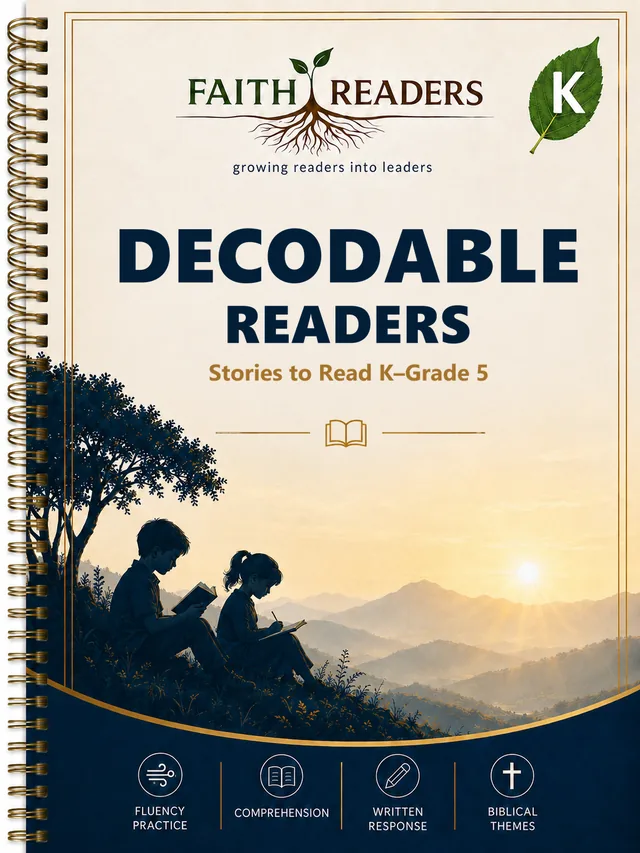
There are 300 original Faith Readers, fifty for each grade from Kindergarten through Grade 5. They are written in-house to the same phonics sequence as the core reading curriculum, so a reader exists for the pattern being taught in a given week rather than approximately near it.
The content is biblical narrative and character: Samuel, Adam, Timothy, Peter, Noah, King David, the woman at the well, Joseph, Jonah, Ruth, Nehemiah, Paul. The virtue for the week — obedience, stewardship, faithfulness, faith, trust — is carried by the story rather than added as a moral at the end, which is the only way it survives a book written with eleven usable consonants.
Each grade page shows a preview you can page through before deciding. The complete library is included with All Access; the teaching guides of the core reading curriculum are readable in the browser whether or not you join.
Browse the readers by grade Faith Readers Weekly Lessons What All Access includes
Common questions
- Are decodable books boring?
- Controlled text is genuinely constrained early on — a book written with six consonants and one vowel cannot have a complicated plot. What makes it worth reading is that the child can read it himself. The constraint loosens quickly: by the middle of Grade 1 the available pattern set is large enough for real stories.
- How many decodable readers does a child need?
- Enough that every new pattern gets read in connected text the same week it is taught, and enough left over to reread. In practice that is one short book per pattern rather than a shelf. The Faith Readers library provides fifty per grade for exactly that reason.
- Can I use decodable readers with a different phonics curriculum?
- Yes, as long as you match the book to what you have taught rather than to a grade label. Read the pattern the reader is built on, check it against your own sequence, and use it when you reach that point. Decodable text is a companion to a phonics program, never a replacement for one.
- My child memorizes the book after two readings. Is that a problem?
- No, if he read it accurately the first time by decoding. Memory after rereading is the normal path to fluency. It is only a problem if he memorized it instead of decoding it, and the test for that is whether he can read the same words out of order, in a list.
- Do decodable readers teach comprehension?
- A little, and not enough on their own. Ask one question after each reading so meaning stays part of the job, but expect comprehension and vocabulary to come mainly from books you read aloud to him, well above his own decoding level, throughout these years.
Sources
- Castles, A., Rastle, K., & Nation, K. (2018). Ending the Reading Wars: Reading Acquisition From Novice to Expert. Psychological Science in the Public Interest, 19(1), 5–51.
- Ehri, L. C. (2005). Learning to read words: Theory, findings, and issues. Scientific Studies of Reading, 9(2), 167-188. (Orthographic mapping - how words become instantly recognisable.)
- National Reading Panel (2000). Teaching Children to Read: An Evidence-Based Assessment of the Scientific Research Literature on Reading and Its Implications for Reading Instruction. NICHD.