
Guide
A sample week, Monday to Friday
One week of the Faith Readers reading sequence, taken from the published catalog rather than invented: the same five-day rhythm at three different grades, with real skills, heroes, verses and words. It also makes one first lesson ready, screen by screen.
Updated 13 October 2026 · Sources read 31 August 2026
How long does a day actually take?
A complete reading lesson is a 45 to 55 minute adult-led block. Within it, the child's own written work is 10 to 15 minutes on five pages, and that figure is recorded identically for all 1,050 daily lessons in the catalog, Kindergarten through Grade 5. A full reading week is recorded as 50 to 75 minutes of student work. The adult's preceptor guide for the week is seven pages, about 15 to 20 minutes of reading.
That is the reading lesson only. Math, handwriting, and any practice pages you add sit on top of it. Faith Schooling supplies focused K–5 reading, language arts, phonics, cursive, math, Bible, and discipleship resources, and families arrange their chosen complementary subjects around that foundation.
The five-day rhythm
Every week in the sequence runs the same way, so neither child nor parent has to work out what happens next. The rhythm is Introduce, Reader, Handwriting, Apply, Check. Monday sets up the week, Friday closes it, and the three days between practice the same pattern in three different ways.
| Day | Lesson | What happens | Pages | Student time |
|---|---|---|---|---|
| Monday | Introduce | Hero, virtue, Scripture and the new pattern | 5 | 10-15 min |
| Tuesday | Reader | Decodable reader and narration | 5 | 10-15 min |
| Wednesday | Handwriting | Handwriting, tracing, copywork and word work | 5 | 10-15 min |
| Thursday | Apply | Grammar, comprehension and written application | 5 | 10-15 min |
| Friday | Check | Weekly review and mastery check | 5 | 10-15 min |
Prepare your first lesson: Grade 1, Week 2
This is one real week made ready, screen by screen: Week 2 of Phonics, Decoding, and Early Fluency in Grade 1, the first week of that year. The sound pattern is long I, the Bible hero is Abram, and the memory verse is Joshua 1:9.
The teaching guide in these steps is open to everyone, so you can follow along now. The student pages are part of All Access.
Find the week to start with
The program is written to be taught in order. Each grade runs from Week 2 to Week 36, and the Grade 1 page lists every week with its story, its skill and its verse. A child who is new to Grade 1 starts at Week 2.
If your child already reads some of these patterns, read down the list and stop at the first skill that is not yet secure. The guide's own weekly Mastery Record, five short Show Me tasks, tells you whether a week has been mastered.
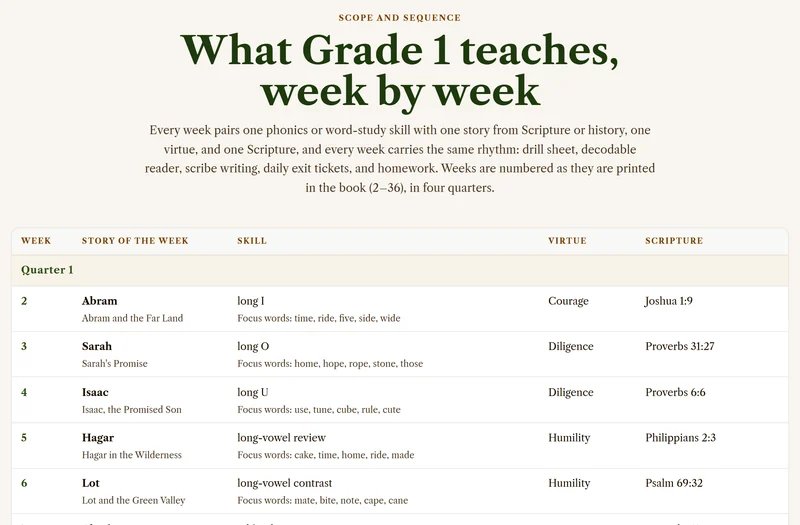
The Grade 1 page lists all 35 weeks. Week 2 is the first. Open the week in the teaching guide
The Grade 1 Teaching Guide is read on the site, page by page. Page 11 is the Week at a Glance for Week 2. It names the week's focus words (time, ride, five, side, wide) and sight words (see, the), and lists what the guide holds for the week: the five daily lesson plans, the Friday Running Record, the Mastery Record and the Remediation sheet.
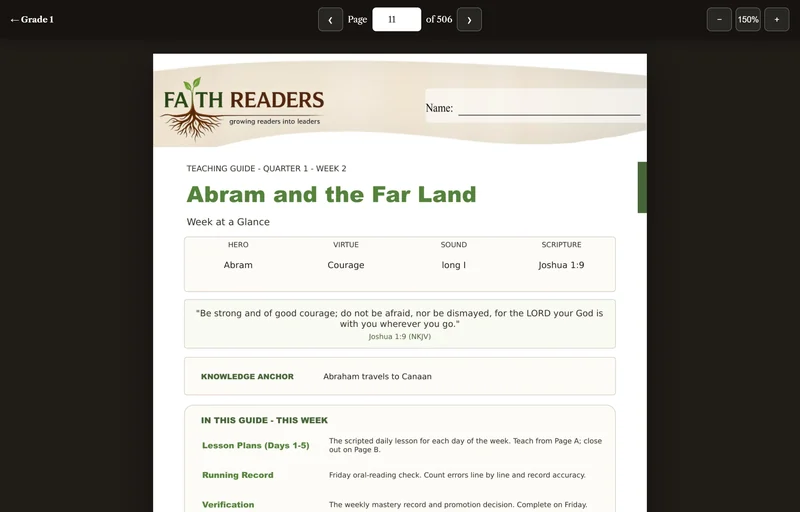
The guide's reader. Type a page number to jump anywhere in its 506 pages. Read Monday's lesson before you teach it
Each day has two pages. Page A is the lesson itself, scripted in the four parts the guide calls PACE: Predict, Act, Correct, Encode. It tells you what to say, what to show and what your child does. Page B closes the day with the verse, the pattern practice and a prayer.
Monday introduces the pattern. Tuesday adds the sight words and blending, Wednesday is connected text, Thursday is writing from sound, and Friday is the check.
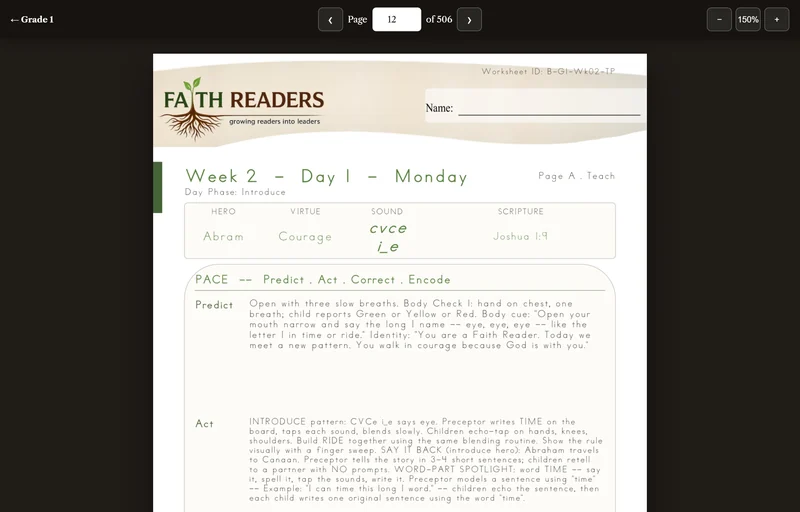
Monday, Page A: the script for introducing long I. Print the student pages
Members open the Grade 1 page, then Quarter-by-quarter files, then Quarter 1. Week 2 is pages 3 to 44 of that book: the Drill Sheet, the Decodable Reader, Scribe Writing, the five Exit Tickets and the Homework pages, in the order you will use them.
In the print box those are pages 12 to 53 of the file, because the front pages are counted first. The pages are taller than Letter paper, so choose the Fit setting and nothing is cut off. You can also print the whole quarter at once.
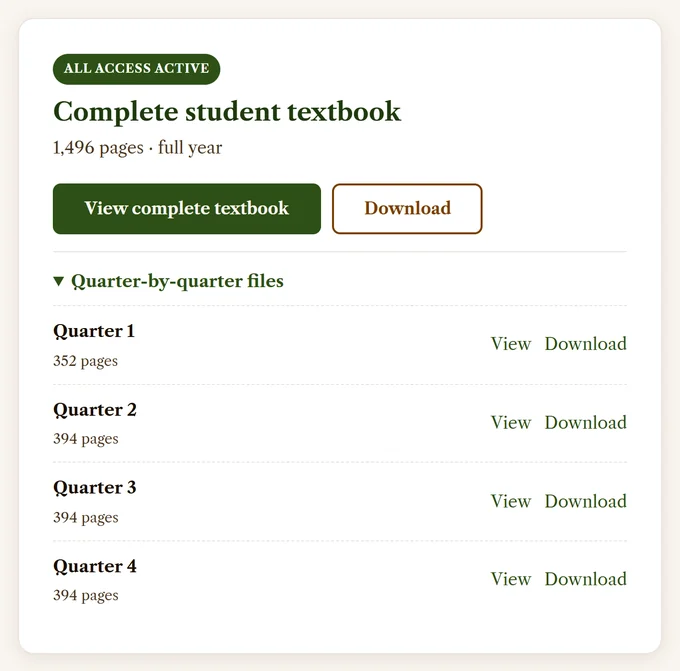
What a member sees on the Grade 1 page. 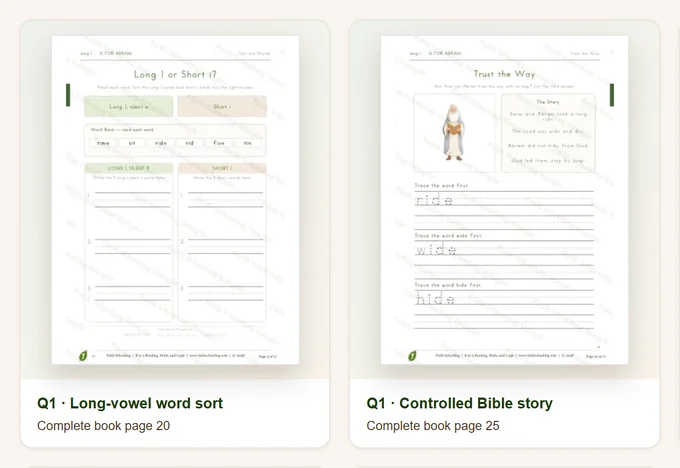
Two of this week's pages are among the open samples on the Grade 1 page. Teach the week, then use Friday's check
Friday is the proficiency check. Your child reads the week's passage aloud while you mark the Running Record. Then you fill in the Mastery Record: five Show Me tasks, each marked Independent, With Help or Not Yet.
The record ends in a decision the guide prints for you: move to Week 3, review the long I words one more day, reread the decodable reader, repeat the Friday Exit Ticket, or use the Remediation sheet. That sheet has four short diagnostic rows. If three or more are Not Yet, the guide says to go back to the Day 1 warm-up, re-teach the pattern and re-test the next day before adding anything new.
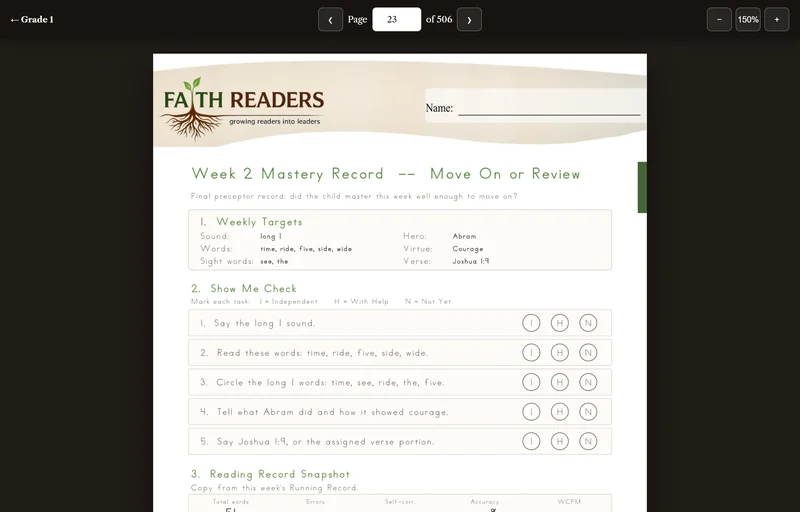
The Week 2 Mastery Record ends in a decision: move on, or review.
Where practice pages and My Workbooks fit
The textbook is the lesson. Extra practice on the week's pattern comes from the practice library: for Week 2, the long-vowel sets.
A member can gather those pages into one printable workbook in My Workbooks. It holds practice pages; the textbooks and teaching guides stay separate downloads on their own pages.
Week 6 in Kindergarten
The hero of the week is Noah and the virtue is trust. The phonics skill is the letter Nn and its sound. The memory verse is Genesis 6:22. The focus words are Noah, tools, on, an, trusts and us; the sight words are was, he, to, you, it and of.
Monday introduces Noah, the virtue, the verse and the sound of Nn. Tuesday reads the decodable story built from that sound and the words already taught, then the child narrates it back. Wednesday traces and writes. Thursday applies the pattern in grammar and comprehension work. Friday checks whether it stuck.
Week 6 in Grade 2
The hero is David and the virtue is humility. The skill is soft c and soft g continued, with the -dge and -ge endings. The memory verse is Psalm 139:23. The focus words are bridge, page, edge, judge and stage; the sight words are very and many.
The shape of the week is identical to Kindergarten's, but the load has moved. By Grade 2 the child is reading connected text on Tuesday rather than sounding out single words, and Thursday's application asks for written grammar and comprehension rather than a traced line.
Week 6 in Grade 5
The hero of the week is Augustine and his City of God, and the virtue is humility. The skill is the Latin root civ, meaning citizen. The memory verse is Ephesians 4:2. The focus words are civil, civilization, citizenship, civic and civilian; the sight words are pilgrim and republic.
By Grade 5 the phonics work has become morphology. The week still opens with a person, a virtue and a verse, still reads, still writes and still checks on Friday, but the pattern being learned is a Latin root and the words it generates rather than a letter and its sound.
How much help the adult has to give
The catalog records an expected level of adult help for every daily lesson, and it steps down as the grades rise. That is a real planning number: it tells you how much of your own attention a reading lesson will take when you have more than one child in the room.
Kindergarten and Grade 1 are recorded as high adult involvement on every lesson. Grades 2 and 3 are medium. Grades 4 and 5 are low, meaning the child can largely work the page and bring it to you. Student time does not change; your time does.
| Grade | Student time per day | Pages per day | Adult help |
|---|---|---|---|
| Kindergarten | 10-15 min | 5 | High |
| Grade 1 | 10-15 min | 5 | High |
| Grade 2 | 10-15 min | 5 | Medium |
| Grade 3 | 10-15 min | 5 | Medium |
| Grade 4 | 10-15 min | 5 | Low |
| Grade 5 | 10-15 min | 5 | Low |
Where this week comes from
The weeks above are not illustrations written for this page. They are read out of the published Faith Readers scope and sequence, which is generated from the week overview page of each grade's student textbook and printed in full on every grade page.
A grade year runs 35 instructional weeks, numbered 2 through 36. The weekly lesson library holds 210 weekly sets across six grades: 1,050 daily student lessons, 210 preceptor guides and 5,250 student pages. The same sequence in textbook form runs to 8,952 student pages with 3,530 pages of teaching guides.
Adding math to the week
Building Number Sense is the complete K–5 arithmetic student-text sequence and runs beside the reading week rather than inside it. Kindergarten through Grade 2 also include a coordinated practice workbook and teaching guide, while Grades 3 to 5 pair their student texts with extensive skill-organized support in the Math Practice Library.
If you want extra pages on a single skill rather than the next lesson, the Practice Library is the place for that. It is practice, not instruction: the first three worksheets in every set are open to everyone so you can see what you would be printing.
Common questions
- What happens if we miss a day?
- Nothing breaks. The sequence is mastery-paced rather than calendar-paced: a child moves on when the skill is there, not when the date says so. A missed Wednesday becomes Thursday's lesson and the week finishes a day later. Friday's check exists to tell you whether the pattern actually landed, which is the only signal that should decide whether you move forward.
- Is the weekly set the same content as the textbook?
- Yes. Phonics, Decoding and Early Fluency and Faith Readers Weekly Lessons follow the same week-by-week sequence; the difference is packaging. The textbook is the whole year in one student book, also offered as four quarter-sized print editions, with a teaching guide. The weekly sets are 25 student pages and a seven-page preceptor guide, printed a week at a time. Most families choose one format.
- Do I need the preceptor guide?
- It is where the teaching is. The seven-page weekly guide tells the adult what to say and do, and is recorded as about 15 to 20 minutes of reading for the whole week. In Kindergarten and Grade 1, where adult help is recorded as high on every lesson, you will lean on it heavily. By Grades 4 and 5, where it is recorded as low, you will use it for planning more than delivery.
- Can we start mid-year?
- Yes, and starting at the right week matters more than starting in September. HARVEST takes about twenty minutes in the browser and names a starting point in the sequence rather than assuming the child's age. Every grade page also publishes its full scope and sequence as text, so you can read the weeks and see for yourself where your child belongs.
- Do we have to print it?
- The weekly sets and textbooks are print-ready PDFs, and the page counts are shown before you print. Teaching guides for the reading textbooks are readable in the browser page by page. Free Apostolic Academy material opens in the same online reader, so you can read a whole book on screen without printing it.
Sources
- Faith Readers reading scope and sequence, generated from the student textbooks: hero, virtue, skill, Scripture, focus and sight words for Weeks 2-36 — checked 2026-08-31
- Faith Readers weekly-lesson catalog: 210 weeks, 1,050 daily lessons, five pages and 10-15 minutes per day, seven-page guides, adult-help ratings by grade — checked 2026-08-31
- Phonics, Decoding and Early Fluency textbook manifest: six grades, Weeks 2-36, 8,952 student pages, 3,530 teaching-guide pages — checked 2026-08-31
- Building Number Sense manifest: student text for all six grades, workbook and teaching guide for Kindergarten through Grade 2 — checked 2026-08-31