
Guide
Authors and editorial process
The educational method behind the books, the process that produces and revises them, the worldview they are written from, and the checks each one passes.
Updated 4 October 2026 · Sources read 31 August 2026
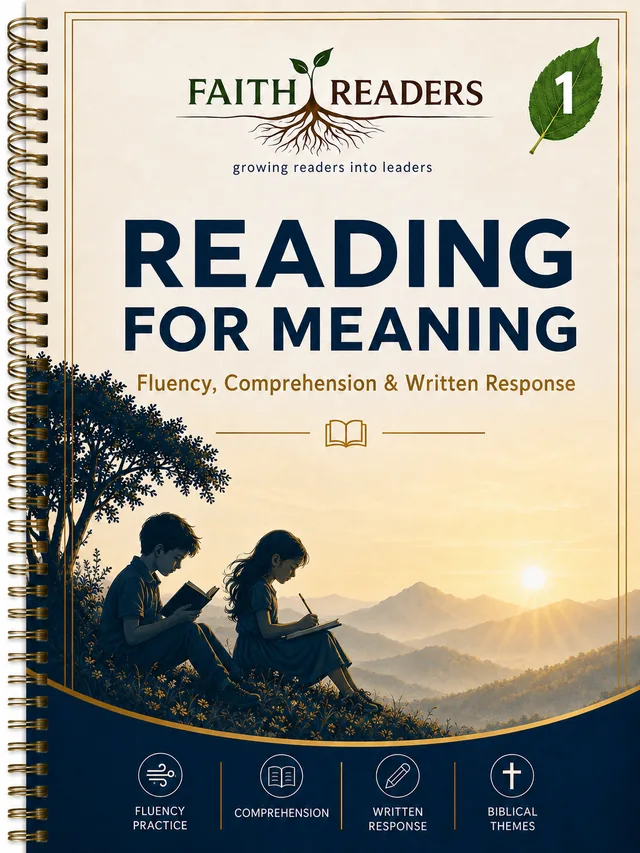
Who writes these materials?
Faith Schooling publishes Christian education and free church resources for families, schools, churches and adults, including Sunday school, Bible study, Apostolic discipleship and a K–5 homeschool curriculum. It began with a plain desire to make learning materials that are academically strong, thoughtfully designed, and genuinely rooted in Christian faith; the reading, math, handwriting, Bible, and Scripture-memory lines all come from the same house while families retain their own records and grades.
Faith Schooling was founded by Tyler, a Christian father and homeschool parent, and its materials are developed under his direction, with his final approval on instructional standards, doctrinal content, and the factual claims the site makes. His background is set out plainly on the founder page. We still do not claim degrees or credentials we cannot substantiate — experience is presented as experience, never as an academic credential — and what we publish alongside it is the method, the development process, the checks each book passes, and the actual sample pages of every book before you decide to buy it.
This page is about the people and the process; how the teaching itself works — structured literacy, mastery pacing, explicit instruction and the rest — has its own set of pages.
How reading is taught here
Reading is taught with explicit, systematic phonics. Sounds and patterns are taught directly and in a fixed order, then read immediately in text built from patterns the child has already been taught. Nothing is left to guessing from pictures or context.
The sequence is visible and can be inspected. Kindergarten Week 2 is the letter Ss and its sound. Grade 2 Week 6 is soft c and soft g with the -dge and -ge endings. Grade 5 Week 6 is the Latin root civ. Every grade page prints its full 35-week scope and sequence as text rather than as a marketing summary.
The parts are deliberately separated. The core sequence teaches. The textbook's own weekly reader is the week's story written on that week's pattern. A separate library of 300 readers, decodable readers for Kindergarten to Grade 2 and fluency passages for Grades 3 to 5, gives more connected text and is not matched to the sequence week by week. Foundations to Fluency, 96 workbooks across six levels, targets one pattern at a time by pattern rather than by grade. The Phonics Lab handles the spelling side, 150 worksheets each with an answer key.
The reading curriculum Decodable Readers Foundations to Fluency
Predictive Rhythm Learning
The instructional approach that decides when each method is used is called Predictive Rhythm Learning. Its premise is our own working view, not a research finding: a child who commits to an answer before being taught, and then checks it, pays closer attention to what comes next. A wrong prediction is treated as useful rather than shameful.
Every instructional block follows the same four-phase PACE cycle: Predict, Act, Correct or Connect, and Encode. Because the shape never changes, the child's attention goes to the content rather than to working out what is about to happen.
Encoding runs through five channels in a deliberate order, hands-on and sensory first, symbolic and abstract last: Body, Predict, Build, Map and Name. The child traces in the air, claps or feels the phoneme in the mouth before building it with objects, locating it on a chart, and finally writing and naming it.
Mastery, not the calendar
Children move forward when they have the skill, not when the date says so. The published standard is 90 percent or better accuracy across five or more sessions on different days, with parallel assessment forms so a retest measures the skill rather than the memory of the first attempt, and structured remediation when mastery is not reached.
Placement follows the same principle. HARVEST is a free browser assessment, about twenty minutes across seven sections covering phonemic awareness, decoding, sight words, fluency and comprehension. It routes adaptively, names a starting point in the sequence, and produces a printable report. It runs in your browser and nothing is uploaded.
The worldview these books are written from
Faith Schooling is written from a Christian conviction, with the Bible treated as the final authority rather than as one option beside others. Scripture, memory verses and Christian character are carried through the lessons rather than added beside them: the week's hero, virtue and verse are the content of the lesson, not a border around it. The passage behind the work reads: "Train up a child in the way he should go, And when he is old he will not depart from it." (Proverbs 22:6, NKJV). Scripture taken from the New King James Version. Copyright 1982 by Thomas Nelson. Used by permission. All rights reserved.
Scripture quoted in this site's own pages and in the academic textbooks is the New King James Version, exact, with the reference and the publisher's credit. Some products use the King James Version and say so: The Hidden Word (read programmatically from a checksummed public-domain text), The Way, the Bible Verse Card Maker and the math practice sheets. Scripture sourcing and credit are set out in full in the editorial policy.
How a book is developed and revised
Every reading format is generated from one sequence source. The six student textbooks, the 210 weekly lesson sets and the decodable readers are not written three times; they are three packagings of the same 35-week year. That is why the textbook and the weekly sets teach the same skill in the same week.
Revision works the same way. When the sequence changes, the whole line is regenerated from it, so the textbook, the weekly sets and the published scope and sequence cannot drift apart. The scope and sequence printed on each grade page is itself generated from the week overview pages of the books, and is regenerated after every rebuild.
This also keeps every claim precise. Building Number Sense is a complete K–5 student-text sequence; Kindergarten through Grade 2 add coordinated workbooks and teaching guides, while Grades 3 to 5 pair with the extensive Math Practice Library. Each grade page lists its exact published package.
How materials are checked
Checking is automated wherever it can be, so that it can actually fail. Published counts are reconciled against the catalog by a drift gate that fails the build when a number cannot be derived from its declared source. Worksheets that should carry an answer key are paired with their keys, and anything unmatched goes onto a review list. Published routes are verified for status, canonical URL and metadata.
Apostolic Academy material passes a documented eleven-point publication gate before it can be marked indexable, and the build stops with an error if a page requests indexing while any item is missing. Pages are also swept in the browser at several viewport widths for layout breakage and accessibility failures.
The full statement of these rules, including how parent statements are handled, why the site publishes no star ratings, and how to report an error, is set out separately.
What we state clearly
Faith Schooling is an independent curriculum publisher for parent-led education. Families keep their own records and choose complementary subjects while using the site's focused K–5 academic and discipleship programs.
Building Number Sense provides a complete K–5 student-text sequence, coordinated workbooks and teaching guides through Grade 2, and extensive upper-grade support in the Math Practice Library. The comparison page keeps Faith Schooling's strengths visible while presenting dated, source-based facts about other publishers.
Common questions
- Who actually wrote the curriculum?
- Faith Schooling's materials are written and published in-house, developed under the direction of Tyler, the founder, who holds final approval for instructional standards, doctrinal content, and published factual claims. His background is described on the founder page, and the site also publishes the method, the development process, the scope and sequence for every grade, the quality checks, and real sample pages so families can judge the actual work before paying.
- Is this aligned with the science of reading?
- Reading is taught with explicit, systematic phonics, in a fixed published sequence, with decodable text matched to the patterns already taught and a separate spelling strand. We describe what the materials actually do rather than adopting a label, because labels get claimed loosely. The full 35-week sequence for every grade is printed on the grade pages so you can check it against your own standard.
- How do you decide when a child moves on?
- By mastery rather than by date. The published standard is 90 percent or better accuracy across five or more sessions on different days, with parallel assessment forms so a retest measures the skill rather than a memory of the first attempt, and remediation when it is not reached. HARVEST places a child by skill at the start. A child who needs three more weeks on a pattern takes three more weeks.
- Is Faith Schooling accredited?
- Faith Schooling is an independent curriculum publisher for parent-led education; accreditation applies to enrolling schools rather than curriculum materials. You teach the material and keep your family's records, grades, and transcripts. Requirements vary by state, so check what your own state asks of homeschooling families.
- What worldview are the materials written from?
- A Christian and Apostolic one, with the Bible treated as the final authority. Scripture, memory verses, and Christian character run through the lessons rather than sitting beside them. Scripture in the site's own pages and the academic textbooks is quoted from the New King James Version exactly, with credit, while The Hidden Word, The Way and the math practice sheets use the King James Version; the translation of every product is listed on the King James guide.
Sources
- About Faith Schooling: Predictive Rhythm Learning, the PACE cycle, the five encoding channels, the 90 percent across five sessions mastery standard and parallel retest forms — checked 2026-08-31
- Our Story: origin, convictions and design commitments — checked 2026-08-31
- HARVEST landing page: seven sections, about twenty minutes, adaptive routing, printable report, runs in the browser with nothing uploaded — checked 2026-08-31
- Faith Readers reading scope and sequence, generated from the student textbooks — checked 2026-08-31
- Building Number Sense manifest: per-grade student text, workbook and teaching-guide components — checked 2026-08-31
- National Reading Panel (2000). Teaching Children to Read: An Evidence-Based Assessment of the Scientific Research Literature on Reading and Its Implications for Reading Instruction. NICHD.
- Rosenshine, B. (2012). Principles of Instruction: Research-Based Strategies That All Teachers Should Know. American Educator, 36(1), 12–19.