
Guide
How to Teach Phonics at Home: A Christian Parent's K–3 Guide
The operational pillar for teaching phonics at home in Kindergarten through Grade 3: the order sounds are taught in, what a twenty-minute lesson contains, the test that says a skill is finished, the five things that stall a home phonics program, and which Faith Schooling material does which job. The case for teaching the code at all is argued separately in the Academy guide to teaching reading in a Christian home; this page is the sequence, the lesson, and the material map underneath it.
Updated 4 October 2026
What does it mean to teach phonics at home?
Teaching phonics at home means teaching the sounds letters make in a fixed order, one new sound at a time, and having your child read words and short books built only from the sounds already taught. In Kindergarten through Grade 3 that takes about fifteen to twenty-five minutes a day.
That is the whole method. The difficulty is not the teaching, it is the ordering. A child handed sounds in a scattered order, or handed books full of words he has no way to work out, starts guessing from the picture and the first letter. Guessing is a habit that has to be undone later, which is the reason a sequence exists at all: to make guessing unnecessary.
The case for teaching the code explicitly — and why guessing strategies come apart around Grade 3 — is argued in the Academy guide to teaching reading in a Christian home. This page is the operational layer underneath that argument: the order, the shape of one lesson, the test that says a skill is finished, and which material does which job.
Faith Schooling's phonics plan sits inside a larger K–5 foundation of reading and language arts, handwriting, math, Bible, and discipleship. Families arrange their chosen complementary subjects around that focused program.
The core K–5 reading curriculum How to teach reading in a Christian home The full K–5 program map
What order should phonics be taught in?
Order matters more than intensity. Each step below depends on the one above it, and a child who is struggling is far more often missing a step than missing effort.
The steps are the same whatever program you use. Only the pace and the labels change.
- Sounds before letters. The child hears and blends spoken sounds — /m/ /a/ /t/ becomes mat — with his ears only, no print in front of him.
- One sound per letter. Each consonant and each short vowel gets its primary sound, taught and reviewed until he produces it without pausing to think.
- Short-vowel words. Three-sound printed words — cat, pin, mud — blended left to right rather than recognized by shape.
- Automatic short vowels. The same words read at speed, so his attention is free for meaning instead of mechanics.
- Consonant digraphs. Two letters making one sound: sh, ch, th, wh, ck.
- Consonant blends. Two consonants that each keep their own sound: st-, bl-, -mp, -nd.
- Long vowels and vowel teams. Silent e first, then ai and ay, ee and ea, oa and ow, igh.
- R-controlled vowels: ar, or, er, ir, ur.
- Syllable division and multisyllable words, then prefixes, suffixes, and Latin and Greek roots through Grades 3 to 5.
Letter sounds Oral blending CVC blending Short-vowel fluency Consonant digraphs Consonant blends
What does a daily phonics lesson look like?
Fifteen to twenty-five minutes, five parts, the same order every day. The predictability is part of the method: a child who knows what comes next spends no attention on the format.
Kindergarten sits at the short end of that range. By Grade 2 or 3 the lesson can stretch, but it is the reading practice, not the drill, that should grow.
- Review, two to three minutes. Yesterday's sounds and words, read aloud quickly.
- New sound, four to five minutes. Say it, show it, write it, find it inside spoken words.
- Word building, about five minutes. Build and change words with the new sound — mat, mad, sad, sat — so he sees exactly what one letter does.
- Connected text, five to eight minutes. A short book or passage using only what has been taught.
- Write it, three to five minutes. Dictate two or three words and one short sentence. Spelling is the same knowledge run backwards, and it is where you find out what he has not truly learned.
Faith Readers Weekly Lessons — the same sequence, a week at a time Decodable Readers for the connected-text step Handwriting and tracing
How do you know when to move on?
A skill is finished when the child reads it correctly on a day you did not teach it. Cold, not warm. Four checks make that concrete.
If any one of the four fails, teach the same pattern for a few more days rather than adding a new one. Re-teaching what is missing this week is quicker than moving forward and repairing it a year later, when the same gap sits buried under four newer skills. That is the difference between pacing by mastery and pacing by calendar: the calendar does not know what your child can read, and these four checks do.
- He reads the words correctly on a day when you have not just taught them.
- He reads them without sounding each one out aloud.
- He can write two or three of them from dictation.
- He can read them inside a sentence, not only down a list.
The five things that stall phonics at home
Five problems come up again and again in home phonics teaching, and four of them are fixed by changing the materials rather than the child.
- Books that outrun the lessons. If the book contains patterns you have not taught, he will guess. Match the text to the lesson.
- Skipping oral blending. A child who cannot blend sounds he hears will not blend sounds he sees.
- Teaching letter names in place of letter sounds. Names help for spelling aloud; sounds are what reading actually runs on.
- Lessons that run too long. Twenty focused minutes beats an hour that ends in tears, and twenty minutes can be repeated tomorrow.
- No writing. If he never spells the pattern, you have no evidence that he owns it.
How to help a reluctant reader Helping a child who is behind in reading
Which material does which job?
Parents rarely need more material. They need to know which piece is the lesson, which is the practice, and which is the reading. Here is how the Faith Schooling programs divide that work.
| Program | What it is | When you reach for it |
|---|---|---|
| Phonics, Decoding, and Early Fluency | The core K–5 reading curriculum: a full-year student text for each grade, with the teaching guide readable in the browser before you join | This is your daily reading lesson |
| Faith Readers Weekly Lessons | The same sequence issued a week at a time — 210 weekly sets of five short daily lessons (Introduce, Reader, Handwriting, Apply, Check) with a preceptor guide | You would rather print one week at a time |
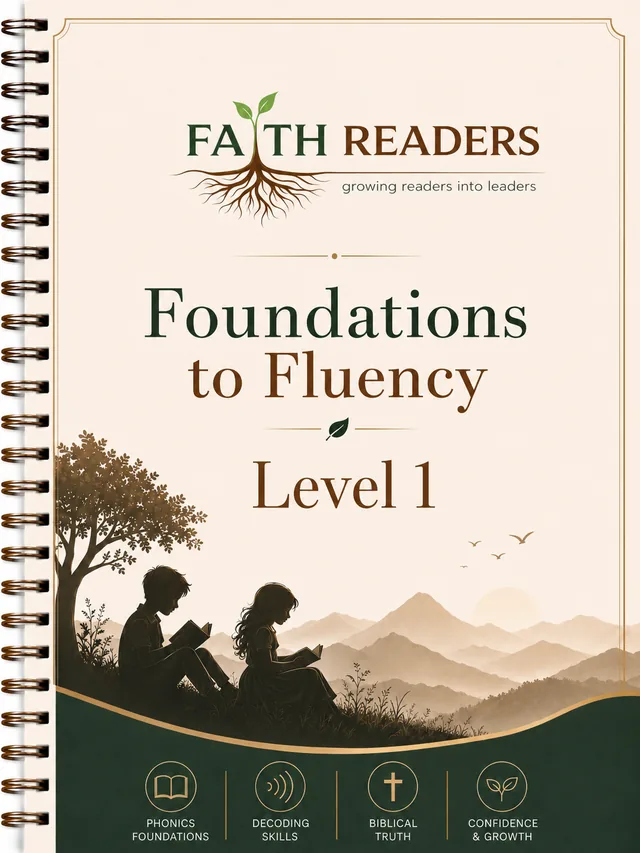
| Foundations to Fluency | 96 short workbooks in six levels arranged by pattern rather than grade, each ending in a mastery check | One pattern is missing and you can name it |
| Decodable Readers | 300 original readers, 50 per grade: decodable stories in K–2, fluency passages in Grades 3–5 | Daily reading practice that stays inside what has been taught |
| Phonics Lab | 150 phonics and word-study worksheets, every one with an answer key | Quick checks on the spelling side |
| The practice library | Thousands of printable pages by subject, grade, and skill; the first three in every set are open to everyone | You want extra pages on one specific skill |
| HARVEST | A free browser placement of about twenty minutes, in seven sections, ending in a printable report | You do not know where to begin |
Foundations to Fluency Phonics Lab Phonics worksheets by grade HARVEST reading placement
Where to go deeper, skill by skill
Each step in the sequence above has its own page: what the skill means, how to tell your child is ready for it, the mistake to watch for, and the practice that builds it. They are the supporting guides to this one. Read the one you are standing on rather than all of them at once.
Two skills sit alongside phonics rather than inside it. Handwriting runs in parallel from the first weeks, because forming a letter helps fix its sound. Comprehension and vocabulary grow mostly through reading aloud to your child from books well past what he can decode himself, and that is worth protecting even in the weeks when decoding is going badly.
Sight words Phonics and sight words together Spelling Reading comprehension Vocabulary The benefits of reading aloud All skill guides
Common questions
- At what age should phonics start?
- When a child can hear and blend spoken sounds and knows a few letter sounds — for most children, the Kindergarten year. The two readiness signs matter more than the age. A child who cannot yet blend /m/ /a/ /t/ into mat by ear is not behind; he needs a few weeks of oral work before print is introduced.
- How long should a phonics lesson be?
- Fifteen to twenty minutes in Kindergarten, twenty to twenty-five by Grade 2. Reading practice sits on top of that, not inside it. If the lesson regularly runs long, the step is probably too big rather than the child too slow.
- Do I need a curriculum, or can I teach phonics from a list of sounds?
- A list will give you the order. What it will not give you is text that stays inside the order, daily review that catches what slipped, and a way to check mastery. Those three are most of the work, and they are why a sequenced program saves time. The complete teaching guide for every grade of Phonics, Decoding, and Early Fluency can be read in the browser before you decide.
- My child already reads some words. Where do we start?
- Place him rather than guess. HARVEST is free, runs in your browser in about twenty minutes, covers phonemic awareness, letter names and sounds, decoding, sight words, encoding, fluency, and comprehension, and ends with a printable report naming a starting point. Start where the report says, not where the grade label says.
- Is phonics on its own enough to make a reader?
- No. Phonics gives a child access to the words. Knowledge, vocabulary, and comprehension come mostly from being read to, from books above his own decoding level, and from talking about what was read. Run both at once from the beginning.
- Does teaching phonics at home require a membership?
- Not to start. HARVEST is free, the teaching guide of every reading grade is readable in the browser, the first three sheets of every practice set are open, and the whole Apostolic Academy is free to everyone. All Access is $39 a month, cancel anytime, covering one household and every child in it.
Sources
- National Reading Panel (2000). Teaching Children to Read: An Evidence-Based Assessment of the Scientific Research Literature on Reading and Its Implications for Reading Instruction. NICHD.
- Ehri, L. C. (2005). Learning to read words: Theory, findings, and issues. Scientific Studies of Reading, 9(2), 167-188. (Orthographic mapping - how words become instantly recognisable.)
- Castles, A., Rastle, K., & Nation, K. (2018). Ending the Reading Wars: Reading Acquisition From Novice to Expert. Psychological Science in the Public Interest, 19(1), 5–51.
- Scarborough, H. S. (2001). Connecting early language and literacy to later reading (dis)abilities: Evidence, theory, and practice. In Handbook of Early Literacy Research (Vol. 1, pp. 97-110). Guilford Press. (The reading rope.)