
Curriculum
Christian Science of Reading Curriculum: What Parents Should Look For
'Science of reading' is a body of research, not a product feature — and lately it is also a marketing sticker. This guide gives you the checks that separate the research from the sticker on any Christian curriculum, and answers its own checklist about our materials, including what we will not claim.
Updated 4 October 2026 · Sources read 5 September 2026
What the science of reading actually is
The science of reading is shorthand for several decades of converging research on how children learn to read: the National Reading Panel's findings on systematic phonics, Linnea Ehri's account of how words become instantly recognisable through mapping spellings to sounds, Hollis Scarborough's rope model — skilled reading as word recognition and language comprehension woven together — and the broad review literature since. Its core, stated plainly: reading is not natural the way speech is, the code must be taught, and comprehension rides on both decoding and knowledge of language and the world.
What it is not: a curriculum, a brand, a certification anyone can hold, or a guarantee. No body issues 'science of reading' licenses, which is precisely why the phrase fits so comfortably on any cover.
Five things to check in any curriculum claiming it
These checks work on samples and scope-and-sequence documents, which any serious publisher will show you before purchase.
| Check | What good looks like |
|---|---|
| A published phonics scope | Every skill named, in order, week by week — visible before you pay, so the claim of 'systematic' is checkable rather than trusted |
| Explicit phonemic awareness work | Hearing and manipulating sounds is taught directly in the early grades, not assumed |
| Aligned decodable text | The practice books use the patterns already taught — ask which sequence the readers are controlled against, because no book is decodable in itself |
| Word study past phonics | Morphology — prefixes, suffixes, Latin and Greek roots — carrying vocabulary and spelling through the upper grades |
| Honest assessment | A stated standard for when a skill counts as learned, with re-checks that use different questions |
The red flags
Three-cueing — coaching a child to identify words from pictures, context or first letters rather than by decoding — is the practice most directly contradicted by the word-reading research; if the teacher script says 'look at the picture, what would make sense?', the sticker on the cover does not matter. Leveled predictable books doing the work of decodables are the same problem wearing a book's shape: text a child can 'read' by memorizing its pattern trains guessing.
And be wary of the phrase itself doing the arguing. 'Rooted in the science of reading' costs nothing to print. A scope and sequence you can read costs the publisher real exposure, which is why it is the better evidence.
What Faith Schooling does — and what we will not claim
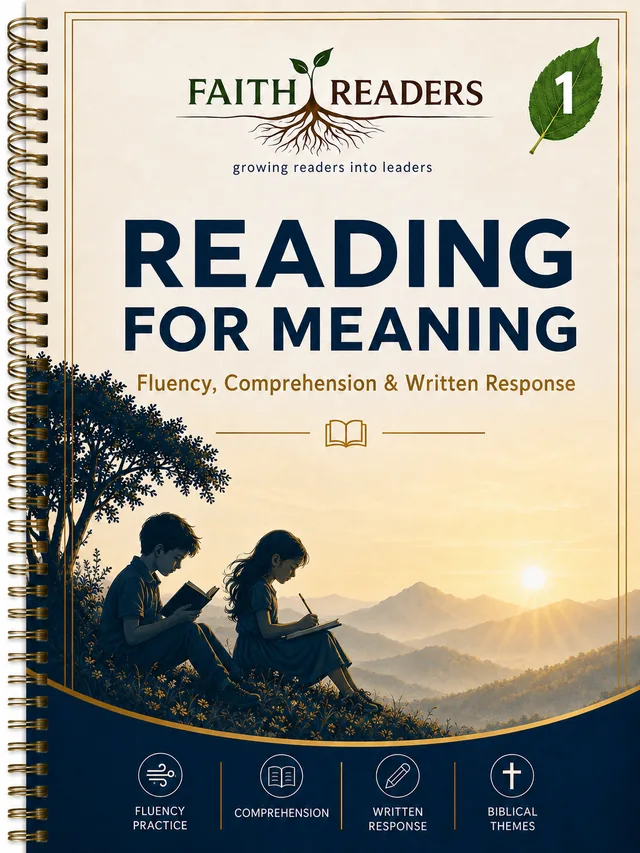
Against the checklist: the reading curriculum publishes its complete scope and sequence for all six grades — every week's skill in plain text. Phonemic awareness is explicit in the early lessons. The 300 separate readers are not matched to that sequence week by week, so check a reader against what your child has been taught before using it. Morphology runs as a full strand — Grade 1 suffixes through Latin and Greek roots across Grades 3 to 5. Assessment is a published rule: 90% or better across five or more sessions on different days, with parallel-form re-checks.
What we will not claim: that Faith Schooling is 'science of reading certified' (no such certification exists), that research has evaluated our materials specifically (it has not), or the label itself as a badge. We describe what the materials actually do and open the teaching guides in full, because that is the evidence a label substitutes for. Judge us by the same checklist you would use on anyone.
Every grade's scope and sequence, in plain text Structured literacy, as we teach it — with its limits
Where comprehension fits
The research is equally clear that decoding is necessary and not sufficient: comprehension grows from vocabulary, knowledge and language — Scarborough's other strand. In practice that means a curriculum should keep rich read-alouds and real discussion in the day, not just controlled text. Ours carries connected reading, stories, narration and written response through every grade, and we would still tell you plainly: keep reading better books aloud to your child than the ones he can decode. Every strong reading home does both.
Common questions
- Is Faith Schooling a science of reading curriculum?
- We do not adopt the label, because labels get claimed loosely and no certification exists. Reading here is taught with explicit, systematic phonics in a fixed published sequence, decodable text matched to the taught patterns, a morphology strand through Grade 5, and a published mastery standard — all checkable from open materials, which is better evidence than any sticker.
- What is three-cueing, and does Faith Schooling use it?
- Three-cueing coaches a child to identify words from pictures, context or first letters instead of decoding them. It is the practice most at odds with word-reading research. Faith Schooling's lessons teach words by decoding; the decodable readers exist precisely so guessing is never the available strategy.
- Does science of reading mean phonics only?
- No. The same research base says comprehension depends on vocabulary, knowledge and language. A sound curriculum teaches the code explicitly and keeps rich reading, discussion and knowledge in the day — and a home should always be reading richer books aloud than the child can decode.
- How can I verify any publisher's claims, including yours?
- Ask for the phonics scope in writing, a sample teacher script, and the sequence their decodable books are controlled against. Ours are all public: the full scope and sequence on every grade page, complete teaching guides readable before purchase, and the readers written against the published sequence.
Sources
- National Reading Panel (2000). Teaching Children to Read — systematic phonics findings — checked 2026-09-05
- Ehri, L. C. (2005). Learning to read words: theory, findings, and issues. Scientific Studies of Reading — checked 2026-09-05
- Scarborough, H. S. (2001). Connecting early language and literacy to later reading (dis)abilities — the reading rope — checked 2026-09-05
- Castles, A., Rastle, K., & Nation, K. (2018). Ending the Reading Wars. Psychological Science in the Public Interest — checked 2026-09-05
- Moats, L. C. (2020). Teaching Reading Is Rocket Science. American Federation of Teachers — checked 2026-09-05