
How we teach
Christian Structured Literacy for K–5 Homeschool Reading
Structured literacy is the name reading researchers give to explicit, systematic, cumulative teaching of how written language works. This page says what that means, what the evidence shows, exactly where it appears in Faith Schooling's materials — and what the term does not mean.
Updated 4 October 2026 · Sources read 5 September 2026
What structured literacy means
Structured literacy is a way of teaching reading in which nothing important is left for the child to infer. The International Dyslexia Association, which popularised the term, describes it around explicit, systematic and cumulative instruction: the teacher states each element of written language directly, the elements arrive in a planned order from simpler to more complex, and every new skill is built on ones already taught and still being reviewed.
The elements themselves run wider than phonics alone: phonemic awareness (hearing the sounds inside spoken words), sound–symbol relationships, syllable patterns, morphology (prefixes, suffixes and roots), and on into sentence structure and meaning. The contrast is with approaches that expose children to rich text and expect the code to be absorbed along the way — which some children manage, and many do not.
What the evidence shows
The National Reading Panel's 2000 review found that systematic phonics instruction produced significant benefits for students in kindergarten through sixth grade, and especially for children having difficulty learning to read. The Institute of Education Sciences' practice guide on foundational reading skills recommends explicitly teaching phonemic awareness and letter–sound relationships, and having students read connected text daily. Linnea Ehri's work on how children learn words describes why: readers store words for instant recognition by mapping spellings to sounds — which is a skill that can be taught directly rather than waited for.
Honesty about the boundary matters as much as the citation. This research supports the approach — explicit, systematic teaching of the code. It has not tested Faith Schooling's materials specifically, and no publisher's use of the label makes its books good by association. The way to judge ours is to read them, which is why the complete teaching guides are open before any payment.
Where it appears in Faith Schooling
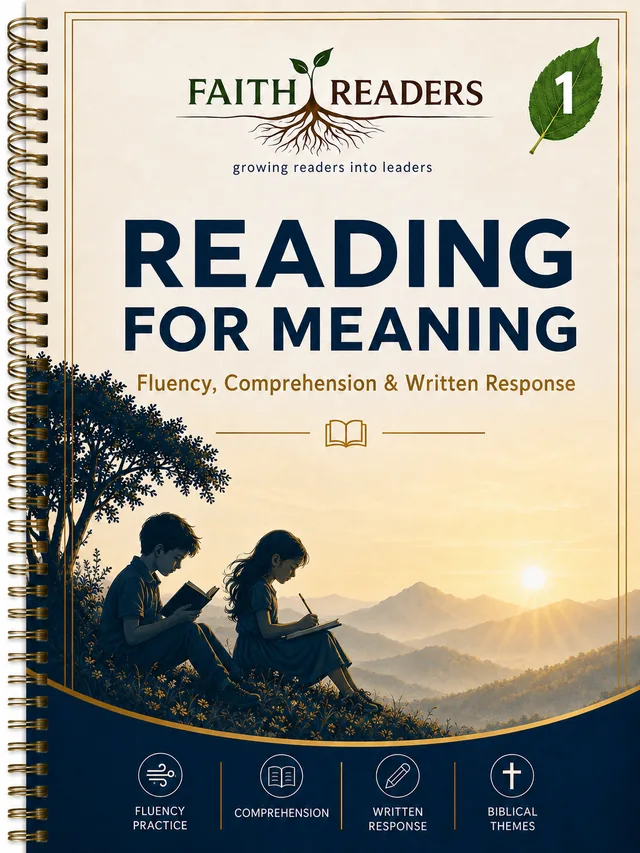
The reading curriculum, Phonics, Decoding, and Early Fluency, is six full-year student textbooks — 8,952 student pages with 3,530 pages of teaching guides — and each of its 35 instructional weeks turns on one skill taught explicitly: a letter-sound in Kindergarten, vowel teams and syllable types in the middle grades, Latin and Greek roots by Grades 3 to 5. The sequence is cumulative on purpose: the decodable readers for each week use only patterns already taught.
Around the spine sit the pattern-first materials: Foundations to Fluency's 96 workbooks arranged by phonics pattern rather than by grade, so an older child filling a gap is never handed a book labeled with a younger grade, and the Phonics Lab's 150 themed practice sheets with answer keys. Each grade page publishes its full scope and sequence as plain text, so you can read exactly which skill arrives in which week before you decide anything.
The reading curriculum, grade by grade Foundations to Fluency — phonics by pattern
What one week actually looks like
Take a Grade 2 week on the prefix un-. The teaching guide scripts the lesson: the skill is stated and modeled, words are built and taken apart, the week's decodable passage applies it, and daily written work follows. A full reading lesson runs 45 to 55 minutes in one sitting — calm start and prayer, phoneme work, blending, decodable reading, a short timed drill, application, and the spaced-review card box — or the same week runs as five shorter days in the weekly-lesson format.
Beside the skill sit the week's Bible hero, virtue and verse, quoted exactly from the New King James Version. The skill is the academic spine of the week; the Scripture is not decoration bolted on afterwards, and neither is it a substitute for teaching the code.
How mastery is checked
Every day ends with an exit ticket, every week with a mastery check that has parallel forms, and a skill counts as mastered at 90% or better across five or more sessions on different days. Cumulative means the checks keep reaching back: last month's pattern turns up in this month's review, because a skill a child cannot use three weeks later was never truly learned.
What structured literacy does not mean
It is not a certification. Faith Schooling draws on structured-literacy principles; it is not an IDA-certified or accredited program, and we will not imply otherwise. It is not only for children with dyslexia — the research case is strongest for struggling readers, but explicit teaching serves every beginner. And it is not the whole of reading: decoding opens the door, while comprehension depends on vocabulary, knowledge and language — which is why the textbooks carry connected reading, stories and discussion rather than drill alone.
It is also not a promise. An approach with good evidence still has to be implemented well, by a real parent on a real Tuesday. The scripted guides exist to make that implementable; whether we succeeded is something you can judge by reading them.
Read a complete teaching guide before paying anything Who writes these materials, and how they are checked
Common questions
- Is Faith Schooling an IDA-certified structured literacy program?
- No. Faith Schooling draws on structured-literacy principles — explicit, systematic, cumulative instruction — but holds no certification from the International Dyslexia Association or anyone else, and does not claim one. The complete teaching guides are open to read, which is a better basis for judgment than any label.
- Is structured literacy only for children with dyslexia?
- No. The evidence case is strongest for children who struggle, but the National Reading Panel found systematic phonics benefits across K–6 generally. Explicit teaching costs a strong reader nothing and saves a struggling one years.
- Does structured literacy mean my child only does drills?
- No. In Faith Schooling each week's skill is taught explicitly and then used at once — in a decodable reader written on patterns already taught, in writing, and in connected reading with a Bible hero, a virtue and a verse. Drill exists; it is not the diet.
- How do I know which skills are taught in which order?
- Every grade page publishes its scope and sequence as plain text — all 35 weeks, with each week's skill, story, virtue and Scripture — so you can read the whole plan before you pay anything.
Sources
- International Dyslexia Association — Structured Literacy: Effective Instruction for Students with Dyslexia and Related Reading Difficulties — checked 2026-09-05
- National Reading Panel (2000). Teaching Children to Read — findings on systematic phonics instruction — checked 2026-09-05
- Institute of Education Sciences, What Works Clearinghouse — Foundational Skills to Support Reading for Understanding in Kindergarten Through 3rd Grade (Practice Guide) — checked 2026-09-05
- Ehri, L. C. (2005). Learning to read words: theory, findings, and issues. Scientific Studies of Reading — checked 2026-09-05
- Castles, A., Rastle, K., & Nation, K. (2018). Ending the Reading Wars. Psychological Science in the Public Interest — checked 2026-09-05