
How we teach
Christian Decodable Readers and Systematic Phonics
A decodable reader is a book a child can actually read with the phonics he has been taught — no guessing, no memorized pictures. This page explains what makes a text truly decodable, why the alignment matters more than the label, and how Faith Schooling's 300 readers are built to land in the same week as the skill they practice.
Updated 4 October 2026 · Sources read 5 September 2026
What a decodable reader is
A decodable reader is a text controlled to the code a particular child has been taught: if the lessons so far cover short vowels, consonant blends and a handful of taught sight words, then that — and only that — is what appears on the page. The child meets no word he has no tools for, so the only strategy available is the one being trained: look at the letters, sound it through, read it.
The alternative in early books is predictable text — repeating patterns and picture support that let a child appear to read by memorizing and guessing. Those books have charms, but as reading instruction they rehearse exactly the habit that fails a child at eight, when the pictures leave and the words get long.
Why decodable means aligned, not merely simple
Here is the part the label hides: no book is decodable in itself. A text is decodable relative to a sequence — the same reader that is perfectly decodable after week 12 of one program is a guessing exercise in week 5 of another. So the honest question to ask any publisher, ourselves included, is not 'are your readers decodable?' but 'decodable against what, and when does each one arrive?'
Research on early word learning explains why alignment matters. Children store words for instant recognition by mapping spellings onto sounds they can already hear and letters they can already decode — Ehri's orthographic mapping. Controlled text gives that mapping machinery a steady diet of solvable words; uncontrolled text feeds it noise.
Where it appears in Faith Schooling
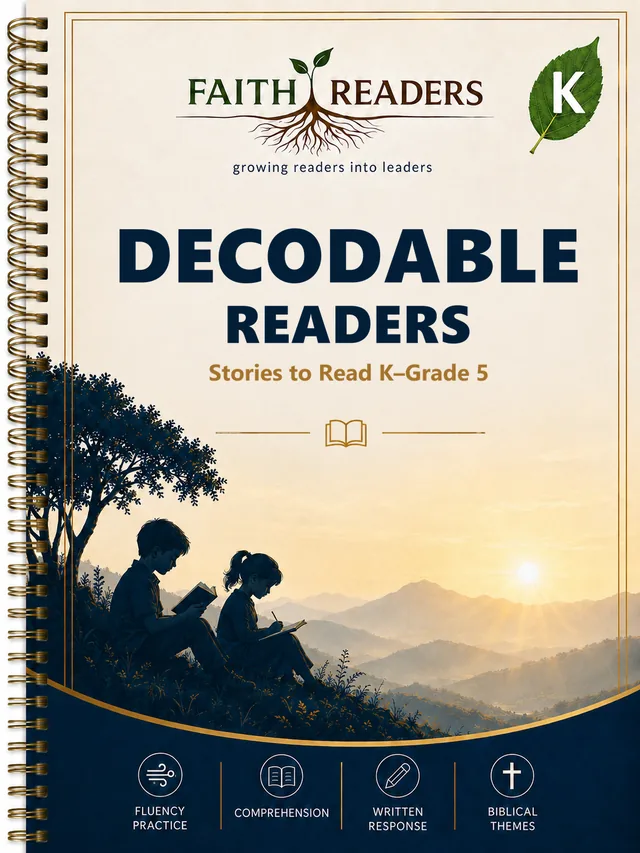
Two things carry the name. Every week of the reading textbook has its own reader, the week's story written on the week's pattern: in Kindergarten's week on the letter Ss the reader is a Samuel story built on it, and the week's virtue and verse ride the same pages. Beside the textbook sits a separate library of 300 original readers, fifty per grade from Kindergarten through Grade 5: decodable readers in Kindergarten to Grade 2 and fluency passages in Grades 3 to 5. That library is a companion, not matched to the sequence week by week.
Because every grade page publishes its scope and sequence in plain text, you can check the alignment claim yourself — the week's skill and the week's reader sit side by side in the table. The readers are connected-text companions to the curriculum, not a standalone learn-to-read kit, and we say so on their own page.
The 300 decodable readers and fluency passages, grade by grade Each grade's scope and sequence, in plain text
How a reader is used in a week
The pattern is taught explicitly first — modeled, blended, practiced. Then the reader: the child reads it aloud, and the parent listens for the week's pattern specifically, because the text was written so that pattern must be decoded, not dodged. Re-readings across the week build fluency on text the child now owns; narration and a few printed questions carry comprehension; the writing pages apply the same words by hand.
By Grades 3 to 5, 'decodable' matures with the child — the controlled element becomes multisyllabic work and the Latin and Greek roots the scope is teaching, so connected practice keeps pace with the word-study strand rather than stopping at short vowels.
What decodable reading does not mean
It does not mean all of a child's books. Decodables are the practice field for the code; read-alouds, real literature and the family's own shelf feed language, knowledge and love of story, and no controlled text substitutes for them. A child should always be hearing books richer than the ones he can decode.
It does not mean forever — controlled text is scaffolding, and a fluent decoder graduates from it. And it is not a brand claim. A publisher can honestly promise only that its readers match its own sequence, and our 300 separate readers are not matched to ours week by week, so check any reader, ours included, against what your child has been taught.
What decodable readers are, and when a child should use them
Common questions
- What makes a reader truly decodable?
- Alignment. A text is decodable only relative to a phonics sequence — it must use the patterns and taught sight words a child has already been given, and no others. Ask any publisher which sequence their readers are controlled against and when each book arrives. Our 300 separate readers are not written against our scope week by week, so check each one against what your child has been taught.
- Are Faith Schooling's decodable readers Bible-based?
- Yes, in two places. The reading textbooks' own weekly readers carry each week's Bible hero, virtue and verse — a Kindergarten Ss week reads a Samuel story. The 300 separate Decodable Readers are short original stories with a Bible verse on every page. The Scripture rides the same controlled text; it is not a separate devotional bolted on.
- How many are there, and are any free?
- Three hundred original readers, fifty per grade K–5, delivered to members. The sample page and teaser images on the readers' own page are open to everyone, and the scope-and-sequence tables that prove the alignment are published in full.
- Should decodables be the only books my child reads?
- No. They are the practice field for decoding. Keep reading richer books aloud — a child's listening diet should always run ahead of his decoding diet, and the curriculum plans for both.
Sources
- Ehri, L. C. (2005). Learning to read words: theory, findings, and issues. Scientific Studies of Reading — orthographic mapping — checked 2026-09-05
- National Reading Panel (2000). Teaching Children to Read — systematic phonics and connected-text practice — checked 2026-09-05
- Castles, A., Rastle, K., & Nation, K. (2018). Ending the Reading Wars. Psychological Science in the Public Interest — on early text and decoding practice — checked 2026-09-05
- Faith Schooling reading scope and sequence — the alignment each reader is written against — checked 2026-09-05