
Curriculum
How to choose a Christian phonics curriculum
A phonics program is either the whole reading year or a patch for one pattern. Knowing which one you need is most of the decision.
Updated 4 October 2026 · Sources read 31 August 2026
What is a Christian phonics curriculum?
A Christian phonics curriculum teaches the sound-letter code explicitly and in a published order — phonemic awareness, letter sounds, blending, digraphs, blends, long vowels, syllables and word parts — and uses Scripture, Bible narrative and Christian character as the reading content itself, rather than as decoration added around a general workbook.
Phonics has two halves, and a complete program teaches both. Decoding is reading the code: seeing a printed word and turning it into speech. Encoding is writing the code: hearing a word and spelling it. They are separate skills, and a program that teaches reading but leaves spelling to a weekly word list has taught only half of what it set out to teach.
Phonics is also not the whole of reading. A reading curriculum built on phonics still has to carry vocabulary, morphology, comprehension, fluency and written response. Without those a child can decode a page accurately and take very little from it, which is usually the trouble that surfaces once the words get longer and the content gets denser.
How to tell explicit phonics from guessing
The distinction that matters is not the label on the box. It is whether the child is taught the pattern before they meet it, and whether the text they read is built only from patterns already taught. A beginner handed an uncontrolled storybook is being asked to work from pictures and context, which is a different skill from reading the word on the page.
- The sequence is published. You can see, before paying, which pattern comes in which week and why that order.
- The stories are controlled. Early reading text is built from patterns already taught, so success comes from decoding rather than from memorizing or guessing.
- Spelling is taught alongside reading, not left to a separate list of weekly words.
- There is a way to know a pattern is secure — a check, a mastery rule, a record — rather than moving on when the calendar does.
- The teaching is scripted for the adult, so a parent without a teaching degree knows what to say when a child stalls.
One full program, or practice on one pattern?
Most families arrive at phonics for one of two reasons. Either a child is beginning to read and needs a whole year of instruction, or a child already reads but keeps stumbling on one thing — blends, vowel teams, silent letters — and needs that one thing fixed. Those call for different products, and buying the wrong one is the common mistake.
If you can name the pattern your child is missing, targeted practice is quicker than restarting a program. If you cannot name it, a placement check will, or a full sequenced program will find it on the way through.
| Program | Job it does | Shape |
|---|---|---|
| Phonics, Decoding, and Early Fluency | Teaches the whole reading year, K–5 | Six full-year student textbooks, 8,952 student pages, with 3,530 pages of teaching guide |
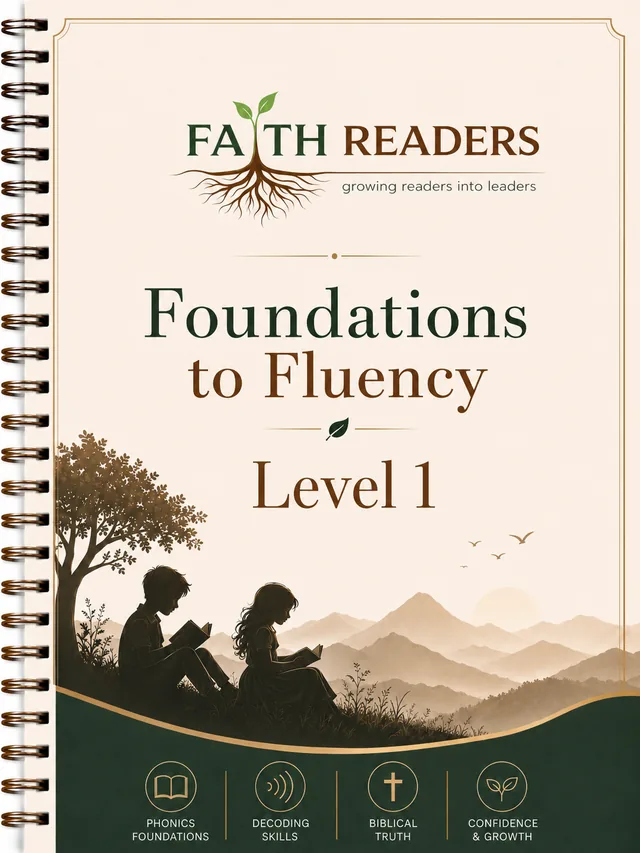
| Foundations to Fluency | Teaches one pattern at a time, at any age | 96 short workbooks in six levels, arranged by pattern rather than grade |
| Decodable Readers | Gives connected reading using only taught patterns | 300 original readers, 50 per grade |
| Phonics Lab | Practices the spelling side after a pattern is taught | 150 worksheets, each with a complete answer key |
How Faith Schooling teaches phonics
The core program is Phonics, Decoding, and Early Fluency: one student textbook per grade for Kindergarten through Grade 5, printed at home, with a teaching guide you can read page by page before you join. Every week pairs one phonics or word-study skill with one story from Scripture or history, one virtue and one Scripture, and runs the same rhythm — drill sheet, decodable reader, writing, a daily exit ticket, homework. The 35-week scope and sequence is printed on every grade page.
Foundations to Fluency is the practice ladder beside it. Its six levels follow the phonics sequence — letters and sounds, short-vowel families, beginning blends, digraphs and ending blends, long vowels and r-controlled vowels, advanced patterns — and each short workbook teaches one pattern with a decodable story, word building, copywork, a mastery check and a certificate. Levels are labeled by pattern, never by grade, so a fourth grader who never got vowel teams starts at Level 5 without being handed a book that looks too young.
Progress is decided by demonstration rather than by the calendar. A skill counts as mastered when a child shows it at 90% or better across five or more sessions on different days, tracked through daily exit tickets, weekly mastery checks with parallel forms, timed drill sheets, and a skill ledger.
Phonics, Decoding, and Early Fluency Foundations to Fluency Decodable Readers Phonics Lab
Is this the right kind of phonics program for you?
It fits a family that wants to teach reading themselves from a script, print the books at home, and see the whole method before paying. Every reading teaching guide, and the complete first workbook and full teaching guide of every Foundations level, can be read page by page without a membership, so the judgment is made on the real pages.
Faith Schooling is built for parent-led K–5 learning: scripted lessons, print-first books, mastery pacing, one household membership, and a complete reading and language arts sequence. Families keep their own homeschool records while the comparison page makes Faith Schooling's format and strengths easy to evaluate.
Cost is a plain fact rather than a pitch. All Access is $39 a month, cancel anytime, covering every grade K–5 and every child in one household. Placement, the teaching guides, the first Foundations workbooks and the first three sheets in every practice set cost nothing.
How Faith Schooling compares with other publishers Membership and what it includes
A sensible order to start in
You do not have to decide everything at once. Find the starting point first, read the guide for the level it names, and only then choose between the full program and targeted practice.
- Run HARVEST, the reading placement, which is open to everyone. About 20 minutes for the core reading scope, adaptive, running entirely in your browser, and it prints a report naming where to begin.
- Open the grade or level the report names and read its teaching guide and preview pages before deciding anything.
- If the report names a whole year of instruction, start Phonics, Decoding, and Early Fluency at that grade. If it names one or two patterns, start the Foundations to Fluency level that teaches them.
- Add Decodable Readers for daily connected practice, and the Phonics Lab when spelling is the weaker side.
- Recheck in about eight weeks by re-running HARVEST.
Take the HARVEST reading placement See the K–5 curriculum map
Common questions
- What age should phonics instruction start?
- Phonics work begins with hearing sounds rather than seeing letters, so rhyme, blending and segmenting come before print — the order HARVEST also tests in. The Kindergarten year starts there and moves into letter sounds and first decoding. Because Foundations to Fluency levels are labeled by pattern rather than grade, an older child who missed a pattern starts at the level that teaches it, without using material aimed at younger children.
- How is a Christian phonics curriculum different from a secular one?
- The instructional method should be the same: explicit, sequenced, with controlled text. The difference is the content children read while learning it. In Faith Schooling's reading program every week is built around a Bible hero, a virtue and a Scripture, and the week's reader is that story itself, rather than a verse added at the end of a general workbook.
- Do we need decodable readers as well as a phonics program?
- They do different jobs. The phonics lessons teach the pattern; decodable readers give the child connected sentences to read, so a new skill gets used in real text. Faith Schooling publishes 300 original one-page readers, 50 per grade: short stories in Kindergarten through Grade 2 and fluency passages in Grades 3 to 5. They are not written against one phonics sequence, so look over a reader and choose the ones that fit the patterns your child has already learned.
- How do I know when a phonics pattern is actually mastered?
- Not by finishing the pages. Faith Schooling counts a skill as mastered when a child demonstrates it at 90% or better across five or more sessions on different days, using daily exit tickets, weekly mastery checks with parallel forms so a retest is not the same questions, timed drill sheets with personal-best tracking, and a skill ledger. Children who need more practice get it first.
- Can I see a phonics program before paying for it?
- With Faith Schooling, yes. The complete teaching guide for every reading grade, eight hand-picked sample pages of every textbook grade, the complete first workbook and full teaching guide of every Foundations to Fluency level, and the first three sheets in every practice set are open to everyone. The membership opens the complete student books and the full practice library.
Sources
- Phonics, Decoding, and Early Fluency program page — checked 2026-08-31
- Foundations to Fluency program page — checked 2026-08-31
- Decodable Readers program page — checked 2026-08-31
- Phonics Lab program page — checked 2026-08-31
- Faith Schooling FAQ — checked 2026-08-31
- National Reading Panel (2000). Teaching Children to Read: An Evidence-Based Assessment of the Scientific Research Literature on Reading and Its Implications for Reading Instruction. NICHD.
- Ehri, L. C. (2005). Learning to read words: Theory, findings, and issues. Scientific Studies of Reading, 9(2), 167-188. (Orthographic mapping - how words become instantly recognisable.)
- Moats, L. C. (2020). Speech to Print: Language Essentials for Teachers (3rd ed.). Brookes Publishing.
- Scarborough, H. S. (2001). Connecting early language and literacy to later reading (dis)abilities: Evidence, theory, and practice. In Handbook of Early Literacy Research (Vol. 1, pp. 97-110). Guilford Press. (The reading rope.)