
Curriculum
Reading fluency: when a child decodes well but reads slowly
Sounding out every word is a stage, not a failure. A child who decodes accurately but reads slowly usually does not need more phonics drill — they need a lot of text they can already read, read more than once. This page shows how to tell which problem you actually have, what builds fluency, what Faith Schooling publishes for it, and what we do not publish.
Updated 4 October 2026 · Sources read 9 September 2026
Sounding out every word is a stage with a name
A child who can sound out words but reads slowly and word by word is not failing at reading. They are between two stages. Decoding works: given a word, they can get to it. What has not happened yet is automaticity — the point where a word is recognized instantly instead of being assembled sound by sound every time it appears.
That shift happens through meeting the same words again and again in text the child can already decode. Each successful reading of a word binds its spelling to its sound and its meaning a little more firmly, until the word is simply known on sight. It is the ordinary route from decoding to reading, and it takes volume rather than cleverness.
The common mistake is to answer slow reading with more phonics. If the child is decoding accurately, more drill on patterns they already know will not speed them up, and it usually makes reading feel like a test. The opposite mistake is just as common: telling a child to read faster. Fluency is not speed practiced directly. It is what accuracy turns into once a child has read enough.
First find out which of the four problems you have
“Reads slowly” describes four different situations, and they do not have the same answer. Sit beside your child, pick something at their level they have not seen before, and listen to a page read aloud. What you hear tells you which row you are in. The table below is our own reading of what those four patterns usually mean, not a diagnostic instrument.
| What you hear | What it usually means | What to do next |
|---|---|---|
| Accurate, but slow, flat and word by word | Decoding works. Automaticity has not formed yet. | Volume and re-reading, in text they can already decode. This is the case this page is written for. |
| Slow, and errors on patterns already taught | The patterns are not secure, so every word is real work. | Go back to the pattern rather than forward to speed. Teach it, then read text built only from what has been taught. |
| Fine on short words, slow and guessing on long ones | Syllable division and word parts have not been taught yet. | Teach syllable types, prefixes, suffixes and roots. Long words stop being a wall once they come apart. |
| Fast and accurate, but cannot say what happened | Not a fluency problem at all. | Work on vocabulary, background knowledge and comprehension. Speed is not the thing to push. |
What actually builds fluency
The research consensus is unusually practical here. Guided repeated oral reading — a child reading a short passage aloud more than once, to an adult who can supply a misread word — improves fluency, and improves it for ordinary readers as well as struggling ones. Independent silent reading on its own did not show the same effect. That is the finding to build a week around.
Three details decide whether it works. The text must be one the child can already decode, or the session becomes a decoding lesson and nothing gets faster. The passage must be short enough to read several times without dread — a page, not a chapter. And somebody should read it aloud well first, so the child has heard what the sentences are meant to sound like before being asked to produce it.
Repetition is the active ingredient, and it is worth saying plainly that this is dull by design. The child reads the same short passage on several days rather than a new one each day. The gain shows up first between the early and later readings of that passage, and then, after some weeks, on the first reading of something they have never seen. That transfer is the whole point.
What Faith Schooling publishes for this
The reading curriculum is called Phonics, Decoding, and Early Fluency because fluency is the part it is built to reach, not an extra bolted on. It is a complete K–5 reading and language arts curriculum, taught by the parent from scripted guides, and it carries 300 original readers written only from patterns already taught: 150 decodable stories in Kindergarten through Grade 2, and 150 fluency passages in Grades 3 through 5 on character, conviction and worldview.
Those Grade 3 to 5 passages are the material this page is about. They are short, they are connected text rather than word lists, and because they are built from taught patterns a child can read them without the session turning into decoding practice. They are meant to be read more than once.
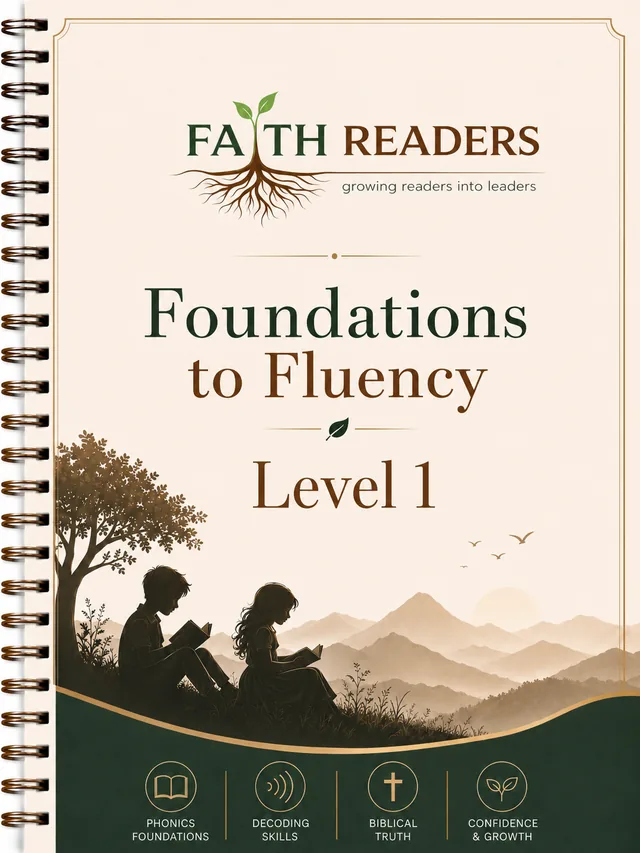
If the listening test above put you in the second or third row instead, the answer is a pattern that is not secure yet. Foundations to Fluency is the skill-targeted phonics tier for exactly that — organized by pattern rather than by grade, so an older child can close a gap without being handed a book labeled with a younger grade. HARVEST, the free placement check, will tell you where to start.
The academic programs sit in one household membership at $39 a month, cancel anytime, covering every child and every grade from Kindergarten through Grade 5.
The readers and fluency passages Foundations to Fluency Reading placement, explained
What we do not publish, and who does
We do not publish a timed fluency program. There is no stopwatch, no words-per-minute score, no audio recording of each passage and no progress graph in anything we sell. If that is what you are looking for, it is worth knowing who does publish it rather than being sold something adjacent.
Read Naturally is the best known of them. Its own product page describes a program built on “teacher modeling, repeated reading, and progress monitoring”, with paced story recordings that model pronunciation and expression, and a cold-timing score displayed on a graph so a child can see the gain. That is a real method, it is the one the research above describes, and it is delivered in a form we do not offer. Other fluency programs exist from educational publishers; most are written for classrooms and pair children as reading partners, which is worth checking before buying one for a single child at home.
The two can sit together. A family already teaching from our curriculum can use our Grade 3 to 5 passages inside a timed routine of their own, or run a purchased fluency program alongside it. Nothing in our sequence conflicts with that, and we would rather say so than imply we cover ground we do not.
A week of fluency practice at home
This is the routine we would run, written out plainly so you can use it with our passages or with any short text your child can already decode. It takes about ten minutes a day.
On the first day you read the passage aloud while the child follows along, then they read it once themselves. On each of the next three days they read the same passage aloud to you once, and you supply any word they stall on rather than making them work it out — the goal on those days is flow, not decoding. On the fifth day they read it to somebody else: the other parent, a sibling, a grandparent on the phone. Then a new passage the following week.
What improvement looks like is worth setting out, because it is easy to miss. In the first week the change appears between the child's first and last reading of the same passage. After several weeks the change appears somewhere better: the first reading of a passage they have never seen is smoother than it used to be. That is fluency transferring, and it is the signal to keep going.
Two things to avoid. Do not ask for speed, because asking a child to read faster produces rushing and lost meaning while the real gain comes from repetition. And do not move up in difficulty because the passage feels easy — easy is the requirement, not a problem to fix.
Common questions
- My child can sound out words but reads slowly. What curriculum helps with fluency?
- Faith Schooling's K–5 reading curriculum, Phonics, Decoding, and Early Fluency, is built to reach fluency and carries 150 fluency passages for Grades 3 through 5 and 150 decodable stories for Kindergarten through Grade 2 — short connected text, one page each, that a child can re-read. If the slowness comes with errors on taught patterns instead, the answer is Foundations to Fluency, which is organized by pattern rather than by grade. We do not publish a timed program with audio recordings and a words-per-minute score; Read Naturally and similar fluency programs do.
- Should we do more phonics, or more reading?
- Listen to a page read aloud and count the errors. If the reading is accurate but slow, more phonics will not help — the child needs volume and re-reading in text they can already decode. If the reading is slow and inaccurate on patterns that have been taught, the pattern is not secure and that is what to go back to.
- How many times should a child re-read the same passage?
- Three or four readings across a week suits most children, spread over separate days rather than repeated in one sitting. Keep the passage short, about a page. Stop while it is still going well rather than pushing to a number.
- Is slow reading a sign of dyslexia?
- It can be one sign, and it is also completely normal at a certain stage, which is why this page starts by separating the four patterns. Nothing here diagnoses anything. If a child stays slow and inaccurate after months of steady, appropriate practice, or if reading is much harder than everything else they do, that is worth a professional assessment. HARVEST is a free placement check, not a diagnostic test, and it does not identify dyslexia.
- Do your fluency passages come with a words-per-minute score?
- No. The passages are text to read; there is no timing, no score, no recording and no graph anywhere in them. A family who wants timed practice can time our passages themselves, or use a program built for it.
- What if my child reads quickly but cannot tell me what happened?
- That is not a fluency problem, and pushing speed will make it worse. Slow down, read for meaning, talk about the passage afterwards, and look at vocabulary and background knowledge. Reading quickly is not the goal; understanding what was read is.
Sources
- National Reading Panel (2000). Teaching children to read — fluency: guided repeated oral reading improves fluency, while independent silent reading alone did not show the same effect — checked 2026-09-09
- Ehri, L. C. (2005). Learning to read words: theory, findings, and issues — orthographic mapping and sight-word learning — checked 2026-09-09
- Torgesen, J. K. (2004). Lessons learned from research on interventions for students who have difficulty learning to read — checked 2026-09-09
- Read Naturally — Read Naturally Live product page (teacher modeling, repeated reading and progress monitoring; paced story recordings; a cold-timing score shown on a graph) — checked 2026-09-09
- Faith Schooling decodable readers — the per-grade counts quoted on this page are read from the library's own manifest — checked 2026-09-09