
Curriculum
Pentecostal homeschool curriculum: where this one stands
Faith Schooling is Apostolic in conviction, one stream within Pentecostalism, and this page states that plainly so a Pentecostal family can judge the fit before committing a school year to it.
By Faith Schooling · Reviewed by Tyler, Founder · Checked 7 September 2026 · Editorial standards
Is there a homeschool curriculum written for Pentecostal families?
Yes, and the useful question is which kind. Pentecostal is not one doctrinal position but a family of them, so material written by Pentecostal believers can still teach something your church does not. Faith Schooling is Apostolic, and publishes a statement of faith saying so.
That leaves two judgements. Is the reading and math instruction good enough to teach from every day, and when the Bible material speaks, does it say what your church says? Better to learn that from a statement of faith than from a lesson your child is already reading aloud.
Pentecostal covers more than one position, so where does this one stand?
Pentecostal describes a wide family of churches that hold the baptism of the Holy Ghost as a present experience. Within it, Trinitarian Pentecostal fellowships and Oneness Apostolic churches differ on the Godhead and on the baptismal formula, a division carried by the New Issue of 1913 and the separation of 1916.
Faith Schooling stands on the Apostolic side of that history. Its statement of faith holds the Bible as the only God-given authority for doctrine, faith and practice; that there is one God, revealed as Father in creation, Son in redemption and Holy Spirit at work in the church, and that Jesus Christ is that one God manifested in the flesh; that Acts 2:38 is the plan of salvation, with water baptism in the name of Jesus Christ and the baptism of the Holy Ghost with the initial evidence of speaking in other tongues; and that God calls His people to holiness inwardly and outwardly. It names the Articles of Faith of the United Pentecostal Church International (2023) as its doctrinal baseline.
Naming a baseline states what the material believes; it is not a claim of endorsement or affiliation. Faith Schooling is an independent family publisher, written by Tyler, a Christian father and homeschool parent in Wisconsin who teaches it to his own daughter.
If your church is Apostolic or Oneness, you are looking for the other page
This page exists because Pentecostal is a category rather than a doctrine, so it has to be answered carefully for readers who may hold any position inside it. If your own church is Apostolic, Apostolic Pentecostal, Oneness or Jesus Name, then you already share this publisher's convictions and the fit question is a short one. The Apostolic page answers it directly, without spending its length on a distinction you have already made.
If you are Trinitarian Pentecostal, stay here. The rest of this page tells you exactly what agrees with your church and what does not, which is the part you actually need.
Apostolic homeschool curriculum and materials How these words relate, defined in full
What would a Pentecostal family actually use here?
The Apostolic Academy is free and open to everyone; nothing inside it sits behind the paid membership. One detail stated precisely: the starter set of Scripture memory cards is delivered by email opt-in, while the full printable collections it comes from are open downloads.
For Scripture memory and quizzing there is The Hidden Word, a King James curriculum of four Collections, sixteen units and 223 selections across 2,695 print-ready pages. It defines what counts as mastered, and every file can be read page by page in the browser or downloaded.
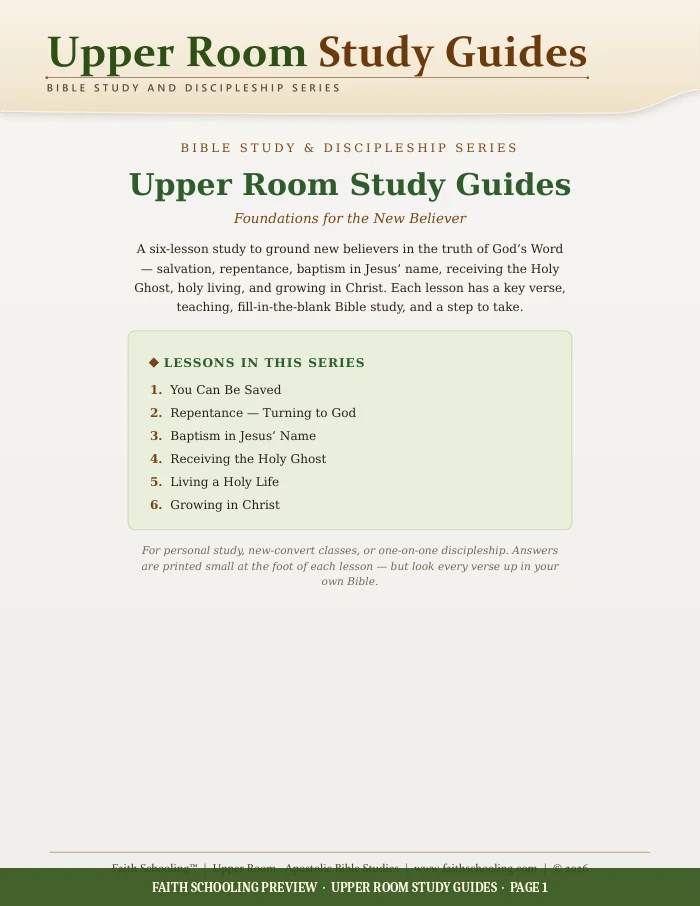
For doctrine there are twelve Upper Room lessons in two six-lesson series, running from salvation, repentance, baptism in Jesus' name and receiving the Holy Ghost to the oneness of God, the name of Jesus and Christ's return. The Way covers the same ground across thirty sessions in three gates. By Many Witnesses adds a ten-volume documentary history whose ninth volume, Tongues of Fire, runs from Topeka in 1901 and Azusa in 1906 to the merger of 1945.
Does the school day itself teach Pentecostal doctrine?
No, and that is deliberate. Phonics is phonics and arithmetic is arithmetic; a page that teaches long vowels does not teach the Godhead. In the academic programs faith is carried as Scripture memory, Bible heroes and virtues, prayer, and in the upper grades reading that weighs worldviews against the Word.
Doctrine is taught directly, and only, in the Apostolic Academy study guides and articles, where each position is opened from Scripture and an interpretation is labelled as one. That is what lets a family teach the academics while doctrine stays with the parents and the pastor.
Two translations, for two purposes. Scripture in the academic programs and across the site is quoted exactly from the New King James Version, with the reference. The Hidden Word uses the King James Version throughout, because Bible quizzing does. This is not a King James only publisher.
How Faith Schooling fits a Pentecostal home
It fits a home where a parent intends to do the teaching. The guides are scripted for the adult reading them, print-focused, and paced by mastery rather than by the calendar. The free HARVEST placement runs in the browser with nothing uploaded and ends by naming the lesson to start with.
It fits churches too: Sunday school classes and quizzing teams use the same free material.
The academics are the paid part, at $39 a month, cancel anytime, covering one household, every child, every grade K–5. It does not extend to co-ops, classrooms, churches or tutoring businesses; group licensing is by request. Complete teaching guides can be read before you join.
When you should look somewhere else
If your family is Trinitarian Pentecostal, the Academy study guides will not agree with your church on the Godhead or on the baptismal formula. The academic programs do not teach those points at all, so some families take the academics here and their Bible curriculum from their own fellowship. If you would rather have both from one publisher aligned to your church, start there instead.
Look elsewhere as well if you need grades above 5; if you want a boxed program with video teachers, or an enrolling accredited school that keeps transcripts, since here the parent teaches and keeps the records; if you want one purchase rather than a monthly membership; or if you need a math workbook and teaching guide at every grade, because those coordinated math components currently reach Kindergarten through Grade 2 while every K–5 grade has a student text.
Whatever you choose, read the doctrinal material yourself before your child does, and take any point that differs from your church to your pastor rather than around him.
Common questions
- Is Faith Schooling Pentecostal?
- Faith Schooling describes itself as a Christian family publisher with an Apostolic foundation, and the Apostolic movement is one stream within the wider Pentecostal family. The published statement of faith sets out the position in full and names the Articles of Faith of the United Pentecostal Church International (2023) as its doctrinal baseline. It is an independent family publisher and claims no endorsement, affiliation or official standing with any denomination or organization.
- Is it Oneness or Trinitarian?
- The statement of faith is the Oneness position. It holds that there is one God who has revealed Himself as Father in creation, Son in redemption and the Holy Spirit at work in the church, and that Jesus Christ is that one God manifested in the flesh, with Acts 2:38 as the plan of salvation. That is published so families can judge the fit, not as a comment on anyone else.
- Does the initial evidence teaching appear in the school lessons?
- No. The statement of faith teaches the baptism of the Holy Ghost with the initial evidence of speaking in other tongues, and the Apostolic Academy study guides open that from Scripture. The reading, phonics, handwriting and math lessons do not teach it, or any other doctrinal position; they carry Scripture, Bible heroes and virtues instead.
- Can a Trinitarian Pentecostal family still use the academic curriculum?
- Many can. Reading, phonics, handwriting and math do not teach the Godhead or the baptismal formula, and their Scripture is quoted from the New King James Version. The doctrinal teaching lives in the Apostolic Academy, which is separate and optional. Complete teaching guides can be read in the browser before you join, so the academic material can be judged on its own.
- Can our church, Sunday school or quizzing team use these materials?
- Yes. The Apostolic Academy is free for home, classroom and church use, including The Hidden Word, the Upper Room studies, The Way, the By Many Witnesses history and the printables, and one page gathers what churches usually want first. The paid academic membership is separate: it covers one household and does not extend to co-ops, classrooms, churches or tutoring businesses, so group licensing is arranged by request.
- Is Apostolic Pentecostal the same as Oneness Pentecostal?
- In ordinary use, yes. Both name churches that hold one God revealed in Jesus Christ and baptize in the name of Jesus Christ for the remission of sins. Apostolic emphasises the pattern of the book of Acts; Oneness names the position on the Godhead. Faith Schooling is described accurately by either word.
- Does Faith Schooling speak for all Pentecostal churches?
- No, and it does not try to. Pentecostalism contains Trinitarian and Oneness streams that differ on the Godhead and on the baptismal formula. Faith Schooling is Apostolic and says so; where the free study guides teach doctrine, they teach the Apostolic position.