
Curriculum
Bible quizzing in your homeschool day
Bible quizzing is usually organised by a church, which leaves homeschooling families without a way in. This page shows how to run the memory work at home on a school schedule, with a free King James curriculum that already defines what mastered means.
By Faith Schooling · Reviewed by Tyler, Founder · Checked 7 September 2026 · Editorial standards
The problem with quizzing at home
Bible quizzing is normally run by a church: a coach, a practice night, a team, a season. That works well when your church has one, and leaves you with nothing when it does not — or when your child is younger than the team, or when the practice night is the one evening your week cannot spare.
The memory work underneath quizzing does not need any of that. It needs a verse list, a rhythm a child can repeat, and a definition of finished that does not move. Those three things fit inside a homeschool morning in about fifteen minutes, and they are what this page is about.
A free King James curriculum to quiz from
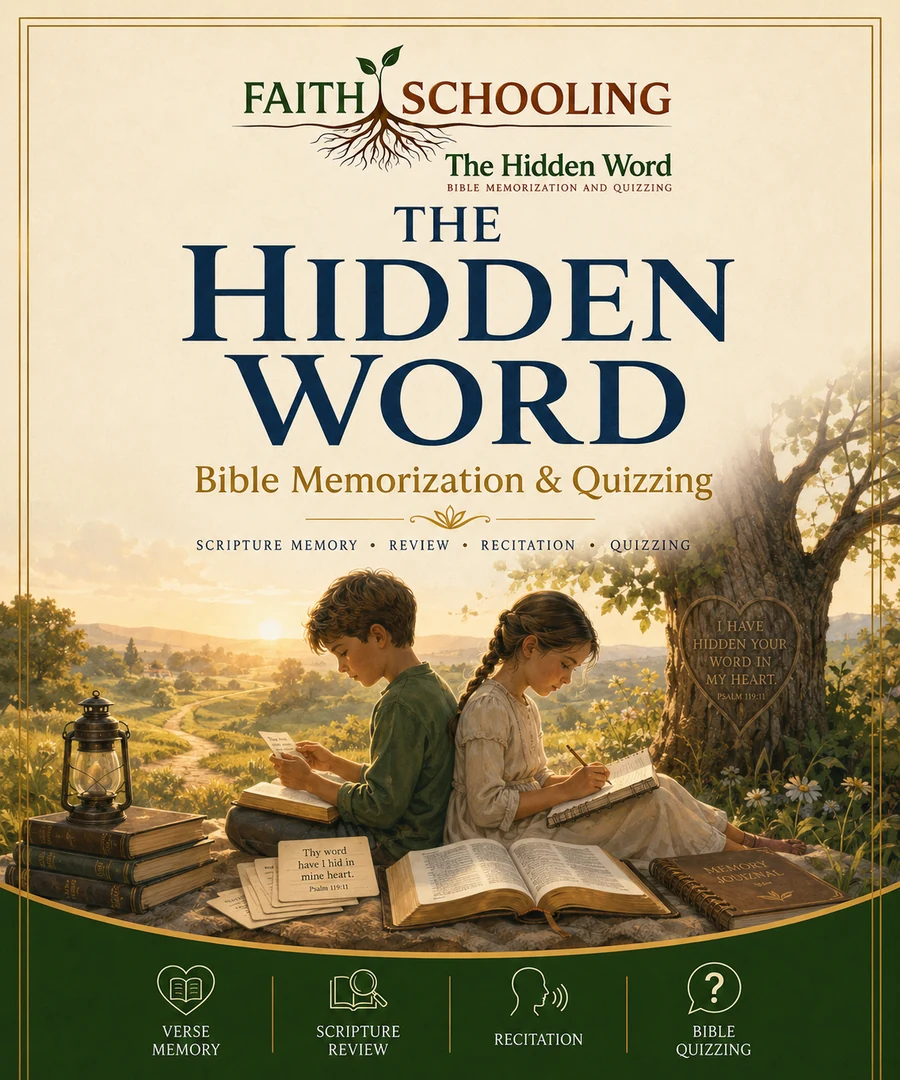
The Hidden Word is a King James Scripture memory and Bible quizzing curriculum, free and complete: four Collections, sixteen units, 223 selections and 2,695 print-ready pages, delivered as sixty collection PDFs and sixteen student packets. Foundation carries 48 selections, Builder 53, Runner 58 and Ambassador 64, so a child moves up a Collection rather than repeating one.
Every page reads in the browser, page by page, or downloads as a PDF. It is open to everyone, with no email gate and no membership; the whole Apostolic Academy is open to everyone.
It is King James because quizzing is. The academic reading and math books on this site quote the New King James Version, and we say so plainly rather than implying the whole platform is one translation.
The Hidden Word — read it or download it Which materials are KJV, and which are not
The five-session rhythm for one verse
Each selection is worked across five short sessions rather than drilled in one. Meet: read it in context, define the hard words, say the reference. Break: echo each phrase, then stack them one at a time. Encode: move it, say it, draw it — at least two of the three. Erase: work the erase sheet, saying the whole verse at every stage. Own: recite it cold, reference before and after, and answer the question.
Five sessions across a week is roughly ten to fifteen minutes a day. Two children on different Collections can run the same rhythm at the same table, which is usually what makes it survive past October.
The shape rests on a plain finding of instruction research — material sticks when it is retrieved and reviewed across separate days rather than crammed into one sitting — but the five sessions themselves are this programme's design, not a laboratory protocol.
What counts as memorised
This is the part most home memory work never settles, and it is why verses learned in September are gone by Christmas. The Hidden Word states it: the reference said before the verse and again after; word-perfect King James, nothing added, changed or left out; no first-word hint from the adult; correct on three separate days, not three tries in one sitting; the meaning explained in the child's own words with the hard words defined; and the final check said with no picture on the page.
Three separate days is the rule that does the work. A verse a child can say twice in one afternoon is a verse in short-term memory; a verse they can say on Monday, Thursday and the following Tuesday is a verse they have.
Scoring, if you want to quiz rather than only memorise
Three tiers make a home quiz work without a league. Recall, ten points: say the reference, then the Scripture, then the reference again. Doctrine, twenty points: everything Recall asks, and say what the Scripture teaches in your own words. Quotation, thirty points: everything Doctrine asks, said cold with nothing on the page.
That scale lets a six-year-old and an eleven-year-old compete in the same room honestly, because the younger child can win on Recall while the older one is reaching for Quotation. For a family with one child, the same tiers work as a ladder rather than a contest.
Apostolic, Oneness Pentecostal, or simply looking for a KJV memory plan
Bible quizzing is strongest in Apostolic and Pentecostal churches, so most families searching for it are searching from inside one. Faith Schooling is Apostolic — the same conviction the words Oneness Pentecostal and Apostolic Pentecostal describe — and publishes its statement of faith rather than leaving you to infer it.
The memory curriculum itself is Scripture, a rhythm and a scoring scale. There is no doctrinal commentary inside the selections, so a Trinitarian Pentecostal family, or any family that wants a King James memory plan, can use it as published. The doctrinal teaching on this site lives in the Upper Room study guides, which are clearly marked and separate.
The Hidden Word is an independent programme. It is not published, endorsed, approved or certified by the United Pentecostal Church International or any other organisation, and its Scripture list is the one transcribed for this programme rather than any current year's official list.
Where it fits in a school week
Put it at the front of the morning, before the work that needs the most attention. Memory is cheapest when a child is fresh, and starting the day with Scripture is the reason many families are homeschooling in the first place.
It does not replace anything academic. Reading instruction is still reading instruction and arithmetic is still arithmetic; quizzing sits beside them, the way a hymn or a prayer does. If the school day itself still needs covering, that is the paid side of this site.
Using it with a class, team or church
Nothing is licensed per child. A quiz coach can print a Collection for a team, a Sunday school can run one unit a month, and a co-op can use the same tiers to score across families. The student packets exist so each child has their own working copy without the leader printing the whole Collection again.
The church page collects what a congregation usually asks for in one place.
Common questions
- Can you do Bible quizzing without a church team?
- Yes. The memory work — a verse list, a repeatable rhythm and a fixed definition of mastered — is the part that matters, and it runs at a kitchen table in ten to fifteen minutes a day. The Hidden Word supplies all three free, with a three-tier scoring scale if you want to quiz rather than only memorise.
- Is there a free Bible quizzing curriculum?
- Yes. The Hidden Word is free and complete: four Collections, sixteen units, 223 King James selections and 2,695 print-ready pages, readable in the browser or downloadable. It is open to everyone, with no email gate and no membership.
- Which Bible version does it use?
- King James throughout, because Bible quizzing is. Faith Schooling's academic reading and math books quote the New King James Version, and the site publishes that split rather than implying one translation across everything.
- How long does Bible quizzing take each day?
- About ten to fifteen minutes. Each selection is worked across five short sessions — Meet, Break, Encode, Erase, Own — rather than drilled in one sitting, which is what makes the verse stay.
- How do I know when a verse is actually memorised?
- The Hidden Word defines it: reference before and after, word-perfect King James, no first-word hint, correct on three separate days rather than three tries in one sitting, the meaning explained in the child's own words, and the final check said with no picture on the page.
- What age is it for?
- The four Collections step up in length and difficulty — Foundation 48 selections, Builder 53, Runner 58, Ambassador 64 — so a child moves up a Collection instead of repeating one. Children of different ages can work the same rhythm at the same table on different Collections.
- Is it a UPCI quizzing programme?
- No. The Hidden Word is an independent programme, not published, endorsed, approved or certified by the United Pentecostal Church International or any other organisation, and its Scripture list is the one transcribed for this programme rather than any current year's official list.
Sources
- The Hidden Word programme page — checked 2026-09-05
- Apostolic Academy home — checked 2026-09-05
- Faith Schooling statement of faith — checked 2026-09-05
- Rosenshine, B. (2012). Principles of Instruction. American Educator — on daily, weekly and monthly review — checked 2026-09-05