
Curriculum
Oneness Pentecostal Homeschool Curriculum: What Families Should Look For
This is an evaluation guide, not a sales page. It names the exact places where general Christian curriculum quietly disagrees with a Oneness Pentecostal home — the Godhead language, the baptismal formula, the salvation framing — and gives you the checks to run on any publisher, including this one.
By Faith Schooling · Reviewed by Tyler, Founder · Checked 7 September 2026 · Editorial standards
Why this page is an evaluation guide
If you searched Oneness Pentecostal homeschool curriculum, you already know the frustration this page exists for: most Christian curriculum is broadly evangelical, and the differences that matter most to your family arrive unlabelled, in the middle of a Bible lesson, read aloud by your child. A page that only advertised our own materials would not solve that. What you need is the short list of places where curriculum quietly disagrees with an Apostolic home, and the way to check each one before you spend a school year on it.
One word about words first: Oneness Pentecostal, Apostolic, Apostolic Pentecostal and Jesus Name describe the same conviction, and this site uses Apostolic for itself. If you want the full statement of what we believe, it is published, with every term defined.
What we believe — the statement of faith Apostolic homeschool curriculum and materials
The six checkpoints, and how to run them
Ask these of any publisher — including us. Each check takes minutes with a sample in hand, and a publisher whose samples will not let you run them is telling you something too.
| Checkpoint | What to look for | Where it hides |
|---|---|---|
| The Godhead | How the material speaks of God — does it assume Trinitarian persons language, or speak of the one God revealed in Jesus Christ? | Doctrinal statements rarely say; Bible-lesson wording and songs are where it surfaces |
| Baptism | How baptism is described when a Bible story or application touches it — the name of Jesus Christ, or the threefold formula? | New Testament story lessons, church-life units, illustrations |
| Salvation framing | Whether salvation is presented as Acts 2:38 — repentance, baptism in Jesus' name, the gift of the Holy Ghost — or solely as a prayer of faith | Evangelism-themed lessons and 'ask Jesus into your heart' applications |
| The Holy Ghost | Whether the baptism of the Holy Ghost is treated as a present, evidenced experience or passed over | Acts units; Pentecost lessons |
| Holiness | How the material handles modesty, separation and practical holiness — respectfully, dismissively, or not at all | Character units, teen material, illustrations and artwork |
| Translation | Which Bible translation is quoted, and whether the publisher states it plainly | Copyright pages; many publishers mix translations without saying so |
The honest options
Pentecostal Publishing House is the movement's own publishing house, and the doctrine-first option: its Christian Home School collection describes itself as Apostolic and Oneness-focused, and its Pathways Bible curriculum — Kindergarten and First Grade as of 5 September 2026, with further grades releasing — is built around doctrine, heritage and disciplines. If a graded Bible course from inside the movement is the priority, start there.
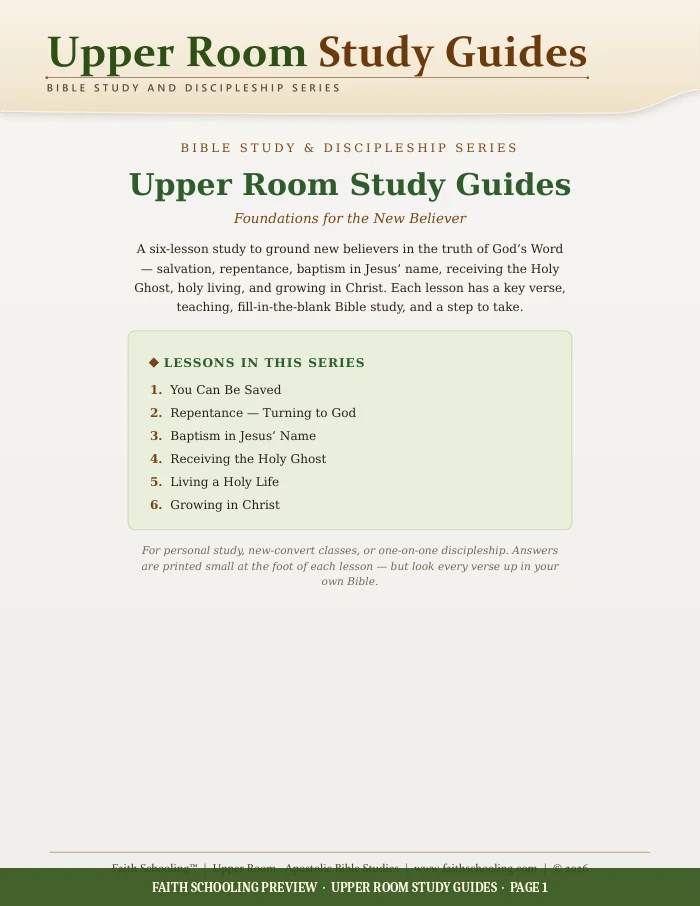
Faith Schooling, this site, is the academics-plus-free-library option: a complete K–5 reading and math curriculum in which the school day carries Scripture, virtue and prayer but deliberately does not teach doctrine — a page that teaches long vowels teaches long vowels — beside an entirely free Apostolic library where doctrine is taught directly, labelled, and readable in full before you decide anything: the Upper Room lessons, The Way, The Hidden Word Scripture memory curriculum, and a ten-volume church history.
General Christian publishers are the third option, and sometimes the right one for a strong academic fit — run the six checks above and count the edits you would be making out loud. Our comparison pages describe the major ones honestly, with dates and sources.
Apostolic Bible curriculum for children: the options How we compare with other publishers
How Faith Schooling answers its own checklist
Fairness requires we go first. The Godhead: our statement of faith says there is one God, revealed as Father in creation, Son in redemption and Holy Spirit at work in the church, and that Jesus Christ is that one God manifested in the flesh. Baptism: by immersion in the name of Jesus Christ for the remission of sins. Salvation: Acts 2:38, stated as the plan of salvation. The Holy Ghost: a present baptism with the initial evidence of speaking in other tongues. Holiness: inward and outward consecration, taught without apology in the study guides.
Translation: published precisely, because it is mixed on purpose — The Hidden Word and The Way carry King James text; the Upper Room lessons and the academic books quote the New King James Version and say so. And the placement of doctrine is the design decision we would most want you to check: it lives in the free, clearly-labelled Academy, never woven unannounced through a phonics page.
The question under the question
Most families running these checks are really deciding between two shapes of school year: buy materials that agree with your church everywhere, or buy the strongest academics you can find and supply the doctrine from home and church. There is no universally right answer — but there is a wrong way to decide, which is not checking and finding out in February.
Whatever you choose, the free library here is yours either way: nothing in the Apostolic Academy requires membership, an account, or the use of our academic curriculum.
Common questions
- Is there a homeschool curriculum written by Oneness Pentecostals?
- Yes, more than one. Pentecostal Publishing House publishes Apostolic, Oneness-focused Bible curriculum including Pathways (K and Grade 1 as of September 2026). Faith Schooling publishes a complete K–5 academic curriculum written from Apostolic conviction, with a free Apostolic doctrine library beside it. This page's checklist works on both, and on everyone else.
- Is Oneness Pentecostal the same as Apostolic?
- In ordinary use, yes — Oneness Pentecostal, Apostolic, Apostolic Pentecostal and Jesus Name name the same conviction: one God revealed in Jesus Christ, baptism in Jesus' name, and the baptism of the Holy Ghost with the initial evidence of speaking in tongues. The full definitions are published on our statement of faith.
- Can a Oneness family use a general Christian curriculum?
- Many do, for academics — the cost is editing the Bible content out loud wherever it assumes positions your church does not hold. Run the six checks on a real sample first and count those moments honestly; some publishers require few, some require one per lesson.
- Does Faith Schooling teach Oneness doctrine in the school lessons?
- No — deliberately. The academic lessons carry Scripture, virtue and prayer, not doctrine. Doctrine is taught directly, and only, in the free Apostolic Academy, where it is labelled and readable in full before you buy anything.
Sources
- Faith Schooling statement of faith — checked 2026-09-05
- Pentecostal Publishing House — Christian Home School collection — checked 2026-09-05
- Pentecostal Publishing House — Pathways Bible curriculum — checked 2026-09-05