
Guide
What to Look For in Faith-Integrated Curriculum
How to tell genuine faith integration from Scripture used as decoration: three levels of integration with a test for each, what real integration looks like subject by subject in K–5, where forcing Scripture does harm, and why doctrine deserves its own check. The Academy's article on faith-integrated schooling covers the institutional question; this page is about the materials on your own table.
Updated 4 October 2026
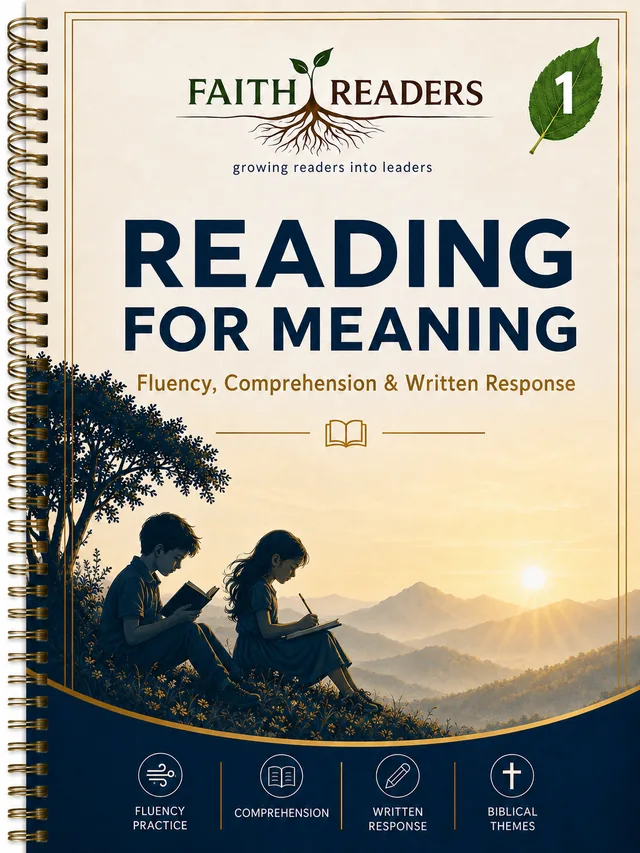
What does faith-integrated curriculum actually mean?
Faith-integrated curriculum means the biblical content is part of the instruction itself rather than added around it. The practical test: delete the Scripture from a mid-year page. If the lesson works exactly as before, the faith was decoration. If the lesson loses its content — because the text being decoded was the biblical narrative, or the sentence being copied was the verse — it was integrated.
Nearly every Christian publisher uses the phrase, and it does very different work in different catalogs. This page is about telling them apart before a year has been paid for.
This is a materials question, distinct from how a Christian school builds faith into its subjects institutionally, which the Academy covers separately. The concern here is the page in front of your child at your own kitchen table.
How Christian schools integrate faith into every subject How to teach a biblical worldview at home Bible integration, one subject of the K–5 day at a time
Three levels of integration, and how to test for each
Almost everything on the market sits at one of these three levels. None of them is dishonest; they simply deliver very different amounts of what a parent thinks she is buying.
The third is the one worth paying for, and it is the one that has to be checked on a mid-year page rather than on a sample chapter.
| Level | What it looks like | The test |
|---|---|---|
| Decoration | A verse in the page header, a border illustration, a Christian name in a word problem | Delete the verse. The lesson is unchanged. |
| Devotional add-on | A short devotion at the front of the lesson, then a standard secular lesson | Skip the devotion. The academic work runs perfectly without it. |
| Structural | The decodable text is biblical narrative; the copywork is the memory verse; the practice is the discipleship | Remove the Scripture and the lesson has no content left to teach. |
Questions that reveal the difference
Ask these while looking at a real page from the middle of the year rather than the publisher's sample.
- If every Bible reference were removed from this page, would there still be a lesson?
- Is the Scripture the child is reading also the text he is practicing his decoding on?
- Does the handwriting practice use Scripture, or a filler sentence with a verse printed above it?
- In math, is the faith content honest framing and word problems, or a verse on a page of sums presented as if it made the arithmetic Christian?
- Whose doctrine is this, and can the publisher's statement of belief be found without hunting?
- Does the program tell my child what to think about God, or teach him to read the Bible for himself?
What real integration looks like, subject by subject
In reading, integration means the connected text a child decodes carries biblical narrative, using only the phonics patterns already taught. That is harder to author than it sounds — the text has to be decodable and faithful at once — which is why many programs use a general reader and print a verse above it.
In handwriting, integration is Scripture copywork as the stroke practice itself. The child forms letters and holds the passage in his head at the same time, which is why copywork has been used this way for centuries. The Learning Cursive sequence weaves Scripture copywork into the stroke work, and the free Copywork Creator will generate a handwriting page from any passage you type.
In math, honest integration is narrower, and a publisher claiming more is overselling. Arithmetic is arithmetic. What genuinely belongs is the framing — order, truthfulness, diligence, the reliability of what God made — and word problems drawn from real life rather than from consumer fantasy. Building Number Sense provides a complete K–5 student-text sequence without pretending that place value is doctrinal. Its pages do carry Scripture, beside the work rather than inside it: each lesson's independent-practice page closes with a short "God's Design" reflection and a New King James verse, and the practice worksheets carry one short King James verse at the foot of most pages. That is a closing encouragement, and it is not presented as what makes the arithmetic Christian.
In memory work and family devotion, integration is simply doing it daily. The Scripture Memory Cards, the Bible Verse Card Maker and the whole Apostolic Academy are free for exactly that reason.
Decodable Readers Phonics, Decoding and Early Fluency Learning Cursive Copywork Creator — free Building Number Sense Free Scripture Memory Cards
Where Scripture should not be forced
Integration can be overdone, and when it is, children learn to skim the Bible content because it is obviously filler. The harm comes from pretending: subtraction facts with a verse bolted into the problems, sold as Bible-integrated math, teach a child that Scripture is a decoration on his worksheet. That is the opposite of the intent.
The working rule: put Scripture where it carries the lesson, and do not dress it up as the lesson where it cannot be. A short verse at the foot of a number-bond page is a closing encouragement, and should be called that. A decodable reader about the widow's oil does not need one added, because it already is one.
"And whatever you do, do it heartily, as to the Lord and not to men." (Colossians 3:23, NKJV) Diligence in ordinary arithmetic is itself formation; it does not need a proof text pinned to it.
One scope note, because it bears directly on this question: Faith Schooling concentrates on K–5 reading, phonics, handwriting and cursive, math, Bible, and faith formation. Families select their preferred complementary subjects and remain free to teach those worldview questions from their own convictions.
The full curriculum map How Faith Schooling compares with other Christian publishers
Check the doctrine, not just the label
"Christian" covers a wide range on a curriculum cover. Publishers differ on real things, and a curriculum used daily for a year teaches a child more than phonics. Before buying, find the publisher's statement of belief and read it. If it is hard to find, that is itself a finding.
This is not a reason for suspicion of every difference. It is a reason to know what is being handed to a child. A family will happily use a program from a tradition not its own for math, and be much more careful about one that shapes daily devotion.
Faith Schooling is Apostolic in conviction and says so plainly rather than leaving parents to work it out. The Apostolic Academy — study guides, church history, Scripture memory and printables — is entirely free and open to everyone, whatever your background, with no membership involved.
Apostolic homeschool curriculum and materials How to choose Apostolic homeschool curriculum Apostolic Academy — free Authors and method
Integration is not a substitute for teaching quality
A curriculum can be deeply integrated and still teach reading badly. The faith test is one of two tests. The other is whether the phonics sequence is systematic, whether the math moves properly from the concrete to the abstract, and whether the pacing follows the child.
Run both tests on the same page. Ask whether the Scripture is structural, and ask whether the instruction is any good. A program that passes the first and fails the second produces a child who loves the Bible and cannot read it for himself, which is a poor trade.
"Train up a child in the way he should go, And when he is old he will not depart from it." (Proverbs 22:6, NKJV) The way includes the skill.
How to choose Christian homeschool curriculum HARVEST — free reading placement Choosing a Christian phonics curriculum Choosing a Christian reading curriculum
A short checklist before you commit
Print one page from the middle of the year and run the deletion test on it. Read the publisher's statement of belief. Check whether the phonics sequence is explicit and systematic, independently of the faith content. Map the included subjects and decide how they fit your full year.
If a publisher will not show a mid-year page, the test cannot be run, and that counts as an answer. Here, the complete teaching guides for the reading sequence and for Kindergarten through Grade 2 in math are readable in a browser before joining, every grade carries hand-picked sample pages, and the first three worksheets in every practice set are free to print.
Reading teaching guides, readable in a browser Free practice sheets A sample week, Monday to Friday Membership and pricing
Common questions
- What is the difference between a Christian curriculum and a faith-integrated one?
- A Christian curriculum is published by a Christian company and may hold Scripture at the edges of the page. A faith-integrated one puts the biblical content inside the instruction, so the text being decoded or the sentence being copied is itself Scripture. Run the deletion test on a mid-year page: if removing the verse leaves the lesson intact, it was decoration.
- Can math genuinely be faith-integrated?
- Only in a narrow and honest sense. Arithmetic is arithmetic, and a publisher claiming doctrinal content in place value is overselling. What legitimately belongs is the framing — order, truthfulness, diligence — and word problems drawn from real life. Be more careful with a math program that claims heavy integration than with one that does not.
- Does Faith Schooling teach science or history from a biblical worldview?
- Faith Schooling concentrates on K–5 reading, phonics, handwriting and cursive, math, Bible, and faith formation. Families choose complementary science and history resources that match their convictions and build them around the Faith Schooling foundation.
- How do I check a publisher's doctrine before buying?
- Find the statement of belief on the publisher's own site and read it rather than relying on the word Christian on the cover. Difficulty locating it is itself informative. Then look at how the material handles Scripture: whether it tells a child what to conclude, or teaches him to read the passage for himself.
- Is too much Scripture in a curriculum a problem?
- It can be, when it is presented as something it is not. Scripture forced into the working of a problem, or a verse on a drill page sold as integration, teaches children to skim the Bible content as filler, which is the opposite of the intention. Scripture carries the lesson in decodable text, copywork and memory work; on a math page, a short verse at the foot is encouragement, and an honest publisher calls it that.
- Is faith integration enough on its own?
- No. A program can be deeply integrated and still teach reading poorly. Test the instruction separately: whether the phonics sequence is explicit and systematic, whether math moves properly from concrete to abstract, and whether pacing follows the child. Both tests have to pass on the same page.