
Curriculum
Choosing a Christian reading curriculum for K–5
Reading is one long sequence, not a stack of subjects. This is what that sequence looks like from Kindergarten to Grade 5, and how to find where your child belongs in it.
Updated 4 October 2026 · Sources read 31 August 2026
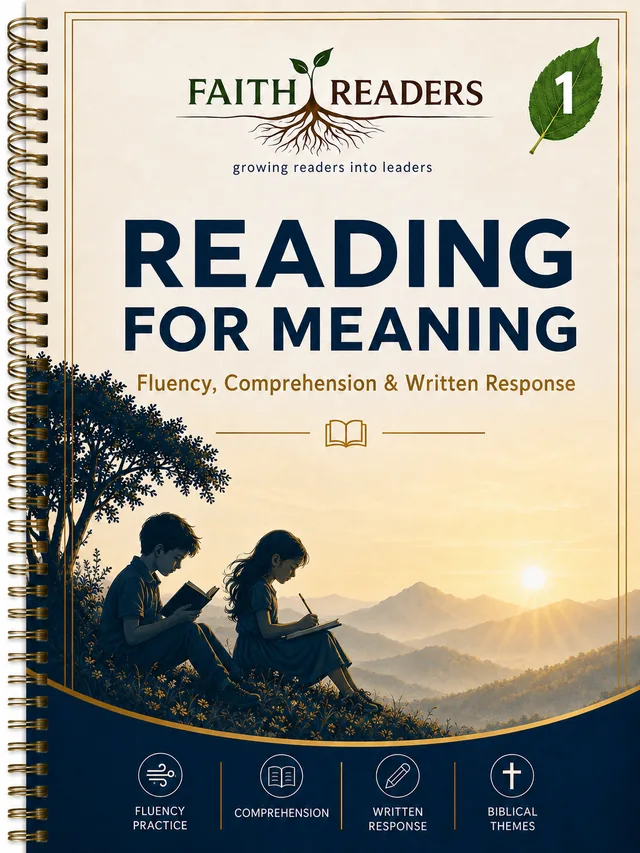
What a K–5 reading curriculum has to cover
A complete K–5 reading curriculum carries a child from hearing sounds to reading and thinking about connected text. In order that means phonemic awareness, letter sounds, decoding, controlled reading, fluency, high-frequency words, spelling, vocabulary, morphology, comprehension and written response, each skill resting on the one before it.
A program that teaches only phonics stops too early. A program that teaches only comprehension strategies starts too late. The reason sequence matters is practical: a child who cannot decode a word cannot think about it, and a child who decodes fluently but has no vocabulary or morphology stalls when words get longer and content gets denser.
A Christian reading curriculum adds one further decision. The question is whether Scripture and Christian character are the material the child actually reads, or a devotional attached to the side of an otherwise general program.
The K–5 path, grade by grade
Faith Schooling's core reading curriculum is Phonics, Decoding, and Early Fluency: one full-year student textbook per grade, printed at home, with a teaching guide the adult can read in full first. The published sequence is 8,952 student pages and 3,530 teaching-guide pages across six grades, organized into four quarters, with a roadmap at the start of each quarter and a check at the end.
| Grade | What the year does | Student pages | Teaching-guide pages |
|---|---|---|---|
| Kindergarten | Letters, sounds, and first decoding | 1,282 | 1,000 |
| Grade 1 | Phonics patterns and readable confidence | 1,496 | 506 |
| Grade 2 | Word growth, fluency, and meaning | 1,538 | 506 |
| Grade 3 | Multisyllable reading and morphology | 1,536 | 506 |
| Grade 4 | Roots, history, and academic language | 1,588 | 506 |
| Grade 5 | Worldview reading and thoughtful response | 1,512 | 506 |
What a reading week actually looks like
Each week is built around one phonics or word-study skill, one story from Scripture or history, one virtue and one Scripture, and every week runs the same rhythm: a drill sheet for automaticity, a decodable reader for connected text, writing, a daily exit ticket, and homework. Weeks are numbered as they are printed in the book, 2 through 36, in four quarters. Each grade page prints its 35-week scope and sequence, so you can read what is taught in week 12 before deciding anything.
The same sequence is also published as Faith Readers Weekly Lessons for families and groups who would rather print a week than a book: 210 weekly sets, 1,050 daily lessons, 210 preceptor guides and 5,250 student pages in all, each week holding five short daily lessons — Introduce, Reader, Handwriting, Apply, Check — and about 25 student pages. Most families choose one format, not both.
The companions, and what each one is for
Around the core program sit five companions, each doing one job. Buying all of them at once is rarely the right move; add the one that matches the weakness you can actually name.
- Decodable Readers — 300 original readers, 50 per grade, for daily connected reading using only taught patterns. Decodable stories in K–2, fluency passages in Grades 3–5.
- Foundations to Fluency — 96 short workbooks in six levels arranged by pattern rather than grade, for a child stuck on one specific thing at any age.
- Phonics Lab — 150 worksheets, each with a complete answer key, for the spelling side and quick checks.
- Learning Cursive — ten sequenced workbooks, 170 pages, about ten to fifteen minutes a day, with Scripture copywork as the application.
- The Practice Library — thousands of printable practice pages organized by subject, grade and skill. It is practice, never the lesson; the first three sheets in every set are open to everyone.
Decodable Readers Foundations to Fluency Learning Cursive The Practice Library
How to place a child in the right year
Grade labels are a poor guide, because a child can read at one level and spell at another. HARVEST is the reading placement, open to everyone: about 20 minutes for the core reading scope, adaptive, run entirely in your browser with nothing uploaded, measuring seven sections in the order skills develop — phonemic awareness, letter names and sounds, decoding, sight words, encoding, fluency in words correct per minute, and comprehension. It ends with a printable report naming a recommended starting point and the reasoning behind it.
Then read before you commit. Every reading grade's complete teaching guide can be read page by page without a membership, along with eight hand-picked sample pages per grade. Re-run HARVEST after about eight weeks to see whether the placement held.
How this serves your family
It fits a parent who wants to teach reading themselves from a scripted guide, print at home, and move a child by demonstrated skill rather than by the calendar — mastery here means 90% or better across five or more sessions on different days, tracked with exit tickets, parallel-form mastery checks, drill sheets and a skill ledger.
Faith Schooling concentrates on parent-led Kindergarten through Grade 5. Families receive the curriculum and teaching tools while keeping their own homeschool records, choosing the pace, and remaining directly involved in each lesson.
One membership covers the household — $39 a month, cancel anytime — for every child and every grade K–5. Placement, the teaching guides and the open samples cost nothing, so the fit can be tested before any spending.
Common questions
- At what point does a reading curriculum stop being phonics?
- It should not stop; it should widen. The Faith Schooling sequence keeps word-level work going while adding more each year, and the grade themes show the shape of it: word growth, fluency and meaning in Grade 2, multisyllable reading and morphology in Grade 3, roots, history and academic language in Grade 4, and worldview reading with thoughtful written response in Grade 5.
- Should I buy the textbook or the weekly lesson sets?
- They are the same K–5 reading sequence in two packages, and most families choose one. The textbook suits a family that wants the whole year in one book, with quarter roadmaps and end-of-quarter checks. The weekly sets suit families who prefer printing about 25 pages a week, and co-ops or Sunday schools that hand out a week at a time with a preceptor guide.
- Is this a full language arts program or only reading?
- Reading and language arts together: the program covers phonics, decoding, fluency, vocabulary, morphology, comprehension, and written response, with handwriting in the weekly lesson rhythm and Learning Cursive as the companion. Families build chosen complementary subjects around that complete K–5 reading and language arts foundation.
- How much can I read before paying?
- The complete teaching guide for every reading grade can be read in the browser, as can eight hand-picked sample pages per grade, the complete first workbook and full teaching guide of every Foundations to Fluency level, and the first three sheets in every practice set. HARVEST and the entire Apostolic Academy are free as well. The membership opens the complete student books and the full library.
- What if my child is in Grade 3 but reading at a Grade 1 level?
- Place by skill, not by age. HARVEST names a starting point from what the child can actually do. From there some families run the earlier grade of the core program, and others keep the child in grade-level content while closing the gap with Foundations to Fluency, whose levels are labeled by pattern rather than by grade so the material does not look aimed at younger children.
Sources
- Phonics, Decoding, and Early Fluency program and grade pages — checked 2026-08-31
- Faith Readers Weekly Lessons — checked 2026-08-31
- HARVEST placement page — checked 2026-08-31
- Learning Cursive program page — checked 2026-08-31
- Faith Schooling FAQ — checked 2026-08-31
- Scarborough, H. S. (2001). Connecting early language and literacy to later reading (dis)abilities: Evidence, theory, and practice. In Handbook of Early Literacy Research (Vol. 1, pp. 97-110). Guilford Press. (The reading rope.)
- National Reading Panel (2000). Teaching Children to Read: An Evidence-Based Assessment of the Scientific Research Literature on Reading and Its Implications for Reading Instruction. NICHD.
- Castles, A., Rastle, K., & Nation, K. (2018). Ending the Reading Wars: Reading Acquisition From Novice to Expert. Psychological Science in the Public Interest, 19(1), 5–51.