
How we teach
Spaced Review for K–5 Christian Homeschooling
A skill practiced once is a skill on loan. Spaced review — returning to material across widening gaps of time — is one of the best-documented effects in learning research, and one of the easiest to skip on a busy morning. This page shows where Faith Schooling builds the return trips in, and what the research does and does not say.
Updated 4 October 2026 · Sources read 5 September 2026
What spaced review means
Ten practice problems today do less for a child's memory than five today and five next Tuesday. That is the spacing effect: material revisited across separated sessions is retained far better than the same amount of practice massed into one sitting. Its close cousin is retrieval practice — the finding that trying to pull something out of memory strengthens it more than looking at it again does.
Every parent has met the dark side of this: the verse recited perfectly on Friday and gone by Sunday, the subtraction that dissolved over Christmas break. Nothing was wrong with the child. The material was simply never scheduled to come back.
What the evidence shows — and its honest limits
The spacing effect is among the most replicated findings in learning research; Cepeda and colleagues' 2006 review synthesised hundreds of comparisons in its favor, and Roediger and Karpicke's work established how strongly testing — retrieval — beats rereading. Rosenshine's Principles of Instruction translates both into classroom terms: begin lessons with review, and revisit material weekly and monthly.
Two honest cautions. The Education Endowment Foundation notes that cognitive-science-informed practices can improve learning while the classroom evidence base has real limitations — and its own evaluation of a specific spaced-learning program produced mixed findings. So we say it carefully: the underlying effect is solid, the way any given curriculum operationalises it is a design choice, and ours has not been independently evaluated. What we can show you is exactly where the review lives in the materials.
Where the return trips are built in
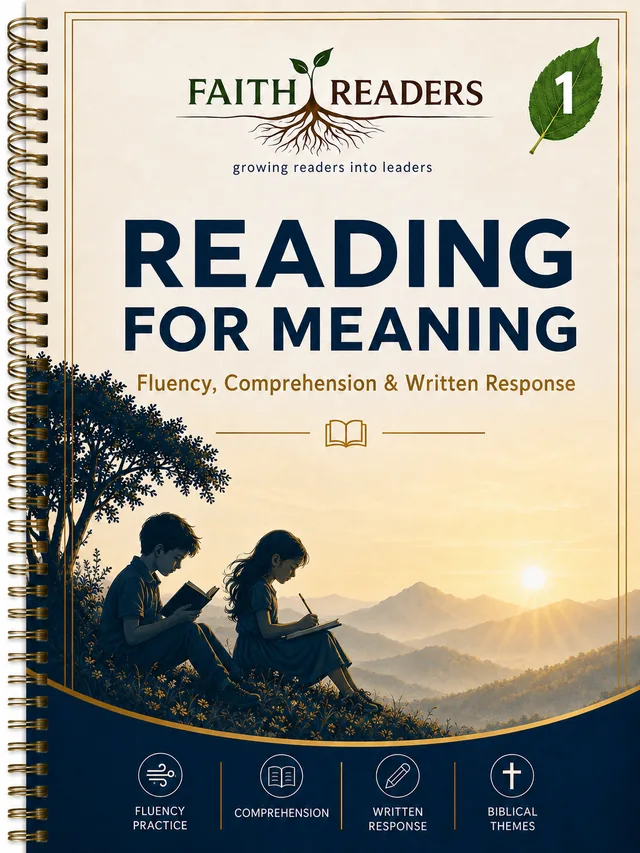
In reading, every lesson closes with the spaced-review card box — a few minutes of retrieval on patterns from previous weeks, not the current one — and the scope itself schedules whole review weeks, like Grade 1's suffix-review week after its five-week suffix block. Weekly mastery checks are cumulative on purpose: last month's skill appears beside this week's, because the only mastery worth recording is the kind that survives a month.
In mathematics, review is the fifth step of every Building Number Sense lesson — the same arc, all six grades — and the mastery rule enforces spacing by definition: 90% or better across five or more sessions on different days cannot be satisfied in one afternoon.
In Scripture memory, The Hidden Word publishes its review schedule outright: a passage returns the same day, the next day, at three days, one week, two weeks and one month. That widening ladder is spaced review in its plainest form, applied to the words a family most wants a child to keep.
The Hidden Word — Scripture memory with scheduled review The reading curriculum
What it looks like on a Tuesday
The lesson opens with review, as Rosenshine would have it: yesterday's exit-ticket miss gets thirty seconds first. New material follows. The close is the card box — perhaps the -ck ending from three weeks ago, the sight words from last month, one verse at its one-week return. Total cost, maybe four minutes; the child experiences it as the easy part of the lesson, because retrieval that succeeds feels like winning.
The design principle is that the schedule must not depend on the parent remembering. The cards, the review weeks, the cumulative checks and the memory ladder are printed into the sequence, so the return trips happen on the mornings nobody feels organized — which are most mornings.
What spaced review does not mean
It does not mean endless re-teaching — a review touch is a retrieval attempt measured in seconds, not a repeated lesson. It does not mean a child never moves on until everything old is perfect; it means old material keeps appearing so weakness shows up early and cheaply.
And it is not magic. Spacing strengthens what was taught well; it cannot rescue what was never understood. That is why review sits beside explicit teaching and mastery checks here rather than replacing either — and why, when a review touch keeps failing, the guides route back to reteaching rather than to more review.
Common questions
- How is spaced review different from spiral curriculum?
- A spiral curriculum re-teaches topics at rising depth across years. Spaced review re-practices already-taught skills across days and weeks without re-teaching them. Faith Schooling sequences for mastery and then spaces the review — the skill is taught once, properly, and then kept alive by scheduled retrieval.
- How much time does the review cost each day?
- Minutes. The card box at the close of a reading lesson is a handful of retrieval touches; the review step ends each math lesson; a verse at its one-week return takes one recitation. The design assumption is that review must be cheap or it will be skipped.
- Is the research on spacing settled?
- The core effect — spaced practice beats massed practice for retention — is among the most replicated findings in learning research. How best to package it in a curriculum is not settled, the EEF's evaluation of one spaced-learning program was mixed, and ours has not been independently evaluated. We publish where the review lives so you can judge the design yourself.
- What review schedule does the Scripture memory use?
- The Hidden Word publishes it plainly: same day, next day, three days, one week, two weeks, one month. A widening ladder, printed on the materials rather than left to memory.
Sources
- Cepeda, N. J., Pashler, H., Vul, E., Wixted, J. T., & Rohrer, D. (2006). Distributed practice in verbal recall tasks: a review and quantitative synthesis. Psychological Bulletin — checked 2026-09-05
- Roediger, H. L., & Karpicke, J. D. (2006). Test-enhanced learning: taking memory tests improves long-term retention. Psychological Science — checked 2026-09-05
- Rosenshine, B. (2012). Principles of Instruction. American Educator — daily, weekly and monthly review — checked 2026-09-05
- Education Endowment Foundation — The ABC of Cognitive Science (blog) and the EEF spaced-learning evaluation's mixed findings — checked 2026-09-05