
How we teach
Mastery-Paced Christian Homeschool Learning
Mastery learning means a child advances on evidence of a skill, not on the date. This page explains the idea, what the research does and does not show, the exact mastery rule Faith Schooling uses, and the honest costs of pacing a school year this way.
Updated 4 October 2026 · Sources read 5 September 2026
What mastery learning means
In a calendar-paced classroom, Tuesday's lesson happens on Tuesday whether or not Monday's lesson landed, and the gaps compound quietly. Mastery learning, an idea usually traced to Benjamin Bloom's 1968 'Learning for Mastery', reverses the constant: the material to be learned is fixed, the time is allowed to vary, and a child moves forward when the evidence says the skill is his — not when the week ends.
A homeschool is the one place this is genuinely practical. There is no class of thirty to hold together; one child can sit with regrouping for an extra week while his sister moves ahead in her own book.
What the evidence shows — and its honest limits
The Education Endowment Foundation's teaching toolkit reports positive average effects for mastery-learning approaches, with the caveat that matters: results vary widely with implementation, and the approach helps most when the checking and the reteaching are actually done rather than merely intended. That caveat is the design problem a curriculum has to solve. A mastery rule that lives in a parent's good intentions collapses by October; one that is printed into the materials, with the checks already written, has a chance.
We state this the careful way round: research supports mastery-learning approaches in general, particularly in mathematics. It has not evaluated Faith Schooling, and our use of the approach is an application of the principle, not a guarantee of the outcome.
The rule itself
Faith Schooling counts a skill as mastered when a child shows it at 90% or better across five or more sessions on different days. Every clause is doing work. Ninety percent, because 'roughly got it' is where reading and arithmetic problems hide. Five or more sessions, because one good afternoon proves the afternoon, not the skill. Different days, because the only memory worth building a next lesson on is the kind that survives sleep.
That is our standard — a design decision, informed by research on review and retrieval but not dictated by any study. We publish it, verbatim and identically, on the FAQ, the curriculum map and the HARVEST page, so nobody discovers a vaguer version after paying.
Where it appears in the materials
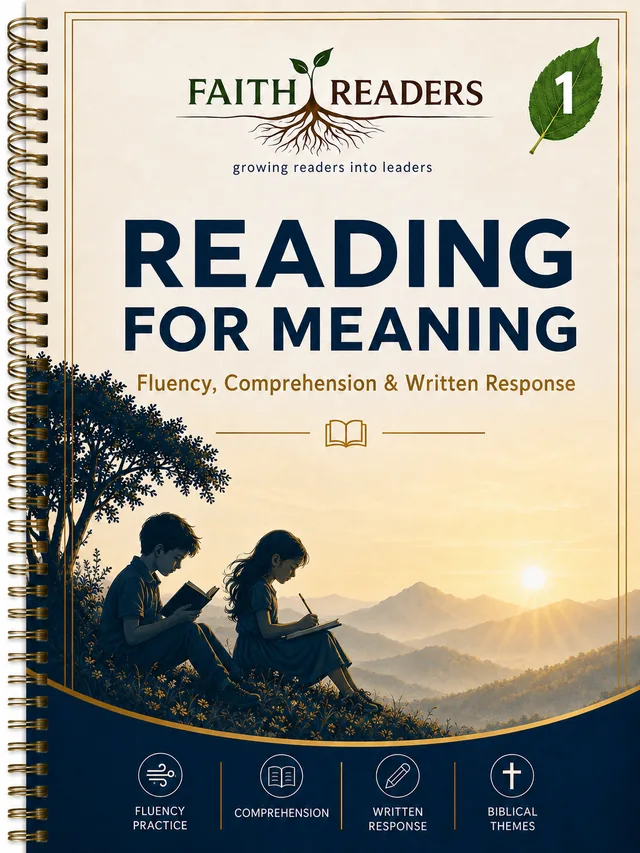
Placement first: HARVEST, the free browser placement tool, starts a child at a skill rather than at a birthday, so mastery pacing begins from an honest baseline. In the reading curriculum, every day ends with an exit ticket and every week with a mastery check that has parallel forms — a child who misses the check gets reteaching and a different form, not the same questions again. In mathematics, Building Number Sense is sequenced so each concept rests on the one before it, with the practice library's thousands of worksheets underneath for the extra sessions the rule sometimes demands.
Foundations to Fluency takes the logic furthest: its 96 workbooks are arranged by phonics pattern, not by grade, so a ten-year-old closing a gap works in a book labeled by the skill — never by a younger child's grade.
HARVEST — free placement, in the browser Building Number Sense — the K–5 math curriculum
What one week of mastery pacing looks like
A Grade 1 child is on the suffix -ed week. Monday to Thursday: explicit lesson, decodable reading, written application, exit ticket each day. Friday: the mastery check. Say she scores 8 of 10 — under the bar. The next week opens with reteaching from the guide and the parallel form of the check; the practice sets supply fresh material so she is not memorizing Friday's answers. Her brother, who cleared his own check, simply turns the page in his own book. Nobody repeats a year; somebody repeats a week, which is the entire point.
What mastery pacing does not mean
It does not mean unlimited delay. A child stuck on one skill for weeks needs a different explanation or a smaller step, not more of the same sheet — the teaching guides say so, and the practice sets carry guidance for when a child is struggling.
It does not mean no grade levels. The books are still organized K–5; mastery decides when a child moves through them, not whether structure exists. It is not a diagnosis of anything, and it is not effortless for the parent: checking evidence honestly costs more attention than trusting the calendar. That cost is real, we have simply tried to pre-pay most of it by writing the checks, the parallel forms and the reteaching paths into the materials.
Common questions
- What exactly is Faith Schooling's mastery rule?
- A skill counts as mastered when a child shows it at 90% or better across five or more sessions on different days. It is stated identically on the FAQ, the curriculum map and the HARVEST page, and it is our published standard — informed by research on review and retrieval, but set by us, not by a study.
- Does research prove mastery learning works?
- The Education Endowment Foundation reports positive average effects for mastery-learning approaches, especially in mathematics — and warns that results depend heavily on implementation. That research supports the approach in general; it has not evaluated Faith Schooling specifically, and we do not claim it has.
- What happens when my child fails a mastery check?
- Reteaching from the guide, then a parallel form of the check — different questions, same skill — with fresh practice material in between. A week gets repeated, not a year.
- Can two children in different places use it at the same time?
- Yes — that is the normal case. Each child sits in the book matching the skill HARVEST placed them at, and one membership covers every K–5 child in the household.
Sources
- Bloom, B. S. (1968). Learning for Mastery. UCLA Evaluation Comment — checked 2026-09-05
- Education Endowment Foundation — Mastery learning, Teaching and Learning Toolkit — checked 2026-09-05
- Rosenshine, B. (2012). Principles of Instruction. American Educator — checked 2026-09-05