
How we teach
Concrete-to-Abstract Christian Math for K–5
Children meet mathematics as objects before they meet it as symbols. This page explains the concrete-to-abstract progression, where the idea comes from, how Building Number Sense applies it with beans and buttons rather than a kit you buy — and what the approach does not promise.
Updated 4 October 2026 · Sources read 5 September 2026
What concrete-to-abstract means
A five-year-old who writes 3 + 2 = 5 without ever having pushed three beans toward two beans is reciting, not calculating. The concrete-to-abstract progression — often called CRA, for concrete, representational, abstract — teaches every new mathematical idea three times over: first with real objects a child can move, then with pictures and models that stand for the objects, and only then with the bare symbols. The child does not abandon a stage; each one becomes the meaning of the next.
The idea is old and well-traveled. Jerome Bruner described children's understanding as moving through enactive, iconic and symbolic forms in the 1960s, and versions of the progression sit inside most mathematics teaching traditions since — including the Singapore-style concrete-pictorial-abstract sequence many homeschool parents have met by name.
What the evidence shows — and its limits
Practice guides from the Institute of Education Sciences on helping students who struggle with mathematics recommend the use of concrete objects and visual representations to build understanding of mathematical ideas, alongside explicit instruction — the combination, not the objects alone. That last distinction is worth being honest about: a bin of counters teaches nothing by itself. The evidence supports objects and models used inside structured, explicit teaching, with the symbols always the destination.
As everywhere on these pages: the research supports the approach. It has not tested Building Number Sense, and we do not claim otherwise. The grade pages show real interior spreads, which is the honest way to judge how we apply it.
Where it appears in Building Number Sense
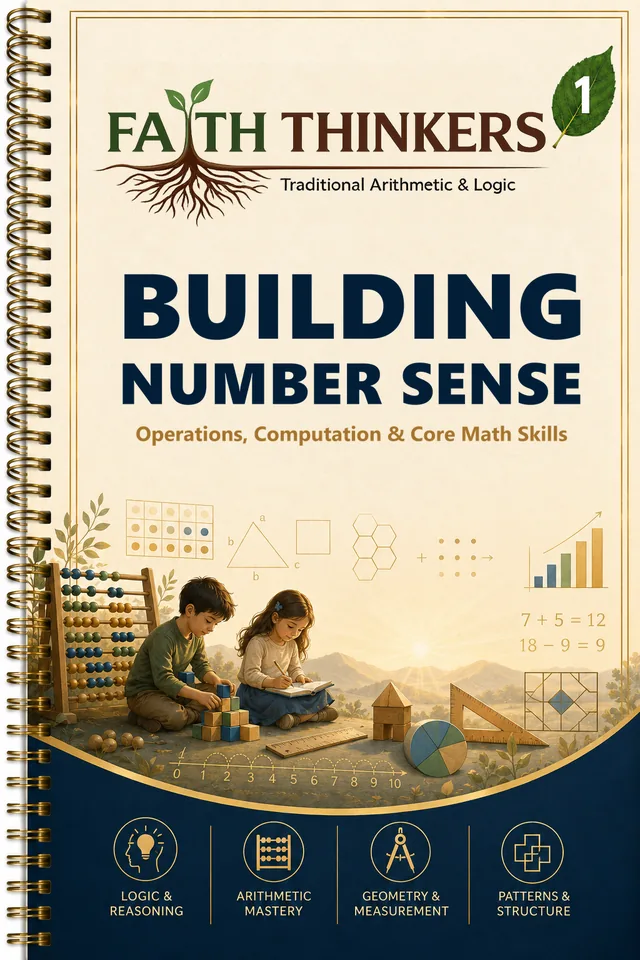
Building Number Sense is the K–5 mathematics curriculum: six sequenced student texts covering computation, number relationships, patterns, measurement, geometry and reasoning, with coordinated practice workbooks and complete teaching guides for Kindergarten through Grade 2. Every lesson follows the same arc — explicit modeling, guided work, independent application, word problems, and review — and the early stages of a new concept are deliberately concrete.
The concrete stage costs nothing to equip. The materials call for countable objects, and beans, buttons, coins or pasta all work; what matters is that a child moves real objects before working with the symbols. There is no manipulative kit to buy, because a kitchen already contains one. Between lessons, the Number Building game offers visual manipulatives in the browser — practice, never the lesson itself.
Building Number Sense — the K–5 math curriculum The math practice library beneath it
What one concept looks like across the three stages
Take addition with regrouping. Concrete: the child builds 47 with bundles of ten and loose ones, adds 25, and physically trades ten ones for a new ten-bundle — the 'carrying' happens in her hands. Representational: she draws the tens and ones, crossing out and regrouping on paper. Abstract: she writes the algorithm, and the small 1 above the tens column now means something she has done twice already with her own fingers.
The word problems that end each lesson pull the idea back out of the symbols and into situations, which is the return journey — from abstract back to the world — that shows whether understanding survived the trip.
How progress is checked
The same mastery standard as the rest of Faith Schooling: review is built into every lesson's closing step, and a skill counts as mastered at 90% or better across five or more sessions on different days. A child who can regroup on Friday but not the following Wednesday goes back to the representational stage, not to a lecture — the drawing is usually where the meaning leaked.
What concrete-to-abstract does not mean
It does not mean mathematics stays concrete. The objects are scaffolding; the point of the progression is to arrive at fluent, abstract calculation with meaning underneath it, and a child kept at the bean-counting stage past its usefulness is being slowed, not helped.
It does not require purchased manipulatives, a screen, or a particular brand of anything. And it is not a promise that mathematics will be painless — regrouping is genuinely hard for many children, and the honest claim is only that hard ideas land better when hands and pictures come before symbols. Building Number Sense is also still growing: all six grades ship a complete student text, while coordinated workbooks and teaching guides currently run Kindergarten through Grade 2, and we say so rather than rounding up.
Common questions
- Do I need to buy manipulatives?
- No. The concrete stages call for countable objects, and beans, buttons, coins or pasta all work. What matters is that a child moves real objects before working with symbols — not that the objects came from a catalog.
- Is this the same as Singapore math's concrete-pictorial-abstract?
- It is the same family of idea — concrete first, then pictures, then symbols — applied inside our own explicit lesson arc of modeling, guided work, independent application, word problems and review. We make no claim of affiliation with any other publisher's program.
- Is Building Number Sense a complete curriculum?
- All six grades, Kindergarten through Grade 5, ship a complete sequenced student text. Coordinated practice workbooks and full teaching guides currently cover Kindergarten through Grade 2, with a large practice library under every grade. We state that split plainly rather than calling the whole thing finished.
- What if my child can do the algorithm but not explain it?
- That is the case the progression exists for. Go back one stage: have the child draw the tens and ones, or build the problem with counters, and the explanation usually surfaces. The teaching guides for K–2 script exactly this.
Sources
- Bruner, J. S. (1966). Toward a Theory of Instruction — enactive, iconic and symbolic representation — checked 2026-09-05
- Institute of Education Sciences, What Works Clearinghouse — Assisting Students Struggling with Mathematics (Practice Guide): concrete and visual representations within explicit instruction — checked 2026-09-05
- Building Number Sense program page — lesson arc and concrete-stage materials as published — checked 2026-09-05