
Curriculum
Choosing a Christian math curriculum for K–5
A math curriculum is the lesson sequence. A worksheet library is practice. Buying one when you needed the other is the most common mistake in elementary math.
Updated 13 October 2026 · Sources read 31 August 2026
Curriculum or practice? Decide this first
A K–5 math curriculum is a sequence of lessons: it introduces a concept, models it explicitly, guides the child through it, then releases them to independent work, application and review, in a deliberate order across six years. A practice library is a bank of worksheets organized by skill. It reinforces a lesson someone else taught. Both are useful; only one of them teaches.
The confusion is easy to fall into, because a worksheet site and a curriculum publisher can both offer thousands of math pages. The test is simple: does the material tell the adult what to teach, in what order, and how to know the child has it? If not, it is practice.
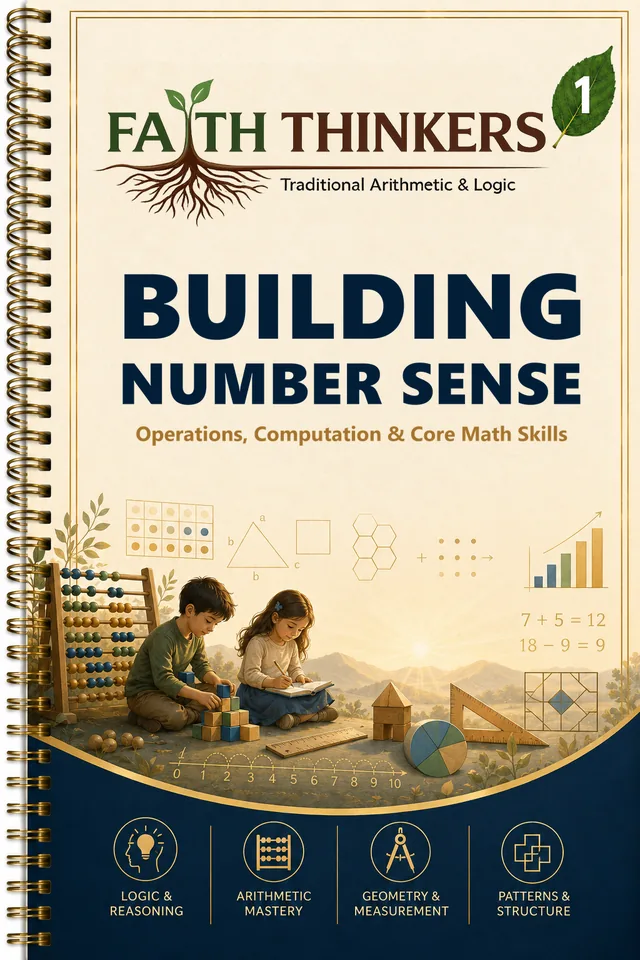
Faith Schooling keeps the two separate and names them differently. Building Number Sense is the sequenced K–5 series — the lessons. The Faith Thinkers Math Practice Library is practice by grade and skill, and it does not claim to be the lesson.
What to look for in an elementary math program
Elementary math has a short list of things that decide whether a child ends Grade 5 confident or guessing. Most of them are visible in the actual pages, which is why being able to inspect real sample pages before paying matters more than any description on a sales page.
- A visible model before independent work — the concept shown concretely and pictorially before the child is left with symbols.
- Number sense before procedure: counting, comparing, composing and decomposing numbers, so place value has something to stand on.
- Computational fluency built through spaced review rather than one unit and never again.
- Word problems as a regular part of the sequence, not an appendix, so children read a situation and choose the operation.
- A clear component list for every grade, so families can see exactly which student texts, workbooks, guides, and practice resources are included.
What Building Number Sense actually contains
Building Number Sense is a sequenced K–5 series. Every student text moves in the same order — explicit modeling, guided work, independent application, word problems, review — so a child always knows what happens next and the adult always knows where they are.
The complete K–5 student-text sequence includes Kindergarten at 40 pages, Grade 1 at 49, Grade 2 at 58, and Grades 3, 4 and 5 at 57 pages each — 318 student-text pages in all. Kindergarten through Grade 2 also include coordinated practice workbooks of 54, 67 and 80 pages and teaching guides of 15, 18 and 21 pages.
The Kindergarten through Grade 2 teaching guides can be read in full in the browser before you join. Grades 3 to 5 pair their student texts with thousands of skill-organized pages in the Faith Thinkers Math Practice Library. Every grade also shows eight hand-picked, zoomable sample pages, so you can judge the real level and layout rather than a cover.
| Grade | Student text | Practice workbook | Teaching guide |
|---|---|---|---|
| Kindergarten | 40 pages | 54 pages | 15 pages |
| Grade 1 | 49 pages | 67 pages | 18 pages |
| Grade 2 | 58 pages | 80 pages | 21 pages |
| Grade 3 | 57 pages | Math Practice Library | Explicit student models |
| Grade 4 | 57 pages | Math Practice Library | Explicit student models |
| Grade 5 | 57 pages | Math Practice Library | Explicit student models |
The practice side, and how to use it well
The Faith Thinkers Math Practice Library holds thousands of printable K–5 math practice pages, organized by grade and skill for review, reinforcement and differentiation. Each grade covers its own skills, from counting, comparing numbers and making ten in Kindergarten, through multiplication, division and fractions in Grade 3, to decimals, expressions, volume and the coordinate plane in Grade 5, and most sets pair every worksheet with its own worked answer key. The first three worksheets in every set are open to everyone.
Math practice also runs through the wider Practice Library at /worksheets/, organized by subject, grade and skill, where the first three sheets in every set are open to everyone. Use it after a lesson: one more page on today's skill, an easier or harder sheet for a sibling, a review page before moving on. Members can gather chosen pages into one printable workbook in My Workbooks.
The Faith Thinkers math game gives visual, on-screen practice between lessons. Two math paths per grade for Kindergarten through Grade 4 are open to everyone.
Math practice by grade Math worksheets by grade and skill The math practice sequence
Is this the right math program for you?
Choose Building Number Sense for arithmetic taught in order, with each model shown clearly before the child works alone. Kindergarten through Grade 2 include the coordinated text, workbook, and readable teaching guide; Grades 3 to 5 combine the sequenced student text with the extensive Math Practice Library.
Use the Math Practice Library for focused review, reinforcement, and extra skill practice alongside the curriculum. The series uses an explicit model-guide-release approach and keeps the parent directly involved in pacing and feedback.
To check a level first, HARVEST's free Math Only check takes about 15 minutes with your child beside you. It covers number sense, operations, place value, math vocabulary and applied problems, gives a math grade estimate, and points you to the matching Building Number Sense grade. Then confirm the fit from the eight sample pages on that grade page and, for Kindergarten through Grade 2, the teaching guide, which can be read in full before you join.
Parent and teacher tools How we compare with other publishers
What it costs, and what costs nothing
All Access is $39 a month, cancel anytime. One household membership covers every child and every grade K–5, with no per-child or per-grade fees, and opens the full student texts, the available coordinated workbooks, the complete practice library and My Workbooks.
Free to everyone: the eight sample pages for every math grade, the complete Kindergarten through Grade 2 teaching guides, open sheets in every practice collection, the first three sheets in every worksheet set, the open paths in the Faith Thinkers math game, and the entire Apostolic Academy.
Faith Schooling is an independent curriculum publisher for parent-led K–5 education. Families keep their own records and choose complementary subjects while Faith Schooling provides its reading, language arts, phonics, cursive, math, Bible, and discipleship programs.
Common questions
- Is Building Number Sense a complete K–5 math curriculum?
- Its student texts are complete for Kindergarten through Grade 5. Teaching guides and coordinated practice workbooks cover Kindergarten through Grade 2, and those guides can be read in full; Grades 3 to 5 pair their student texts with thousands of skill-organized pages in the Faith Thinkers Math Practice Library.
- Can the worksheet library be used as our math curriculum?
- No, and it is not offered as one. The Faith Thinkers Math Practice Library and the wider Practice Library are practice: pages organized by grade and skill for review, reinforcement and differentiation after a lesson has been taught. They stay deliberately distinct from Building Number Sense, which is the lesson sequence, so you always know which one you are holding.
- How do I place my child in math?
- Start with HARVEST's Math Only check, about 15 minutes with your child beside you: it gives a math grade estimate and points you to the matching Building Number Sense grade. Then open that grade page and look at the eight hand-picked sample pages, which show the real level, modeling and computation your child would meet, and read the Kindergarten through Grade 2 teaching guides in full. The estimate is guidance, not a diagnosis. The parent tools include a Math Practice Path for planning a practice routine once you have chosen a level.
- How is a Christian math curriculum different from any other?
- The arithmetic is arithmetic. What differs is the surrounding content and framing: Faith Schooling is Christian and Apostolic in conviction, carries Scripture through the school day rather than beside it, and states its position plainly rather than keeping it vague. The method itself is explicit and traditional — model, guide, release, apply, review.
- Does one membership cover more than one child?
- Yes. All Access is a single household membership covering the parents or guardians and children in one household, every grade from Kindergarten through Grade 5, with no per-child limits, at $39 a month, cancel anytime. It does not cover co-ops, classrooms, churches or tutoring businesses; licensing for those is arranged by request.
Sources
- Building Number Sense program and grade pages — checked 2026-08-31
- Faith Thinkers Math Practice Library — checked 2026-08-31
- Worksheet directory index counts — checked 2026-08-31
- Membership terms and pricing — checked 2026-08-31
- National Mathematics Advisory Panel (2008). Foundations for Success: The Final Report of the National Mathematics Advisory Panel. U.S. Department of Education.
- Rosenshine, B. (2012). Principles of Instruction: Research-Based Strategies That All Teachers Should Know. American Educator, 36(1), 12–19.