
Guide
Christian Morning Basket Ideas for K–5
A workable 25-minute morning basket for K–5: the order, the pieces you can assemble free, how to run it with several ages at once, and how to shrink it when the season is hard.
Updated 13 October 2026
What a morning basket is
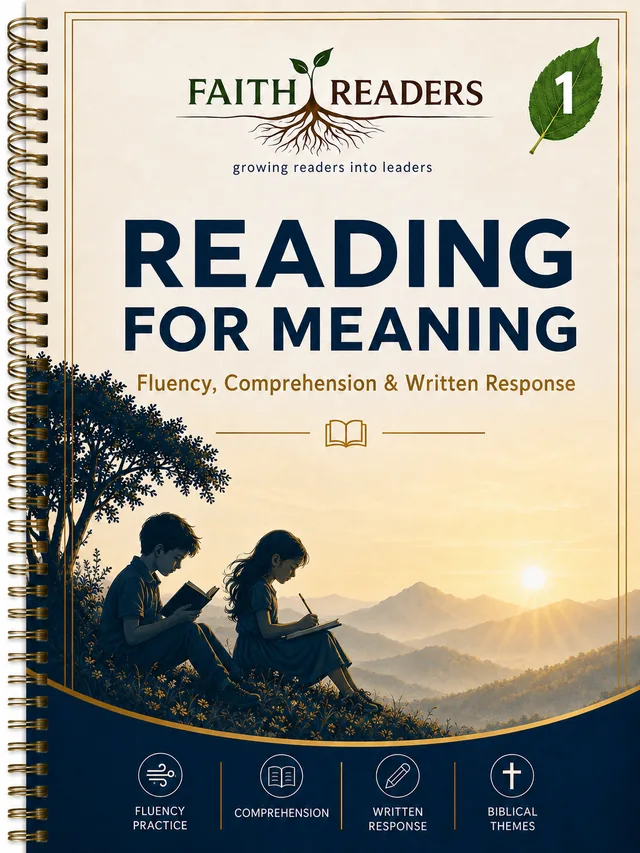
A morning basket is a short block at the start of the school day when everyone sits together for the things that do not fit in a workbook: Scripture, prayer, a read-aloud, memory work, a hymn, and one poem or picture. Twenty to thirty minutes is enough for K–5.
The name comes from the container. Everything the block needs lives in one basket, bin, or shelf, so the day starts without anyone hunting for a book. That sounds trivial. It is most of why the habit survives.
It is not a subject and it is not a curriculum, and it is not the same thing as family devotions. Devotions belong to the household and often to the evening, when a working parent is home. The morning basket is the seam between waking up and working: it gathers the family, fixes attention, and puts Scripture in first while everyone is still fresh. A family can reasonably keep both.
How a school day is structured here Starting family devotions
A 25-minute basket, in order
Keep the order fixed. A predictable sequence means nobody has to be told what happens next, and the block starts moving before anyone has decided whether they feel like it.
Time each piece loosely rather than strictly. The point of the clock is to stop the basket from swallowing the morning, not to hurry a good conversation.
| Minutes | Piece | What it is doing |
|---|---|---|
| 2 | Prayer | Settling the room. One child prays aloud, in turn. |
| 4 | Scripture reading | The passage the family is in, read straight through without commentary. |
| 5 | Memory work | One verse, reviewed the same way every day, out loud. |
| 5 | Read-aloud | A chapter, or a short reader a younger child can hold and follow. |
| 4 | Copywork or a hymn | Written or sung, on alternate days. |
| 5 | One question | Asked out loud, answered out loud, not graded or written down. |
What to put in it, from what already exists
A morning basket does not need buying. Nearly every piece can be assembled from material that is free and open to everyone.
For memory work: Scripture Seeds gives one verse at a time for family worship and review, The Hidden Word is a complete King James Scripture memory program you can read online or print, and the Scripture Memory Cards are its verse cards in one file to print and cut apart. The Bible Memory Studio builds a short session with review prompts and keeps everything private in your own browser.
For the rhythm itself: Family Bible Rhythm shapes a four-week path through Acts, with a two-minute minimum version for days that fall apart, and the Apostolic Family Altar walks a mixed-age household through twenty sessions of Scripture, teaching, prayer, and practice. Both print.
For copywork and reading: the Copywork Creator prints a verse at the right line height for each child, every Faith Readers Originals printable is free, including a month of one-page morning devotions and fifty missionary stories that make a short read-aloud, and Words of Truth and The Bible in View print Scripture and study charts for the wall behind the basket.
- Scripture Seeds — one verse at a time, for memory and review
- Free Scripture Memory Cards — the verse cards of The Hidden Word, in one file to print
- The Hidden Word — a free King James Scripture memory program, read online or printed
- Family Bible Rhythm — a four-week Acts path with a two-minute version for hard days
- Apostolic Family Altar — twenty mixed-age sessions of Scripture, prayer, and practice
- Copywork Creator — a verse printed at each child's line height
- Tabernacle Prayer Guide — a four-step prayer pattern in child, teen, and adult voices
Scripture Seeds Free Scripture Memory Cards The Hidden Word Family Bible Rhythm Apostolic Family Altar Tabernacle Prayer Guide Words of Truth Faith Readers Originals Morning Praises devotions Missionary stories
Running one basket for several ages
The mixed-age problem is real and it has a standard solution: keep the content the same for everyone and vary the response.
Everybody hears the same reading. A seven-year-old and an eleven-year-old can listen to the same chapter; only what you ask afterwards should differ. The younger child retells one thing that happened; the older one answers why it happened.
Everybody learns the same verse. Splitting memory work by age is how memory work dies, because nobody can lead it together. One verse, one review, every voice.
Give the youngest something to hold — the reader, the verse card, the picture — because a child with empty hands at a table will find something else to do with them. Give the oldest something to carry: reading a paragraph aloud, holding the timer, choosing tomorrow's hymn. And let a toddler wander. A morning basket that requires perfect stillness will not last a month.
Family routines that build readers Homeschool Rhythm Builder
What Faith Schooling brings to the morning basket
Faith Schooling brings Scripture, memory, prayer, copywork, and read-aloud support to the morning basket, alongside deep K–5 reading, phonics, spelling, vocabulary, grammar and writing, handwriting, and math resources for the school day.
Families can add chosen nature readings, history chapters, composers, paintings, and other complementary subjects to make the basket their own.
The result is a flexible opening rhythm connected to the same academic and discipleship resources used throughout the day.
What the curriculum covers How Faith Schooling compares to other publishers
When the basket stops working
Most morning baskets that collapse collapse for the same reason: they grew. A twenty-minute block became forty, then became the thing everyone dreads before breakfast.
Cut it rather than abandon it. Ten minutes of prayer, one verse, and one paragraph read aloud is a real morning basket. A shortened basket that survives a hard season is worth more than a full one that gets abandoned in October and never restarts.
Other repairs worth trying before you quit: move it after breakfast rather than before, drop the hymn for a month, let a child choose the read-aloud, or run it four days a week instead of five. The Family Bible Rhythm tool has a deliberate two-minute version built into it for exactly this, which is a fair sign that the problem is normal.
Where the basket ends and school begins
The basket is not reading instruction and it is not math. It gathers the family; the teaching happens after it, and confusing the two is how families end up doing devotions for an hour and phonics for nine minutes.
When the basket closes, the school day opens with the skill work: a phonics or reading lesson, then math. The reading sequence runs on a five-day rhythm of introduce, reader, handwriting, apply, and check, so the handwriting and copywork the basket touched has a proper home later in the week.
If you are not sure where a child should start in that skill work, HARVEST is a free reading placement that takes about twenty minutes and runs entirely in your browser. Building Number Sense provides the complete K–5 math student-text sequence, and the Practice Library supplies focused repetition after the lesson.
Phonics, Decoding and Early Fluency Building Number Sense Weekly lesson sets HARVEST reading placement The practice library
Common questions
- How long should a morning basket be for K–5?
- Twenty to thirty minutes, and shorter for a family with only young children. Fifteen minutes done every day is worth more than forty-five done twice a week.
- What goes in the basket for a child who cannot read yet?
- Listening and speaking. A read-aloud, one memory verse said out loud, a prayer, and something to hold — a verse card or the picture from the reading. Tracing a single word from the Copywork Creator is enough writing at that stage.
- Do we need an actual basket?
- No. A shelf, a bin, or a stack on the table does the same job. The container matters only because it means the block can start without five minutes of looking for the book.
- Is the morning basket the same as family devotions?
- No. The basket opens the school day and belongs to whoever is teaching; devotions belong to the whole household and often to the evening. Many families keep both, and the Family Bible Rhythm and Apostolic Family Altar tools are built for the evening version.
- Does Faith Schooling sell a morning basket curriculum?
- No. There is no single morning basket product. What exists are the pieces — Scripture memory collections, memory and copywork tools, prayer guides, and readers — most of them free, and this page is how they fit together.
- Can it work with a toddler in the room?
- Yes, if you plan for interruption rather than against it. Keep the pieces short, give the toddler something from the basket to handle, and accept that some days you get through prayer and one verse.