
Faith Readers Originals · Free collection
Free Christian Nature Study Printables for Children
Eight two-page outdoor learning kits for Christian nature study. The first page is a hunt of twenty things to find and observe; the second gives twelve ways to respond afterward, from sketching and sorting to writing a sentence of thanks to God.
8 kits 16 printed pages Letter-size PDF Free
Every printable here is free to download and print. No account or membership required.
Every kit in the collection
All eight outdoor learning kits. Every PDF is free. Read online opens one on screen. Free PDF downloads it to print.
| # | Kit | Pages | What it is | Read or download |
|---|---|---|---|---|
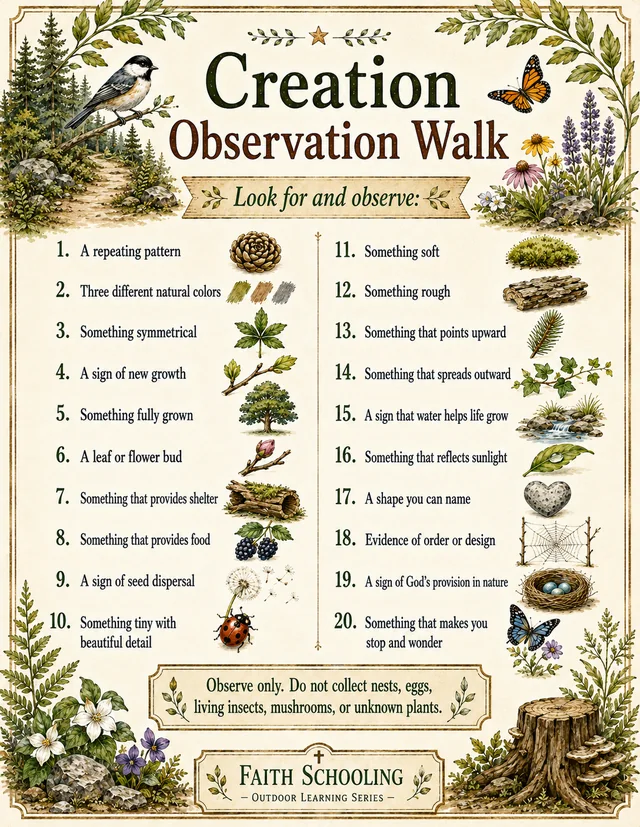
| 1 | 2 pages | Twenty things to observe on a walk through creation, from a repeating pattern to a sign of God’s provision, and twelve ways to respond. | Free PDF: Creation Observation Walk 1.3 MB | |
| 2 | 2 pages | Twenty things to find and collect, and twelve crafts to make with what you find, from pinecone animals to a nature mandala. | Free PDF: Nature Scavenger Hunt 1.4 MB | |
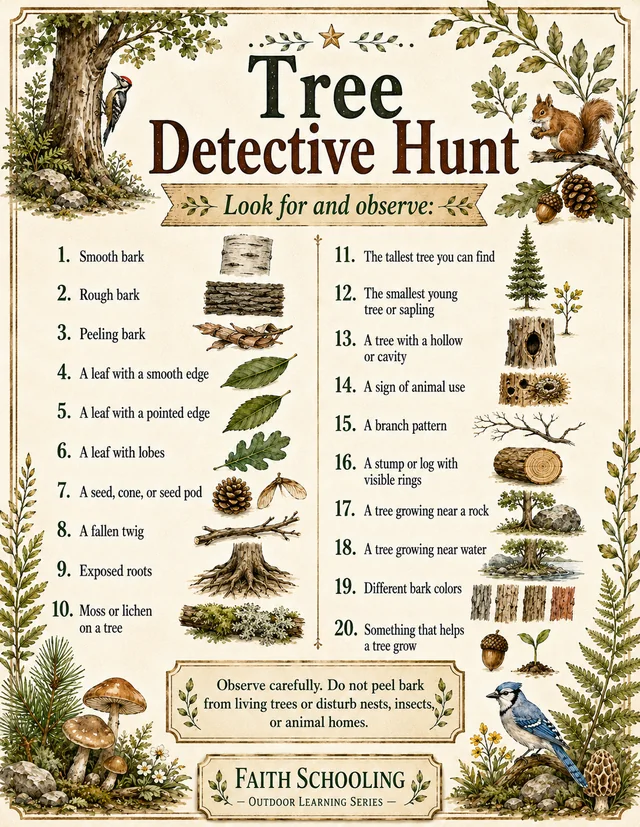
| 3 | 2 pages | Bark, leaves, seeds, roots and rings to find, then bark rubbings, leaf cards, ring counting and a tree care response. | Free PDF: Tree Detective Hunt 1.4 MB | |
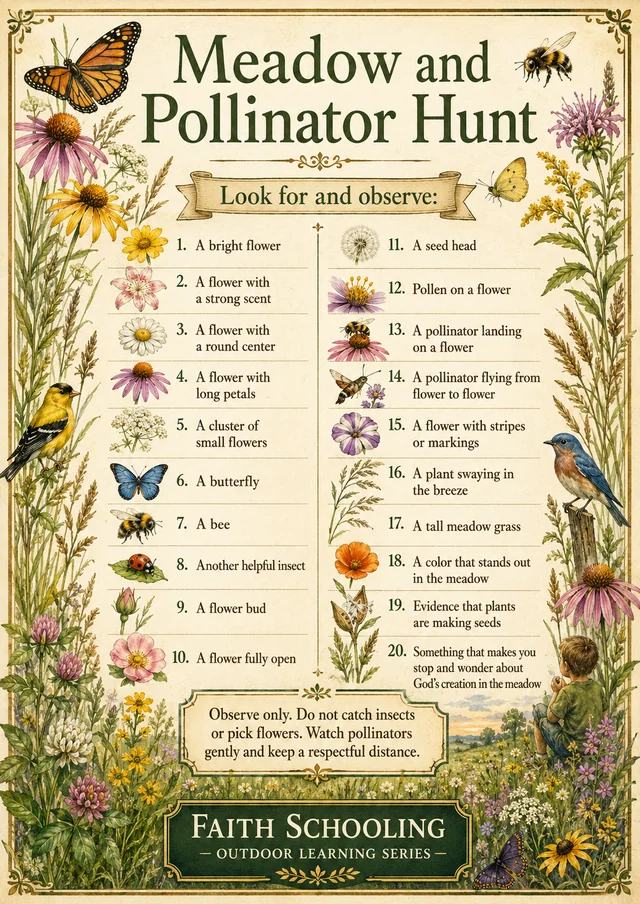
| 4 | 2 pages | Flowers, bees, butterflies and seed heads to watch, then a flower diagram, a pollination path and a paper pollinator craft. | Free PDF: Meadow and Pollinator Hunt 1.3 MB | |
| 5 | 2 pages | Stripes, spots, spirals and shades to look for, then pattern printing, a nature color wheel and symmetry art. | Free PDF: Nature Colors and Patterns Hunt 1.4 MB | |
| 6 | 2 pages | Sun, shade, clouds, wind and wetness to observe, then a weather journal, a rain gauge and a weather wheel. | Free PDF: Weather Watch 1.3 MB | |
| 7 | 2 pages | Rocks and soils to find and compare, then rock sorting, a soil layers jar and an erosion demonstration. | Free PDF: Rock and Soil Investigation 1.3 MB | |
| 8 | 2 pages | Twenty things to find on a farm walk, and twelve crafts including pinecone farm animals and a tiny farmhouse or barn. | Free PDF: Farm and Nature Scavenger Hunt 1.3 MB |
The whole collection in one file. All 8 kits as separate PDFs in a single ZIP, numbered in the order above.
Download the free collection (ZIP, 11 MB)What is in a kit
Every kit is two illustrated pages in a vintage field-guide style. Page one lists twenty things to look for, each with a small drawing: a repeating pattern, three shades of green, a tree with a hollow, a pollinator landing on a flower, evidence of recent rain. Page two gives twelve ways to respond once you are back inside: a journal entry, a careful sketch, a color sort, a symmetry check, bark rubbings, a soil layers jar, a weather wheel.
The six observation kits end the same way, with a Creation Reflection and a Thankfulness Response: write one sentence thanking God for what you observed. The two scavenger hunts are different on purpose. They ask children to find and collect, and their second page is Crafts to Do With What You Find, twelve crafts from a nature collage and pinecone animals to a nature mandala and a tiny shelter.
The eight kits
The Creation Observation Walk is the place to start. It asks for patterns and symmetry, signs of growth and of God’s provision, and something that makes you stop and wonder. The Tree Detective Hunt looks at bark, leaf edges, seeds and cones, roots and rings. The Meadow and Pollinator Hunt follows bees, butterflies and seed heads. Nature Colors and Patterns hunts for stripes, spots, spirals and shades.
Weather Watch compares sun and shade, clouds, wind and wet ground, with a rain gauge and a weather wheel on its companion page. The Rock and Soil Investigation sorts rocks and soils and includes an erosion demonstration. The Nature Scavenger Hunt and the Farm and Nature Scavenger Hunt ask children to collect, and pair each list with twelve crafts to make from the finds.
Nature study that looks up
Christian families have long treated nature study as more than science. Romans 1:20 and Psalm 19 both point to creation as a witness to its Maker, and these kits are built on that idea. They teach real observation: compare, classify, measure, label the parts of a flower, trace a shadow and come back to it later. Then they turn a child’s attention to the One who made what they have been studying.
Nothing in the kits needs special knowledge. A parent who cannot name a single tree can still lead the Tree Detective Hunt, because it asks children to notice smooth bark, a leaf with lobes or a stump with visible rings, not to identify species. The thankfulness prompt at the end of each observation kit is short on purpose. One honest sentence of thanks, in a child’s own words, is enough.
Safety on every page
Each hunt carries a short safety line, and it is worth reading aloud before you leave the house: observe only; do not collect nests, eggs, living insects, mushrooms or unknown plants; do not peel bark from living trees; watch pollinators gently from a respectful distance; watch the weather from a safe place; wash hands after handling soil.
The two collecting hunts ask for fallen and loose things, like a piece of bark already on the ground or a flower that has already dropped.
What to bring
A clipboard and a pencil for each child, a magnifying glass if you have one, and a small bag or basket for the two collecting hunts. A nature journal or a few sheets of plain paper will hold the sketches and sorting the companion pages ask for. Dress for the weather, and on the Rock and Soil Investigation bring a small trowel and a jar with a lid for the soil layers activity.
A year of nature study
Eight kits make a comfortable year at one a month through the school year: the Creation Observation Walk and the Tree Detective Hunt in the fall, the Nature Colors and Patterns Hunt and the Weather Watch through winter, the Rock and Soil Investigation on a thawing spring day, the Meadow and Pollinator Hunt when the flowers open, and the two scavenger hunts for the summer. On a day the weather keeps you inside, the Weather Watch still works from a window.
How to use the kits
Clip the hunt page to a clipboard, give each child a pencil, and let them tick items off as they find them. Back inside, choose three or four of the companion activities rather than all twelve. Repeat a kit in each season: a Tree Detective Hunt in October and again in April shows a child how much changes and what stays the same. A co-op can run the Weather Watch for a whole month, one entry a day.
The kits pair with the Outdoor Projects sheets for families who want to build something after the walk, and with God’s Wonderful Creation, a free seven-day unit study of Genesis 1 and 2. Each kit is a two-page letter-size PDF; printed back to back on cardstock, it survives a morning outdoors.