
Curriculum
Choosing a Christian grammar and writing curriculum for K–5
Most grammar curriculum teaches children to label sentences; far less of it teaches them to write better ones. This guide gives you the checks that separate the two on any publisher's samples — and answers its own checklist about Grammar Garden, the dedicated language and writing curriculum here.
Updated 4 October 2026 · Sources read 5 September 2026
The problem with most elementary grammar
A child can underline every noun on a worksheet in October and write run-on sentences in March, and most families have watched it happen. The gap is not the child's; it is structural. Grammar taught as identification — circle the verb, label the adjective — trains recognition, and recognition alone does not transfer into writing. The skill that changes a child's sentences is using grammar: building sentences with it, editing real passages against it, and returning to it until it shows up unprompted in the child's own composition.
So the useful question when shopping this category is not 'does it cover the parts of speech?' Everyone covers the parts of speech. The question is what the child does with them in week three, and whether the curriculum ever asks again in week twenty.
Five things to check in any grammar and writing curriculum
All five are checkable from samples, and a publisher whose samples cannot answer them has answered them.
| Check | What good looks like |
|---|---|
| Application, not just identification | Every skill ends in use — sentence building, editing, or composition in the same week it is taught, not a label-and-move-on page |
| Editing with real passages | The child repairs genuine flawed paragraphs — missing commas, tense hops, fragments — not single detached sentences |
| Cumulative return | Taught skills reappear weeks later in review, editing, and writing; a rule used once is a rule on loan |
| Developmental honesty | Kindergarten work is oral and shared, not parsing; formal grammar arrives gradually, and writing stamina is built, not assumed |
| Visible teaching support | The teacher material is inspectable before purchase — scripting, answers in context, and what to do when a child struggles |
Where Grammar Garden fits, honestly
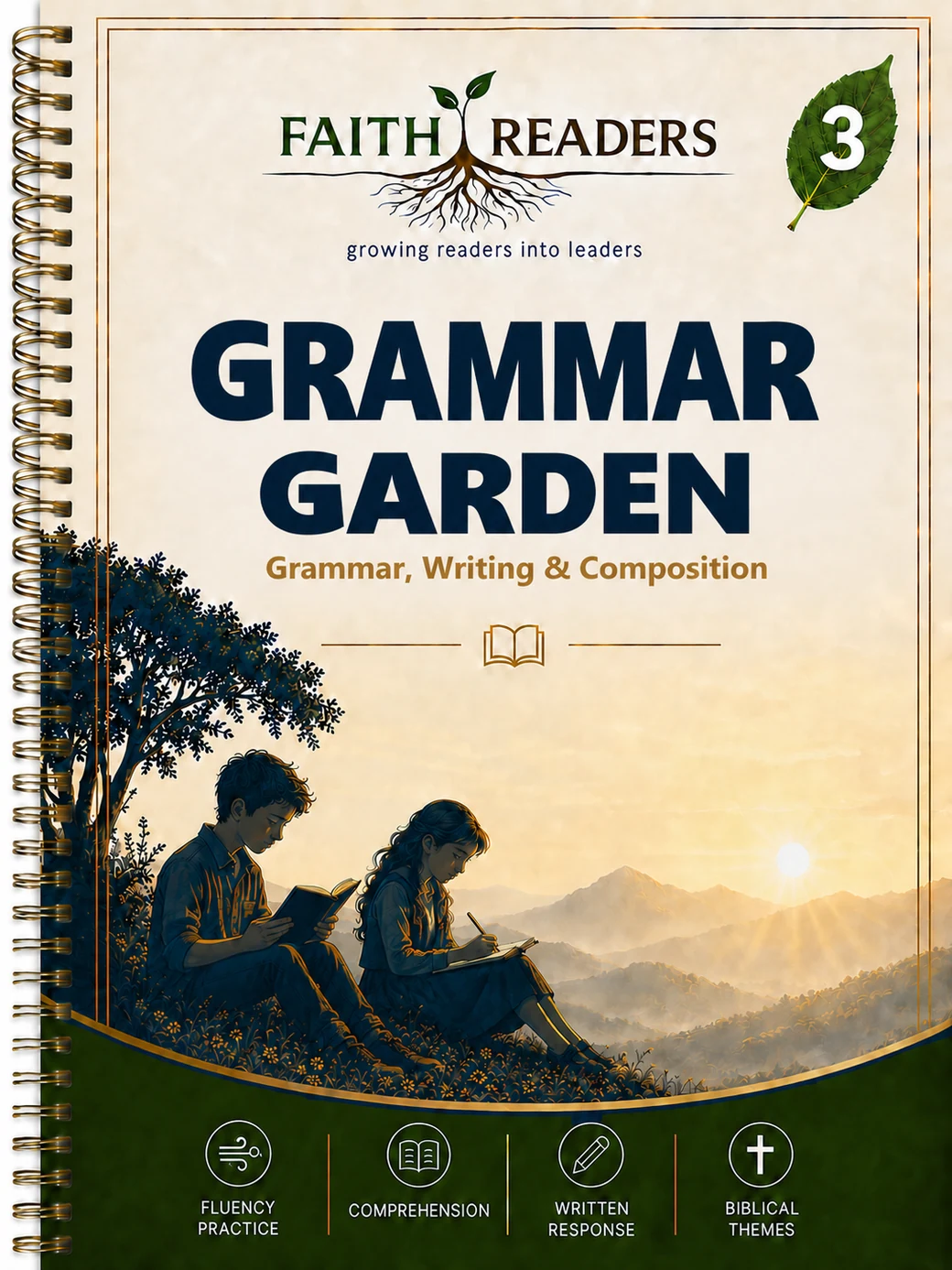
Grammar Garden is this site's dedicated K–5 language and writing curriculum — 42 books across six grade levels: four quarterly Student Coursebooks per grade, a yearlong Preceptor Guide, an Assessment & Resource Book, and a durable Student Reference Booklet. Its organizing idea is the first check above, held all year: grammar that grows into writing. Every week runs five days — Learn & Notice, Practice Together, Build Sentences, Edit & Revise, Write & Show — so the skill taught on Monday is built with, edited against, and written with by Friday, and deliberately returns in later weeks.
Against the rest of the checklist: the editing labs repair real teacher-written passages, never Scripture; Kindergarten is oral, shared, and tactile, with formal parsing beginning gradually in Grade 1; and every grade's complete Preceptor Guide reads online, page by page, before you pay anything. Each grade page also publishes its full 36-week scope and sequence, generated from the curriculum's own skill registry.
One naming note, stated plainly: the coursebook files' own cover pages carry the series' cover title — Strong Sentences: Grammar, Writing & Composition — under the Faith Readers imprint. Same books, one program: Grammar Garden.
Grammar Garden — every grade, previews, and the full scope Read a complete Preceptor Guide before paying anything
How it relates to the reading curriculum
Phonics, Decoding, and Early Fluency — the core reading curriculum here — already carries integrated language arts inside the reading week: grammar met in context, writing in response to reading. For many families, especially in K–1, that integration is enough on its own.
Grammar Garden takes the writing side further. Pair it with the reading sequence when you want a dedicated language block — grammar, sentence construction, mechanics, editing, revision, and composition taught as the subject itself rather than carried inside reading. The two stand independently and run naturally side by side; neither requires the other.
Phonics, Decoding, and Early Fluency — the core reading curriculum
Where Scripture sits in it
The same split the whole site holds. Notice-the-Word moments quote the New King James Version exactly and are never rewritten to make an exercise work; copywork never reproduces error-hunt text; and doctrine is not taught through grammar lessons — that lives, labeled, in the free Apostolic Academy. A grammar page teaches grammar.
When to look elsewhere
If you want sentence diagramming as the spine, a classical recitation-and-memory approach, or a program that continues into middle and high school, other publishers serve those convictions better — Grammar Garden stops at Grade 5 and teaches through application rather than diagramming. Our comparison pages describe the major Christian publishers honestly, with dates and sources, including where each one is the better choice.
And if you only want extra practice sheets beside a grammar program you already own, you do not need a curriculum at all — the Grammar & Writing practice library is organized by grade and skill for exactly that.
How we compare with other publishers Grammar & Writing practice worksheets
Common questions
- What is the best Christian grammar curriculum for elementary grades?
- The honest answer is that it depends on the checks that matter to your family: whether grammar ends in real writing, whether editing uses genuine passages, whether skills return after they are taught, whether the early grades are developmentally honest, and whether you can inspect the teacher material first. This page gives you those five checks to run on any publisher's samples — ours included.
- Does Grammar Garden teach writing or just grammar?
- Both, deliberately connected. Every week moves from Learn & Notice through Practice Together and Build Sentences into Edit & Revise and Write & Show, so grammar is taught into sentence construction, editing, revision, and composition rather than stopping at identification. The upper grades reach summary, paraphrase, register, and honest source use.
- Do I need Grammar Garden if I already use the reading curriculum?
- Not necessarily. The reading curriculum carries integrated language arts inside the reading week, and for many families that is enough. Grammar Garden is for families who want a dedicated language and writing block — deeper, explicit development of grammar, mechanics, editing, and composition. The two run side by side or stand alone.
- Is the Grammar Garden game the curriculum?
- No. The Grammar Garden Game at /play-grammar/ is the browser practice companion — short, calm practice between lessons. The curriculum is the 42-book print program at /grammar-garden/, and the game is never the lesson.
- What can I see before paying?
- Every grade's complete yearlong Preceptor Guide reads online page by page, eight interior coursebook pages per grade are zoomable, and each grade's full 36-week scope and sequence is published as plain text — generated from the curriculum's own skill registry, so it cannot drift from the books.
Sources
- Grammar Garden program page — components, scope, and access as published — checked 2026-09-05
- Graham, S., & Perin, D. (2007). Writing Next: Effective Strategies to Improve Writing of Adolescents in Middle and High Schools — on the weak transfer of isolated grammar instruction and the value of sentence-combining — checked 2026-09-05
- Faith Schooling curriculum map — checked 2026-09-05