
How we teach
Scripture-Integrated Christian Homeschool Curriculum
'Christian curriculum' can mean anything from a verse in the margin to a theology course wearing a math cover. This page states precisely how Scripture is integrated in Faith Schooling — built into the week's structure, quoted exactly, never a substitute for teaching the skill — and where doctrine deliberately lives instead.
Updated 4 October 2026 · Sources read 5 September 2026
The two failure modes of 'Christian curriculum'
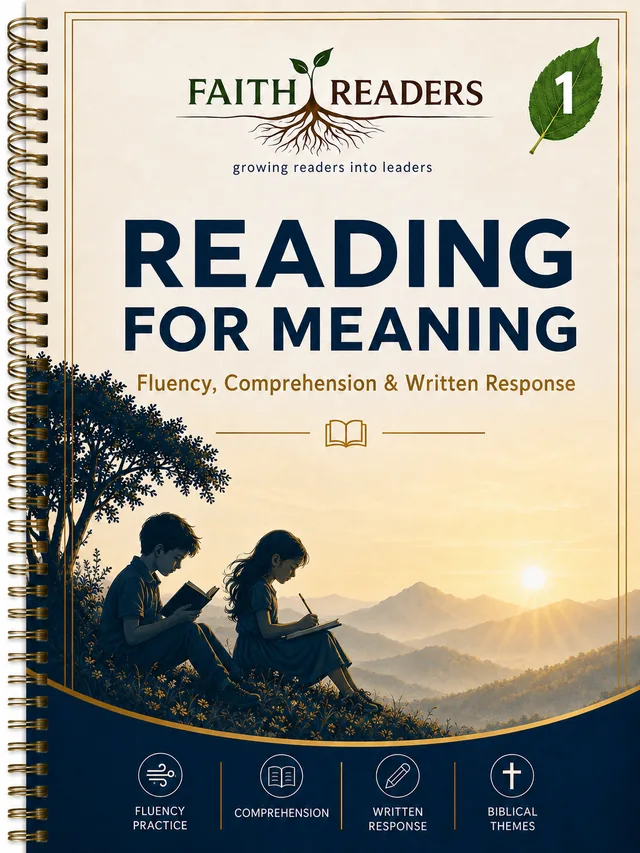
Families shopping this category have usually met both disappointments. The first is decoration: a secular workbook with a verse stamped in the corner, where the faith touches nothing and teaches nothing. The second is substitution: materials so busy being devotional that the academics underneath go soft, and the child ends the year loved but behind.
Our conviction, stated on the What We Believe page, is that a Christian education is one in which the fear of the LORD is the starting point of every subject — not a verse added beside it. What follows is how that conviction is actually built, so you can judge whether we live up to it.
How integration is structured in reading
Every week of the reading curriculum is built on four fixed elements: one phonics or word-study skill, one story from Scripture or history, one virtue, and one verse. They are not four boxes ticked separately — the week's decodable reader is that story written on the week's pattern, the virtue threads the discussion, and the verse anchors the copywork. Kindergarten's week on the letter Ss reads a Samuel story, practices obedience, and carries 1 Samuel 3:9; the structure holds for all 35 weeks of all six grades, and the published scope-and-sequence tables show every week's four elements in plain text.
Scripture is always quoted exactly — the academic books use the New King James Version, named plainly — never paraphrased into curriculum-speak. A verse a child copies is the verse, entire.
Every grade's scope and sequence, with each week's Scripture
Where the line is drawn — and why
Now the deliberate limit, because it is the part most publishers leave vague. Phonics is phonics and arithmetic is arithmetic: a page that teaches long vowels does not teach the Godhead, and we do not pretend otherwise. The academic lessons carry Scripture, virtue and prayer; they do not carry doctrine.
Doctrine is taught directly — and only — in the Apostolic Academy: the Upper Room study guides, The Way, the Scripture memory curriculum, the church history. That library states its Apostolic convictions openly and is entirely free, so what your children would be taught about baptism, the Godhead and holiness is readable in full before you ever open a math book. The split protects both sides: the academics stay rigorous, and the doctrine stays visible instead of seeping unlabelled through a phonics page.
The Apostolic Academy — where doctrine is taught, free The Upper Room study guides
The practices around the lessons
Integration extends past the textbook into the day's habits. The scripted reading lesson opens with a calm start and prayer. Scripture memory has its own complete curriculum — The Hidden Word, King James throughout because Bible quizzing is, with a published five-session rhythm and review ladder. The Copywork Creator and Bible Verse Card Maker put any verse list your family chooses onto printable pages, and the cursive program gives the hand that will copy those verses its training.
None of this requires the paid membership to inspect: the Academy is free end to end, and the scope tables showing each week's verse are public.
What Scripture integration does not mean
It does not mean every subject becomes a Bible lesson — that is the substitution failure, and it shortchanges both the subject and the Bible. It does not mean doctrine hides inside academics; ours is labeled and lives in its own free library. It does not mean paraphrase: verses appear exactly or not at all.
And it does not replace the family and the church. A curriculum can put the Word in front of a child every schoolday and train the habits of prayer and memory; the discipling of a child belongs to the home and the body of Christ, and we would distrust any publisher that claimed otherwise.
Bible integration across subjects — what it does and does not accomplish
Common questions
- How is Scripture actually integrated into lessons?
- Structurally. Every reading week is built on one skill, one story from Scripture or history, one virtue and one verse — the decodable reader is that story on the week's pattern, and the verse anchors the copywork. The published scope-and-sequence tables show all four elements for every week of every grade.
- Which Bible translation does the curriculum use?
- The academic books and the Upper Room study guides quote the New King James Version, exactly — never paraphrased. The Hidden Word Scripture memory curriculum and The Way use the King James Version, as do the math practice sheets. The split is published, because a family that cares about translation cares exactly.
- Does the math curriculum teach doctrine?
- No, and that is deliberate. Arithmetic pages teach arithmetic. Doctrine is taught directly and only in the free Apostolic Academy, where it is labeled, stated openly and readable in full before you buy anything.
- Is the doctrinal material included in the paid membership?
- No — it is free to everyone. The entire Apostolic Academy, including The Hidden Word, the study guides and the church history library, sits outside the paywall. The membership covers the academic curriculum and practice library.
Sources
- Faith Schooling — What We Believe (statement of faith and the role of Scripture in teaching) — checked 2026-09-05
- Faith Schooling reading scope and sequence — each week's skill, hero, virtue and verse — checked 2026-09-05
- The Hidden Word — translation and method as published — checked 2026-09-05