
Curriculum
Bible-based elementary curriculum, honestly described
"Bible-based" means one thing in reading and something different in arithmetic, so this page says which is which: in the reading curriculum Scripture is the content the child decodes and writes about; in the math it sits beside the work as a short verse, and the arithmetic stays arithmetic.
Updated 13 October 2026
What does "Bible-based" actually mean in an elementary curriculum?
Two different things travel under the same phrase. One is a general academic program with a verse printed in the margin and a Bible class beside it. The other is a program whose content — the stories a child reads, the sentences they copy, the character a year is organized around — comes out of Scripture itself.
The honest answer for most publishers, this one included, is that it depends on the subject. Reading can be built from Scripture all the way down, because reading needs content and Scripture is content. Arithmetic cannot be, without the verse becoming decoration.
So the useful question is not whether a publisher calls itself Bible-based, but which subjects are integrated, how, and whether the publisher will say so plainly. This page says where the integration is structural at Faith Schooling, and where a page of sums stays a page of sums with a verse beside it.
Where Scripture is the material: reading and language arts
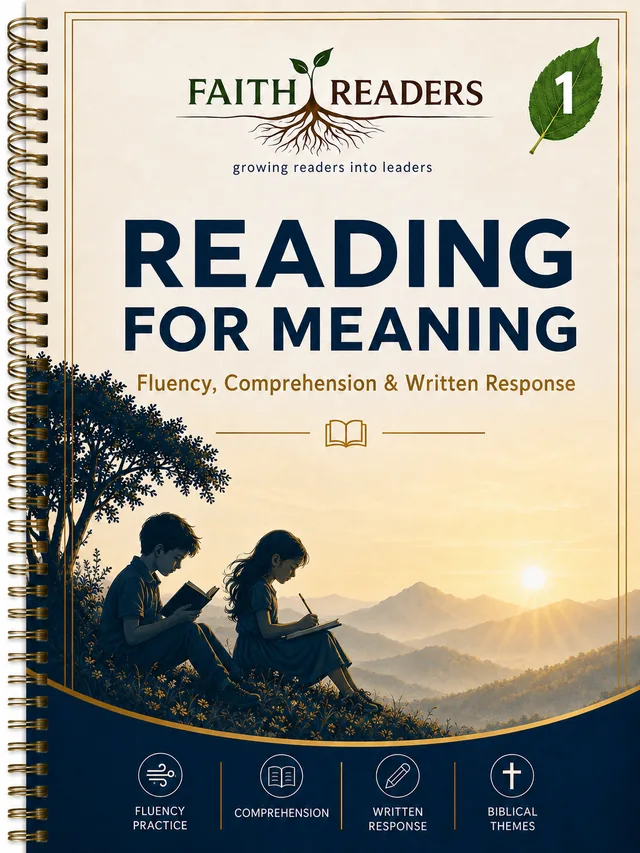
In the K–5 reading curriculum, Phonics, Decoding, and Early Fluency, the integration is structural. Every week of every grade pairs one phonics or word-study skill with one story from Scripture or history, one virtue, and one Scripture, and every week carries the same rhythm: drill sheet, decodable reader, scribe writing, daily exit tickets, and homework.
Grade 2, week 6 is a concrete example. The skill is soft c and soft g continued, with -dge and -ge endings. The hero is David becoming king, a humble heart before God; the virtue is humility; the Scripture is Psalm 139:23. The decodable reader that week uses only patterns already taught, and carries that story. Nothing is added beside the lesson, because the lesson has no other content.
You can check this rather than take it on trust: each reading grade page prints its full 35-week scope and sequence as text — hero, skill, virtue and verse for every week — and every grade's complete teaching guide can be read in the browser before you pay.
Where it is not: arithmetic is arithmetic
Building Number Sense is the sequenced K–5 math series. All six student texts teach computation, number relationships, patterns, measurement, geometry, and reasoning in the same order every time: explicit modeling, guided work, independent application, word problems, and review. Kindergarten through Grade 2 also include a coordinated practice workbook and a teaching guide; Grades 3 to 5 pair their texts with the Math Practice Library.
It is a Christian family's math book in the sense that a Christian family wrote it and stands behind it, and it is not a book in which Scripture carries the mathematics. Scripture sits beside the work instead: each lesson's independent-practice page closes with a short "God's Design" reflection and a New King James verse, and each unit opens with one. The practice worksheets work the same way. Most carry one short King James verse on a small card at the foot of the page, some story problems use Bible names and settings, and the seasonal pages end with a line of encouragement. No verse is turned into a math problem.
That is a decision rather than an omission: Christian education without forcing Scripture into places it does not belong. Biblical truth is explicit throughout Faith Schooling's reading, writing, Bible, and family discipleship resources. Mathematics remains academically focused while belonging to the same Christian K–5 program and educational philosophy. If you want Scripture to carry the arithmetic itself, choose another publisher.
What about handwriting, copywork and the Bible material itself?
Between those two sits the work where Scripture is the application rather than the subject. Learning Cursive is ten sequenced workbooks, 170 pages, about ten to fifteen minutes a day; the letters and joins are taught as handwriting, and the copywork that applies them is Scripture, prayers and notes. The Copywork Creator and Scripture Copywork Studio build the same kind of page from any passage.
The Bible material proper is kept separate, in the Apostolic Academy, and all of it is free: Scripture memory, church history, study guides, family printables and guidance articles for parents, readable online or downloadable, open to everyone with no paid tier inside it. Keeping it separate is the point. Doctrine is taught directly there, rather than implied through a reading lesson.
How does Faith Schooling fit a family, and what does it cost?
Faith Schooling is an independent publisher run by one family in Denmark, Wisconsin. The parent teaches every lesson from a script and keeps the household's own records. It suits a home that wants the faith integration visible and checkable rather than asserted.
What costs nothing, and needs no card: HARVEST placement, the complete teaching guide of every reading grade and of Kindergarten through Grade 2 math, real sample pages of every book, the first three worksheets in every practice set, starter paths in the games, the parent tools, and the whole Apostolic Academy.
All Access is $39 a month, cancel anytime: one household, every child, every grade K–5. It opens the full student books, the coordinated workbooks, the full practice library, and My Workbooks.
When should you look elsewhere?
If you want a boxed full-grade curriculum, this is not it. The programs cover reading and language arts, phonics, cursive, math, Bible and discipleship. There is no history, science or geography curriculum; a few nature and unit-study printables sit on the enrichment shelf, and they are not a science program. You build those subjects around this and keep your own records.
If you want video teachers or a program that grades itself, choose a publisher that sells one; here the parent teaches every lesson. If you would rather not print, the student work is print-at-home PDFs. If you need an enrolling accredited school, this is a curriculum publisher, not a school.
And if your family's doctrine differs from an Apostolic position, read the statement of faith and the free Upper Room lessons before anything else. They are specific on purpose, so that the difference turns up in week one rather than week nine.
Common questions
- Is Scripture inside the lessons, or printed beside them?
- Both, depending on the subject, and the difference is worth knowing before you buy. In the reading curriculum Scripture is inside the lesson: the week's Bible hero, virtue and verse are the content the child decodes, reads and writes about, and the decodable reader carries that story. In cursive it is the copywork the new handwriting is applied to. In the math texts and the practice worksheets it is printed beside the work: a short verse closes each textbook practice page and sits at the foot of most worksheets, and the arithmetic itself stays arithmetic. The site says so rather than implying more.
- Which Bible translation is used?
- Scripture on the site and in the academic programs is quoted from the New King James Version, exactly, with the reference and the publisher's credit. Two things use the King James Version: The Hidden Word, the Scripture memory curriculum in the Apostolic Academy, because its mastery standard requires the verse word-perfect, and the short verse at the foot of a math practice worksheet. Nothing is paraphrased.
- Can we use the Bible material without buying the curriculum?
- Yes. The Apostolic Academy is free and open to everyone, with no email requirement and no paid tier inside it — Scripture memory, church history, study guides, family printables, browser tools and the parent guidance articles. It sits apart from the paid academic membership and stays free.
- Does a Bible-based program mean weaker academics?
- It should not, and the way to check is to read the material rather than the description. Every reading grade page prints its full 35-week scope and sequence as text; every math grade page lists its exact published components and shows eight zoomable sample pages; the complete reading teaching guides and the Kindergarten to Grade 2 math guides can be read in the browser before joining. Judge those pages against your own standard, and do the same to every publisher you are weighing.
- Is this a complete curriculum for every subject?
- No. It covers reading and language arts, phonics, cursive handwriting, math, Bible and discipleship for Kindergarten through Grade 5. There is no history, science or geography program, so families choose those separately and keep their own homeschool records. Faith Schooling is an independent curriculum publisher for parent-led education, not an enrolling school.