
Compare
Faith Schooling vs Memoria Press for K–5 reading and math
Compare Memoria Press's classical Christian grade sets — Latin, recitation, literature, and a day-by-day Curriculum Manual — with Faith Schooling's one-household K–5 membership, explicit phonics, mastery pacing, and print-first learning.
Updated 4 October 2026 · Sources read 4 September 2026
Which one fits: the short answer
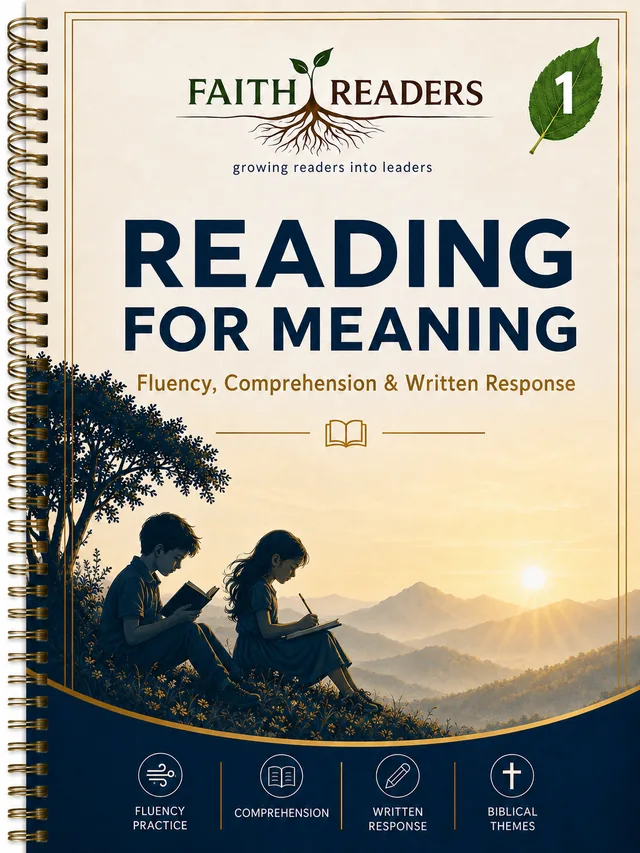
Memoria Press publishes a classical Christian curriculum: full-year sets from Preschool through Tenth Grade, grade menus running to Twelfth, Latin from second grade, and a Curriculum Manual that, in their words, “has every day already planned.” Faith Schooling is Kindergarten through Grade 5 only — complete reading and language arts, a dedicated grammar and writing curriculum, phonics by pattern, cursive, a complete K–5 math student-text sequence, and Bible through the free Apostolic Academy — parent-taught, paced by mastery, on one $39 a month household membership.
Both are careful, serious work, so the question is not which is better made. It is what you want the elementary years to be for: a classical education centered on Latin, memory, and the great books, or a concentrated foundation in reading and arithmetic you can read in full before you pay.
What each one is, and who does the teaching
Memoria Press describes the Classical Core Curriculum as “a complete classical Christian curriculum that emphasizes the traditional liberal arts of language and mathematics and the cultural heritage of the Christian West,” with “an early focus on the basic skills of reading, writing, and arithmetic and a special emphasis on Latin.” Their homeschool page says it “is constantly being refined in brick-and-mortar schools around the country” and is “currently being used in over 650 schools.” The parent teaches from the grade’s Curriculum Manual, sold separately at $30; optional streaming videos accompany several courses, including Kindergarten phonics and the Latin courses. Memoria Academy, a separate online school, teaches live classes for grades 3–12.
Faith Schooling has one teacher and it is you. There is no video option and no screen the child sits in front of to learn. The reading lesson is scripted end to end and totals 45 to 55 minutes — calm start and prayer, phoneme work, blending, decodable reading, a timed drill, application, and a spaced-review card box. Cursive is 10 to 15 minutes, and everything the child touches is paper you print at home.
Side by side
Every Memoria Press fact below was read on memoriapress.com on 4 September 2026. Sets, contents and prices change; build your own order on their site before deciding.
| Memoria Press | Faith Schooling | |
|---|---|---|
| Grades | Full-year sets Preschool through Grade 10, with grade menus to Grade 12 | Kindergarten through Grade 5 only |
| What it is | A classical Christian curriculum — “the traditional liberal arts of language and mathematics and the cultural heritage of the Christian West,” with Latin from second grade | A concentrated K–5 foundation: reading and language arts, a dedicated grammar and writing curriculum, phonics by pattern, cursive, a complete K–5 math student-text sequence, and Bible through the free Apostolic Academy |
| Who teaches | The parent, from a grade Curriculum Manual (sold separately at $30) that “has every day already planned”; optional streaming videos; Memoria Academy teaches live classes for grades 3–12 | The parent, always, from scripted lessons; no video option |
| Format | Printed full-year sets shipped to you; a Consumable Curriculum Set replaces only the write-in books for later children | Print-at-home PDFs; reprint for the next child at no extra charge while you are a member |
| Reading in Kindergarten | First Start Reading, “a complete phonics course,” taught over “25 weeks introducing a letter at a time” | A phonics spine running all six years: six student texts, 210 weekly lesson sets, 300 decodable readers and fluency passages, 96 pattern workbooks |
| Pacing | One planned year per set, day by day from the Curriculum Manual | Mastery: 90% or better across five or more sessions on different days |
| Where Scripture sits | Christian Studies is an academic course “equal in content and examinations to all other areas of the curriculum”; their Kindergarten page states “Doctrine will not be taught but is left up to the church, family, and particular school” | Scripture inside the academic work (quoted exactly, NKJV), with doctrine stated openly in the free Apostolic Academy |
| Cost shape | Per grade, per student: on 4 September 2026, Kindergarten $544.91 to Third Grade $821.28 (each discounted from a higher list); Third Grade consumables alone $315.53 | $39 a month, cancel anytime — one household, every K–5 child, no per-grade or per-child fee |
What each costs
Memoria Press sells full-year sets by the grade, for one student. These prices showed on their Classical Core Curriculum page on 4 September 2026, each discounted from a higher list price: Kindergarten $544.91 (list $716.22), First Grade $494.00 (list $672.01), Second Grade $618.73, Third Grade $821.28, Fourth Grade $434.80, and Fifth Grade $654.08 — about $3,568 for one child across those six years.
Two things keep that table honest. Fourth Grade looks inexpensive because it is a continuation year: their Fourth Grade page says the program lets “3rd-4th graders work at a moderated pace, taking two years” to finish several third-grade books. And a Consumable Curriculum Set replaces only the books students write in — $315.53 for Third Grade against $821.28 for the full set — so later children cost far less.
Faith Schooling All Access is $39 a month, cancel anytime — $468 across twelve months, for one household and every K–5 child, with no per-grade or per-child fee. What it does not include is paper and toner, because you print the pages yourself, and that is a real cost we are not pretending away. Prices move on both sides, so build your own order rather than trusting any comparison table, this one included.
Latin, recitation, and what a classical day adds
This is the substance of the difference. Latin starts in second grade with Prima Latina, continues with Latina Christiana in third and fourth, and reaches First Form Latin by fifth. The Kindergarten manual includes recitation and prayers; the first and second grade manuals list recitation and copybook and memory work beside reading, math, and cursive. From third grade the subjects widen to Latin, math, composition and grammar, spelling, cursive, literature, classical and Christian studies, geography and science, and read-alouds.
Faith Schooling does not have that. There is no Latin, no classical studies, and no science or history taught as school subjects — church history is present, but as free reading in the Apostolic Academy rather than a graded course. Faith Schooling teaches reading and language arts, handwriting, and arithmetic, and teaches Bible directly through the Academy; families choose their own science, history, and language study around it.
How reading is taught in each
Both teach phonics explicitly, worth saying plainly because “classical” is sometimes assumed to mean otherwise. The Kindergarten set page calls First Start Reading “a complete phonics course” covering pencil grip and correct letter formation, mastering one sound, then “short and long vowel sounds, 3-letter words, consonant blends, long vowel teams, soft c and g, three sounds of y, and 67 common words,” taught over “25 weeks introducing a letter at a time.” By second grade the reading strand shares the day with Latin and grammar.
Faith Schooling keeps the phonics spine running all six years: six full-year student texts with teaching guides you can read in full before joining, 210 weekly lesson sets, 300 original one-page readers, and 96 pattern workbooks in six levels. Progress is decided by evidence — daily exit tickets, weekly mastery checks with parallel forms, and a skill counted as mastered at 90% or better across five or more sessions on different days.
Where Memoria Press is the better choice
For a good many families it plainly is, and these are the cases worth naming.
You want one publisher for all the years. Memoria Press lists full-year sets through Tenth Grade and grade menus through Twelfth. Faith Schooling stops at Grade 5, so you will be choosing again for middle school. If re-deciding in four years is what you are trying to avoid, that settles it.
You want the classical education itself — Latin, recitation, the great books, and Western and church history as taught subjects rather than background. That is Memoria Press’s stated reason for existing, and no amount of phonics quality substitutes for it.
You want literature-rich elementary years. Their grade sets are built around real books with study guides — Little Bear, Make Way for Ducklings, Homer Price — plus scheduled read-alouds. Faith Schooling’s decodable readers serve decoding practice; they are not a literature course.
You have a child with special needs. Their Simply Classical line runs from My First Words through Levels 11 and 12, publishes downloadable Readiness Assessments with plain scoring rules for placement, and from Levels 5 and 6 upward sells each package in a one-year and a two-year pace. Faith Schooling has nothing equivalent.
You want a teacher other than yourself for upper elementary. Memoria Academy teaches live classes for grades 3–12. Faith Schooling will never offer that; the parent teaches, always.
You want a curriculum shaped by classroom use, or you simply want the box to arrive. Memoria Press says its materials are refined in brick-and-mortar schools and used in over 650 of them, and it ships bound books, a printed manual, and literature you can hand a child. Faith Schooling is print-at-home by design, and for some households that is the wrong trade.
Where Scripture sits in the day
Memoria Press’s Christian Studies page describes an academic course “equal in content and examinations to all other areas of the curriculum,” developing “Bible literacy, knowledge of church history, and a strong faith and Christian consciousness,” with Scripture in K–6, church history in grades 7–11, and apologetics in grade 12. Their Kindergarten page adds: “Doctrine will not be taught but is left up to the church, family, and particular school.” For families across many congregations who want Bible content graded like Latin or math while doctrine stays at home and church, that is a deliberate strength.
Faith Schooling makes the opposite choice and says so. Scripture sits inside the academic work — every reading week is built on one phonics skill, one story from Scripture or history, one virtue, and one verse, quoted exactly from the New King James Version. Direct Bible teaching lives in the Apostolic Academy, which states its Apostolic convictions openly, and every part of it is free.
How to decide this week
Start with the question neither website can answer for you: do you want a classical education, or depth in reading and arithmetic first. If the answer is classical, go price a Memoria Press grade set.
If it is the second, three steps, none of which costs anything. Read the K–5 curriculum map. Read a complete teaching guide and the real student pages. Then run HARVEST, free and about twenty minutes in the browser, and print the report — so you begin at a skill rather than at a birthday.
Common questions
- Does Faith Schooling teach Latin or classical studies?
- No. Faith Schooling teaches reading and language arts, phonics, cursive, and a complete K–5 mathematics student-text sequence, with Bible through the free Apostolic Academy. There is no Latin, no classical studies, and no science or history taught as school subjects. Families who want the classical sequence should look at a classical publisher such as Memoria Press; families who want Latin alongside Faith Schooling can buy it separately.
- How much does Memoria Press cost for one grade?
- It depends on the grade and the day. Observed on their Classical Core Curriculum page on 4 September 2026, each discounted from a higher list price: Kindergarten $544.91, First Grade $494.00, Second Grade $618.73, Third Grade $821.28, Fourth Grade $434.80, and Fifth Grade $654.08 — per student, per year. Fourth Grade is lower because it continues books bought in third. Consumable-only sets are sold for later children; the Third Grade consumable set was $315.53. Price your own order at memoriapress.com, since packages and prices change.
- Does Memoria Press use phonics?
- Yes. Their Kindergarten set page describes First Start Reading as "a complete phonics course" covering pencil grip and letter formation, one sound at a time, then short and long vowels, three-letter words, consonant blends, vowel teams, soft c and g, the three sounds of y, and 67 common words, taught over 25 weeks. Classical does not mean phonics is skipped. The difference from Faith Schooling is how long the phonics spine stays at the center of the day, and what shares the day with it from second grade on.
- Can I use both?
- Families do combine publishers, and nothing prevents it. A common pairing would be Memoria Press for Latin, literature, and classical studies with Faith Schooling for the reading spine and daily practice. Two full grade-level plans running at once is usually more than a day holds, so decide which program owns reading and which owns the rest before you buy either.
- Is either curriculum accredited?
- Neither set of books is. Accreditation is granted to schools that enroll students and keep records, not to curriculum publishers. Memoria Academy is a separate online school for grades 3–12 and states that it is accredited by the Classical Latin School Association; enrolling there is a different purchase from buying the books. Faith Schooling has no academy and no enrollment: families teach from the materials and keep their own records, as with any homeschool curriculum.
Sources
- Memoria Press — Classical Core Curriculum (mission wording; full-year sets Preschool–Grade 10 with prices observed that day) — checked 2026-09-04
- Memoria Press — Homeschool ("refined in brick-and-mortar schools"; "over 650 schools") — checked 2026-09-04
- Memoria Press — Kindergarten Curriculum Set (First Start Reading quotes, 25 weeks, streaming phonics videos, doctrine statement, price) — checked 2026-09-04
- Memoria Press — First Grade Curriculum Set ("every day already planned", manual subject list, $30 manual, price) — checked 2026-09-04
- Memoria Press — Second Grade Curriculum Set (Prima Latina, "approximately 20 minutes each", manual list, price) — checked 2026-09-04
- Memoria Press — Third Grade Curriculum Set (Latina Christiana, "approximately 15 minutes", two-year pacing, subject list, price) — checked 2026-09-04
- Memoria Press — Third Grade Consumable Curriculum Set (consumables-only price $315.53) — checked 2026-09-04
- Memoria Press — Fourth Grade Curriculum Set ("3rd-4th graders ... taking two years", subject list, price) — checked 2026-09-04
- Memoria Press — Fifth Grade Curriculum Set (First Form Latin, subject list, price) — checked 2026-09-04
- Memoria Press — Christian Studies (Bible literacy, K–6 Scripture, church history 7–11, apologetics 12) — checked 2026-09-04
- Memoria Press — Curriculum for Students with Special Needs (Simply Classical levels, readiness assessments, one- and two-year pace) — checked 2026-09-04
- Memoria Academy — online classical school, live audio/video classes grades 3–12 — checked 2026-09-04
- Memoria Academy — Accreditation (Classical Latin School Association) — checked 2026-09-04
- Faith Schooling — All Access pricing — checked 2026-09-04
- Faith Schooling — The K–5 curriculum map (program roles and counts) — checked 2026-09-04
- Faith Schooling — A day in the classroom (the 45–55 minute lesson) — checked 2026-09-04
- Faith Schooling — HARVEST reading placement (about 20 minutes) — checked 2026-09-04
- Faith Schooling — How we compare (all publishers) — checked 2026-09-04