
Compare
Faith Schooling vs Easy Peasy All-in-One for K–5
Compare Easy Peasy's daily web-link model with Faith Schooling's K–5 print-first household membership, explicit phonics, parent-led scripts, mastery pacing, and Apostolic foundation.
Updated 13 October 2026 · Sources read 31 August 2026
Which one fits: the short answer
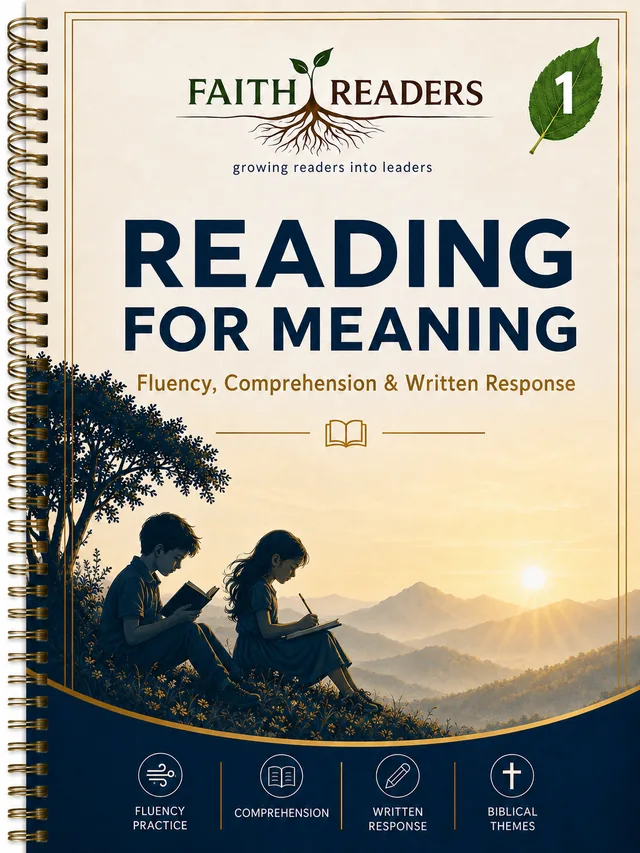
Easy Peasy All-in-One is a free Christian curriculum for PreK through Grade 8, delivered as daily web pages linking to readings, videos, and activities. Faith Schooling uses one paid K–5 household membership for complete reading and language arts, phonics, cursive, math, Bible, and discipleship, taught by a parent from printed pages.
Faith Schooling's strength is a coherent parent-led and print-first system: explicit phonics, mastery pacing, household pricing, and Apostolic conviction with the child's core work kept on paper.
What each one is, and who does the teaching
Easy Peasy was built by Lee Giles and is donation-supported. The child works down a daily checklist of links; the parent monitors rather than instructs. That independence is the design, and once a child can read it genuinely reduces the teaching load. Neither the site nor its reviewers post a standard daily time — the day is however long the list takes that day.
Faith Schooling uses an adult-led script: prayer and a calm start, explicit phoneme work, blending, a decodable text read and retold from memory, a timed drill with a personal-best record, application, spaced-repetition cards, and one open-ended question. That is 45 to 55 minutes of teaching, plus 10 to 15 minutes for cursive.
Side by side
Easy Peasy facts were observed on the curriculum's own site in August 2026. It is a volunteer-authored, donation-supported site rather than a catalog publisher, so pages are revised continuously and what you find today may differ from the row below.
| What to compare | Easy Peasy All-in-One | Faith Schooling |
|---|---|---|
| Grades | PreK through Grade 8, with a separate high-school site | Kindergarten through Grade 5 only |
| Subjects | All subjects, including science and history | Complete reading and language arts, phonics, cursive, a complete K–5 math student-text sequence, and Bible through the Apostolic Academy. |
| Who teaches | Parent-monitored; the child works through the day's links | The parent, from a scripted guide |
| Format and screen load | Free web pages linking to online readings, videos and activities; optional printed workbooks. Highest screen load in this comparison. | Print-at-home books; the browser holds placement, teaching guides, games and the workspace |
| Time per day | Not published; the day is the length of the daily list | A complete reading lesson is scripted at 45–55 minutes; cursive is 10–15 minutes |
| Pacing | A daily sequence you work through in order | Mastery-paced: 90% or better across five or more sessions on different days |
| Reading method | Letter names and sounds, then sight words, then phonics — described on its own About page as a tool for words you do not recognize | Phonics-led and explicit, one skill taught each week |
| Placement | Free placement guides | HARVEST — free, adaptive, about twenty minutes for reading, nothing uploaded |
| What you can see before paying | Everything. The entire curriculum is free. | Complete teaching guides, complete first workbooks, eight sample pages of every grade's book, three open sheets in every practice set |
| Accreditation | None — describes itself as a curriculum, not a school | None — a publisher, not a school |
| Price | Free | $39/month, cancel anytime — one household, every K–5 child |
The reading method is the real difference
Easy Peasy's own About page, quoted in Cathy Duffy's review, describes the sequence as letter names and sounds, then sight words, then phonics — with phonics presented as a tool for words the child does not already recognize. The program leans on Phonics Pathways and McGuffey. Cathy Duffy flags that sequence as unusual, and several reviewers report families adding a dedicated phonics program when reading stalls.
Faith Schooling runs the other way. Phonics comes first and explicitly, one skill per week, with 300 original one-page readers for connected reading practice. Foundations to Fluency adds ninety-six workbooks arranged by pattern rather than grade, for the child who is behind on one specific thing.
This is not a claim that one method produces better readers; we publish no efficacy claims and have no study to point at. It is a description of two different sequences, written so you can choose the one you actually want rather than the one you assumed you were getting.
Cost, and what a free curriculum still costs
Easy Peasy is free. Not a free sample or a free first level — the whole curriculum, every subject, every child, supported by donations. That is a rare thing in this category and it deserves to be said plainly rather than hedged into a footnote by a publisher that charges money.
Faith Schooling All Access is $39 a month, cancel anytime, covering every K–5 program and the complete practice library for every child in one household, and you print the pages yourself. Measured against free, that price has to earn itself on what is inside the lessons.
The one cost Easy Peasy does carry is device time and supervision. The day's work arrives as links, so a child needs a screen and an adult who checks that the links were actually opened and done. Optional printed workbooks exist if you would rather not run the whole day online.
Screens, and what a child touches all day
This is the widest gap in any comparison on this site. Easy Peasy's daily work lives on web pages that send the child to readings, videos and activities. If reducing screen time is one of the reasons you are homeschooling, that single fact matters more than any feature list either publisher can print.
Faith Schooling's browser layer is for the adult: HARVEST placement, the teaching guides, the practice library, My Workbooks and the optional games. The child's daily work — student text, workbook, drill sheet, exit ticket, decodable reader, cursive page — is printed paper. There are no video lessons anywhere in the program.
Why families choose Faith Schooling
Faith Schooling is for families who want a parent to teach from a clear script while the child's daily work stays on paper.
- One membership covers every K–5 grade and every child in the household.
- Complete reading and language arts is built on explicit phonics, weekly mastery checks, and 300 original decodable readers.
- HARVEST gives free adaptive placement and names the reading lesson where a child should begin.
- The complete K–5 Building Number Sense student-text sequence works with coordinated early-grade materials and extensive math practice.
- Parents can read full teaching guides and inspect real student pages before joining.
- The Apostolic Academy is free and brings Scripture memory, Bible study, church history, and discipleship into the same site.
Faith Schooling at a glance
Faith Schooling concentrates on Kindergarten through Grade 5 reading, language arts, phonics, cursive, math, Bible, and discipleship, with families choosing complementary subjects around that foundation.
The materials are delivered digitally for printing at home. Browser tools support the parent with placement, complete guides, planning, games, library search, and packet building while the child's core work remains on paper.
How to decide this week
Use the open Faith Schooling materials to evaluate the actual teaching before joining.
- Run HARVEST placement and print the report; it names a starting skill rather than a grade.
- Open a complete Faith Schooling reading guide and inspect the real student pages.
- Read a Faith Schooling reading teaching guide in full before paying anything, and teach two days from it.
- Review the curriculum map and build your chosen complementary subjects around the Faith Schooling foundation.
HARVEST reading placement Phonics, Decoding, and Early Fluency
Common questions
- Is Easy Peasy really free?
- Yes. The full curriculum for PreK through Grade 8 is published free on its own website and supported by donations, with a separate site for high school and optional printed workbooks for sale. It describes itself as a curriculum rather than a school, so there is no enrollment, no records service and no accreditation attached to it.
- Why do families add a phonics program to Easy Peasy?
- Its own About page, quoted in Cathy Duffy's review, describes teaching letter names and sounds, then sight words, then phonics as a tool for unfamiliar words. Cathy Duffy flags that sequence as unusual, and several reviewers report families adding a dedicated phonics program when reading stalls. Whether that matches your convictions about early reading is the decision to make.
- Which one has less screen time?
- Faith Schooling, clearly. Easy Peasy delivers the day as web links to readings, videos and activities, so the child works on a screen. Faith Schooling's child-facing work is printed paper — student text, workbook, drill sheet, exit ticket, decodable reader and cursive page — with no video lessons anywhere. The browser is used by the parent for placement, guides and the workspace.
- Can I use Easy Peasy for science and history and Faith Schooling for reading?
- Yes. Families can build their chosen complementary subjects around Faith Schooling's complete reading and language arts, phonics, cursive, and math foundation. Its membership is priced per household rather than per grade, so the cost does not scale with the number of K–5 children.
- What does Faith Schooling cost, and what is open to everyone?
- All Access is $39 a month, cancel anytime, for one household and every K–5 child. Open Access costs nothing: HARVEST placement, the complete reading and K–2 math teaching guides, the first workbook of every phonics level, samples in every practice set, starter paths in the learning games, and the entire Apostolic Academy.
Sources
- Easy Peasy All-in-One Homeschool — curriculum site — checked 2026-08-31
- Easy Peasy — official Facebook group directory — checked 2026-08-31
- Cathy Duffy Reviews — Easy Peasy All-in-One Homeschool — checked 2026-08-31
- Homeschool Start Guide — Easy Peasy All-in-One curriculum — checked 2026-08-31
- Faith Schooling — How we compare (all publishers, observed 26 August 2026) — checked 2026-08-31
- Faith Schooling — All Access pricing — checked 2026-08-31