
Compare
Faith Schooling vs Christian Light for K–5 reading and math
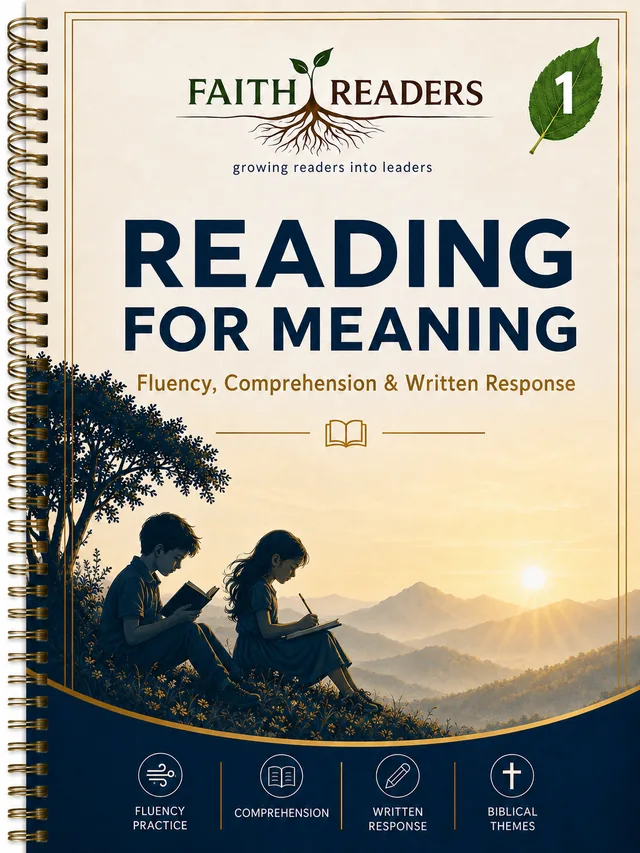
Christian Light sells consumable printed LightUnit worktexts by subject, K–12, with no screen component at all. Faith Schooling is a K–5 household membership, parent-taught, print-first, with browser tools for the adult.
Updated 13 October 2026 · Sources read 31 August 2026
Which one fits: the short answer
Christian Light is a Mennonite publisher selling printed, consumable LightUnit worktexts by subject for Kindergarten through Grade 12, taught by the parent from teacher's guides. Faith Schooling uses one K–5 household membership for complete reading and language arts, phonics, cursive, math, Bible, and discipleship, parent-taught from scripts and printed at home.
These two are more alike than any other pair on this site. Both are plain, serious, parent-taught and Scripture-carrying, and neither is trying to entertain a child into learning. What separates them is scope, how you pay, and where the browser sits in the day.
What each one is, and who does the teaching
Christian Light's Learning to Read is its Grade 1 phonics program, followed by Reading and Language Arts. Reviewers including Cathy Duffy describe the phonics as thorough — sounds before letter names at the start, spelling used to reinforce phonics, incremental lessons and heavy review, roughly thirty per cent new material to seventy per cent review in the later grades. Cathy Duffy also notes that Grade 1 takes significant teaching time.
Faith Schooling's reading lesson is scripted for the adult at 45 to 55 minutes: prayer and a calm start, explicit phoneme work, blending, a decodable text read then retold, a timed drill with personal-best tracking, application, spaced-repetition cards and one open question. Cursive is 10 to 15 minutes. Both publishers expect a parent at the table for the whole lesson.
Side by side
Christian Light facts were observed on the publisher's own site in August 2026. Because it is priced by subject rather than by grade, a single row cannot show what a full year costs; build the subjects you actually intend to teach before comparing totals.
| What to compare | Christian Light | Faith Schooling |
|---|---|---|
| Grades | Kindergarten through Grade 12 | Kindergarten through Grade 5 only |
| Subjects | All core subjects, each purchased separately by subject | Complete reading and language arts, phonics, cursive, a complete K–5 math student-text sequence, and Bible through the Apostolic Academy. |
| Who teaches | The parent, with the teacher's guides | The parent, from a scripted guide |
| Format and screen load | Printed consumable LightUnit worktexts and hardcover readers. No screen component at all. | Print-at-home books; the browser holds placement, teaching guides, games and the workspace |
| Time per day | Short lessons, though Cathy Duffy notes Grade 1 takes significant teaching time | A complete reading lesson is scripted at 45–55 minutes; cursive is 10–15 minutes |
| Pacing | Incremental LightUnits with heavy cumulative review | Mastery-paced: 90% or better across five or more sessions on different days |
| Placement | Free diagnostic tests for language arts and math | HARVEST — free, adaptive, about twenty minutes for reading, nothing uploaded |
| Scope and sequence | Printed scope-and-sequence booklet | Week-by-week scope and sequence printed on every reading grade page |
| What you can see before paying | A free LightUnit mailed on request | Complete teaching guides, complete first workbooks, eight sample pages of every grade's book, three open sheets in every practice set |
| Accreditation | Christian Light Academy is the school; the books are not accredited | None — a publisher, not a school |
| Price | Grade 1 math LightUnit set $55.50 plus teacher's guide $31.90 | $39/month, cancel anytime — one household, every K–5 child |
What each costs
Christian Light's pricing is granular because you buy by subject. Observed on 26 August 2026: a Grade 1 math LightUnit set at $55.50 with the teacher's guide at $31.90. Build a whole grade across subjects and the total rises, but you buy only what you use, and the books arrive printed.
The recurring cost is that LightUnits are consumable: the next child needs a new set. Faith Schooling All Access is $39 a month, cancel anytime, for one household and every K–5 child — but you print every page, so paper and toner replace the consumable invoice rather than removing it. Run both numbers for the children you actually have.
What you can check before you pay
Christian Light will mail a free LightUnit on request and also provides a printed scope-and-sequence booklet and diagnostic tests. Faith Schooling makes its own teaching especially transparent online: complete reading and phonics teaching guides, substantial real student pages, and HARVEST placement are open before a family joins.
Faith Schooling's version of the same idea is digital and immediate. Every reading and phonics teaching guide is readable page by page in the browser before joining, along with the complete first workbook of each phonics level, eight sample pages of every grade's book, three open sheets in every practice set, and a week-by-week scope and sequence on each reading grade page.
Faith, and the culture around it
Christian Light's tone is wholesome, rural and God-honoring, described that way by retailers and reviewers alike, and its Mennonite framing runs through the stories and illustrations. For many families that is exactly the atmosphere they want; for others it is a cultural fit question worth settling before ordering. Bible is a separate subject you buy.
Faith Schooling carries Scripture inside the academic work — one phonics skill, one story from Scripture or history, one virtue and one verse each reading week, quoting the New King James Version exactly. It is Christian and Apostolic in conviction and says so rather than staying vague. Direct Bible teaching lives in the free Apostolic Academy, including The Hidden Word, a four-Collection King James Scripture memory curriculum of 223 selections.
Pacing and screens
Christian Light moves through LightUnits with steady incremental review — Cathy Duffy's roughly thirty per cent new to seventy per cent review figure describes the later grades — and its teacher's guides include classroom-flavored oral drills that some one-child families skip. Faith Schooling gates progress on evidence instead: exit tickets, weekly mastery checks with parallel forms, drill tracking and a skill ledger, with mastery set at 90% or better across five or more sessions on different days.
Faith Schooling keeps student work on paper and uses the browser purposefully for the parent: placement, complete teaching guides, games, and My Workbooks. Files are ready to print before the child begins.
Why families choose Faith Schooling
Faith Schooling combines parent-led scripts, print-first student work, mastery pacing, household pricing, and openly Apostolic teaching in one K–5 system.
- One membership covers every K–5 grade and every child in the household.
- Complete reading and language arts includes structured phonics, cursive, weekly lessons, and 300 original decodable readers.
- HARVEST gives free adaptive reading placement and a printable starting-point report.
- Building Number Sense includes all six K–5 student texts, coordinated K–2 workbooks and guides, and extensive math practice.
- Complete teaching guides and substantial real-page samples are available before joining.
- The free Apostolic Academy supports Scripture memory, Bible study, church history, and discipleship at home, in class, and in church.
Faith Schooling at a glance
Faith Schooling focuses on Kindergarten through Grade 5 reading, language arts, phonics, cursive, math, Bible, and discipleship. Families build chosen complementary subjects around that coherent foundation.
Materials are delivered digitally for home printing, with browser tools for the parent and paper-based work for the child. Mastery evidence guides the pace, and each family keeps its own homeschool records.
How to decide this week
These two are close enough that a real trial settles the question faster than any comparison table, including the one above.
- Run HARVEST and print the report so the reading starting point is based on demonstrated skill.
- Read a complete Faith Schooling guide and teach from the actual student pages.
- Read a Faith Schooling reading teaching guide in full in the browser and teach two days from it.
- Count children and subjects. Consumable LightUnits per child and one household membership scale in opposite directions, and only one of the two covers science and history.
Common questions
- Which one is cheaper, Christian Light or Faith Schooling?
- For one child in one subject, Christian Light: a Grade 1 math LightUnit set was $55.50 with a $31.90 teacher's guide in August 2026, against $39 a month here. The gap narrows as you add subjects and children, because LightUnits are consumable and bought again for each child, while Faith Schooling is one price, cancel anytime, for the whole household.
- Does Christian Light have a placement test?
- Yes. It publishes free diagnostic tests for language arts and math, and it will mail a free LightUnit on request so you can see the actual materials before buying. Faith Schooling's HARVEST is a free adaptive reading placement that runs in the browser in about twenty minutes, uploads nothing, and prints a report naming the grade and quarter your child should start in.
- Which has less screen time?
- Christian Light: it has no screen component at all. Faith Schooling's child-facing work is on paper too, but the parent uses the browser for private placement, complete teaching guides, library search and My Workbooks, then prints the student materials needed for the lesson, and the optional learning games are on a screen.
- How does the Bible content differ?
- Christian Light sells Bible as a separate subject, and its Mennonite convictions shape the tone and stories throughout the other courses. Faith Schooling carries Scripture inside the academic lesson — one story from Scripture or history, one virtue and one verse each reading week, quoted exactly from the New King James Version — with direct Bible teaching in the free Apostolic Academy, including The Hidden Word Scripture memory curriculum.
- Can I use Christian Light for math and Faith Schooling for reading?
- Yes. Faith Schooling is priced once per household rather than per grade, so one membership covers its complete K–5 reading and language arts, phonics, cursive, math, Bible, and discipleship foundation for every child. Families remain free to add chosen complementary subjects.
Sources
- Christian Light — publisher site — checked 2026-08-31
- Christian Light — Language Arts overview — checked 2026-08-31
- Cathy Duffy Reviews — Christian Light Reading and Language Arts, Grades 1 and 2 — checked 2026-08-31
- Rainbow Resource — Christian Light Learning to Read, Grade 1 — checked 2026-08-31
- Homeschool Start Guide — Christian Light Education overview — checked 2026-08-31
- Faith Schooling — How we compare (all publishers, observed 26 August 2026) — checked 2026-08-31
- Faith Schooling — All Access pricing — checked 2026-08-31