
Curriculum
K–5 Christian curriculum for co-ops, microschools and schools
A curriculum that works for one child at a kitchen table does not automatically work for twelve children in a rented room. These are the differences that decide it, licensing included.
Updated 13 October 2026 · Sources read 31 August 2026
What changes when a curriculum has to serve a group
Group settings break curriculum in predictable ways. A program written for one parent and one child assumes the adult can adapt on the spot; a co-op tutor with mixed levels and ninety minutes cannot. Before choosing anything for a microschool, hybrid school, co-op or Christian school classroom, four practical questions decide most of it.
Can the lesson be handed to a different adult each week and still be taught the same way? Does the material arrive in units small enough to distribute — a week at a time, rather than a bound year? Can two children at different levels work on the same skill without the teacher writing new material? And can a retest use different questions, so a child repeating an assessment is not simply memorizing the first version?
Licensing is the fifth question, and the one most often discovered too late. A household license does not cover a classroom, however small the classroom is.
Licensing and printing, stated honestly
Faith Schooling's self-serve membership is one household. All Access at $39 a month, cancel anytime, covers the parents or guardians and children in a single household, every grade K–5, with no per-child limits. The membership page states directly that it does not cover co-ops, classrooms, churches, tutoring businesses, file sharing or redistribution.
The Terms grant a limited, non-transferable license to print and use the materials with the children in your own household, and to make as many printed copies as you need for that use. They prohibit sharing, selling or redistributing the digital files outside your household, and uploading them to any file-sharing service.
Co-op and school licensing is available by request, and there is no published price for it. That is deliberate rather than evasive: the right arrangement depends on the size and setting of the group and how the material is distributed. Describe your group through the contact page and access is set up to fit it. Do not assume a household membership covers a group, and do not build a budget on a rate quoted somewhere else.
Contact about co-op and school licensing Membership terms Terms of Service
What is free for any group, with no license at all
A useful amount of material is open to everyone, groups included, and can be used to test the fit before any licensing conversation.
- HARVEST reading placement — about 20 minutes per child for the core reading scope, adaptive, running in the browser with nothing uploaded, and it prints a report per child.
- The complete teaching guide for every reading grade, and the Kindergarten through Grade 2 math teaching guides, readable in full in the browser.
- The complete first workbook and full teaching guide of all six Foundations to Fluency levels.
- The first three sheets in every practice set across the worksheet library, plus eight hand-picked sample pages from every textbook grade.
- The entire Apostolic Academy — The Hidden Word Scripture memory and quizzing curriculum, the Upper Room study guides, The Way, the By Many Witnesses history, six printable collections and the Tabernacle Prayer Guide — free for home, classroom and church use.
- The open paths in the learning games, and the parent and teacher tools.
HARVEST placement Apostolic Academy Parent and teacher tools
What actually scales in these programs
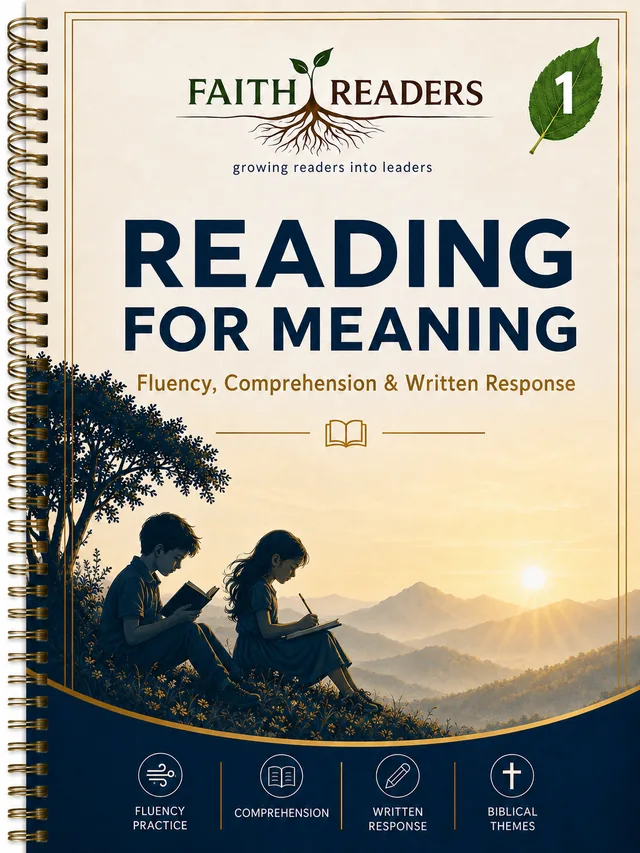
The weekly lesson format is the piece built for distribution. Faith Readers Weekly Lessons carry the same K–5 reading sequence as the textbook, packaged as 210 weekly sets — 1,050 daily lessons, 210 preceptor guides, 5,250 student pages in all — with each week holding five short daily lessons in a fixed rhythm of Introduce, Reader, Handwriting, Apply and Check, and about 25 student pages. A co-op or classroom can hand out a week at a time.
The teaching is scripted for whichever adult is in the room. Every week has a preceptor guide telling the adult what to say and do, and complete teaching guides can be read in full before a term starts, which matters when volunteers rotate.
Assessment suits a group setting. Weekly mastery checks use parallel forms so a retest is not the same questions, daily exit tickets show who needs more work before the next lesson, drill sheets track personal bests rather than ranking children against each other, and a skill ledger keeps the record in one place. A skill counts as mastered at 90% or better across five or more sessions on different days.
For small groups, Faith Schooling describes a station rotation for four to six children, with prediction cards that let children reveal answers simultaneously so no child's answer influences another, and differentiated content at each station so mixed-level groups can work together.
Faith Readers Weekly Lessons Walk through a complete lesson About the instructional approach
Differentiating a mixed-level room
Mixed levels are the normal condition in a microschool, and the practical answer is a large practice library organized by skill, plus a phonics ladder that is not labeled by grade.
The Practice Library holds thousands of printable practice pages organized by subject, grade and skill across five subjects: math, phonics and spelling patterns, vocabulary and word study, reading comprehension and fluency, and grammar and writing. A teacher can pull an easier or harder sheet on the same skill for two children in the same room, and members can gather chosen pages into one printable workbook with a cover, bookmarks and page numbers.
Foundations to Fluency runs the same way for phonics: 96 short workbooks in six levels arranged by pattern rather than grade, so an older student closing a gap is not handed material that looks aimed at younger children. Decodable Readers give every level connected text built only from patterns already taught — 300 readers, 50 per grade.
The Practice Library Foundations to Fluency Decodable Readers
How schools and microschools use Faith Schooling
Faith Schooling gives schools and microschools a focused Kindergarten through Grade 5 foundation in reading, language arts, phonics, cursive, math, Bible, and discipleship, with freedom to select complementary subjects around it.
As an independent curriculum publisher, Faith Schooling supplies the teaching materials while each school keeps its own enrollment, accreditation arrangements, transcripts, grades, attendance, reporting, and records.
My Workbooks supports staff with library search, saved workbooks, and merged printable PDFs. Schools keep their existing roster, assignment, gradebook, and parent-communication systems.
The program is print-first by design: student work happens on paper, while the browser carries placement, teaching guides, games, and the workspace. Group budgets can account for printing while benefiting from one coherent K–5 resource system.
How we compare with other publishers Frequently asked questions
A sensible way to evaluate it for a group
Take a term to test it rather than committing on a description. Every step below can be done at no cost.
- Read the complete teaching guide for one grade you would actually teach, page by page, in the browser.
- Run HARVEST with three or four children across your range and see whether the reports match what you already know about them.
- Print the open sheets from a few practice sets and one free Foundations workbook, and teach a week from them.
- Print the free Homeschool Curriculum Comparison Worksheet and fill one out per subject, on Faith Schooling and on every other publisher you are weighing.
- Then contact Faith Schooling with your group size and setting to arrange co-op or school licensing before you distribute anything.
Common questions
- Can our co-op share one All Access membership?
- No. All Access is a single household membership, and the membership page states that it does not cover co-ops, classrooms, churches, tutoring businesses, file sharing or redistribution. The Terms limit printing and use to the children in your own household and prohibit sharing files outside it. Co-op and school licensing is available by request through the contact page.
- What does co-op or school licensing cost?
- There is no published price, and inventing one here would not help you budget. Licensing depends on the size of the group, the setting and how materials are distributed, so it is arranged case by case. Describe your group through the contact page — how many children, what grades, home co-op or classroom — and access is set up to fit. Everything listed above as free can be used meanwhile.
- Can we print class sets of the workbooks?
- Printing rights follow the license you hold. A household membership permits as many printed copies as you need for the children in your own household, but not distribution beyond it. For a co-op or school serving multiple families, that is what group licensing exists to cover, so arrange it before printing and distributing sets rather than afterwards.
- Does Faith Schooling work for a mixed-age classroom?
- That is the setting it handles best on the phonics side, because Foundations to Fluency levels are labeled by pattern rather than grade, so a nine-year-old and a six-year-old can work at their real level without one of them holding a book that looks wrong for their age. The practice library adds easier and harder sheets on the same skill, and small-group work uses a station rotation for four to six children.
- Is Faith Schooling accredited, and can it issue transcripts?
- Faith Schooling is an independent K–5 curriculum publisher for parent-led homes, schools, and microschools. Each setting keeps its own enrollment, grades, transcripts, evaluator reports, and accreditation arrangements while using the curriculum and teaching tools.
- Do you provide a gradebook or student portal?
- No. My Workbooks searches the library, saves workbooks and merges chosen pages into one printable PDF with a cover, bookmarks and page numbers — a printing and planning tool, not a class roster or parent portal. Progress records live on paper inside the programs: exit tickets, weekly mastery checks with parallel forms, drill sheets and a skill ledger.
Sources
- Membership page, household terms and co-op licensing — checked 2026-08-31
- Terms of Service, intellectual property and licensing — checked 2026-08-31
- Faith Readers Weekly Lessons counts — checked 2026-08-31
- About page, small-group instruction — checked 2026-08-31
- Comparison page — checked 2026-08-31