
Curriculum
Christian homeschool curriculum without cartoons
Material that teaches rather than entertains can be identified on the page itself: no mascot narrating the lesson, no reward animation, and Scripture carried as the content being read rather than printed around the edge of it.
Updated 4 October 2026
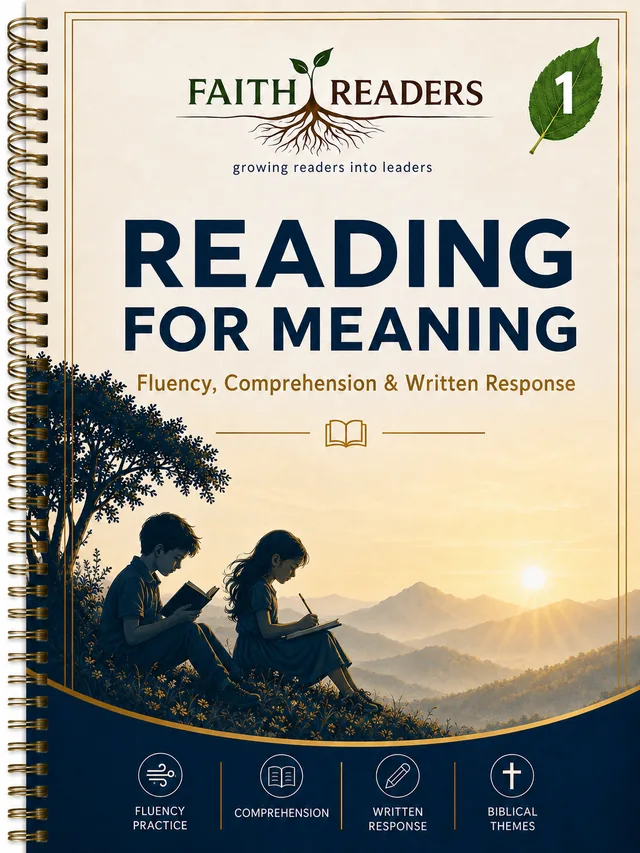
What does “without cartoons” actually mean?
Parents searching this phrase are rarely objecting to drawings. They are objecting to material that has to be made fun before a child will do it — a mascot who reacts to right answers, a lesson whose real subject is the entertainment wrapped around it.
The useful distinction is not whether a page has pictures. A picture that is the thing being worked on is instruction: five ducklings a child counts, a dotted letter he traces, the arrows showing stroke order in a numeral. A picture that comments on the work, rewards it, or exists so the page will not look plain is decoration.
The test takes seconds on a real page. Cover every image with your hand. If the lesson is still there — words to read, a sentence to write, a question to answer — the pictures were doing a job. If the page collapses, the pictures were the page.
What do the pages actually look like?
A Kindergarten reading page runs under the head “Ss is for Samuel” and is titled “Speak, Lord”. Under it sits a four-line story built from sounds already taught — Eli helps Sam see. Sam sits up on his mat. Sam says, ‘Speak, Lord.’ Sam will obey — then three words to trace on ruled lines, two comprehension questions and a sentence to finish. There is no illustration on the lesson.
A Grade 1 cumulative-review page titled “Words You Already Know” holds twelve words in boxes to read and sound out, a lined space for a sentence using one of them, one question about the week’s story — what did Jacob do that showed wisdom — and a tick-list at the foot: contrast, s-blends, l-blends, r-blends. Friday in the weekly packets is a cold read: five highlighted words and three short sentences, read aloud to the teaching adult.
A Foundations to Fluency page for bl- gives a blend ladder, ten speed words, four sentences to read aloud with three circles to shade as each read gets smoother, and dated lines for first read and smooth read. Green and gold labels, cream boxes, no pictures.
Is the Scripture the lesson, or a border around it?
Every week in the K–5 reading sequence is built on one hero, one virtue, one Scripture and one skill, and in the early grades those are the lesson’s material rather than its trim. Kindergarten Week 6 is Noah, trust, Genesis 6:22 and the letter Nn, and the decodable story that week is about Noah, written using only the sounds taught so far. Remove the narrative and there is no text left to decode, because the narrative was the reading practice.
Two honest qualifications. The hero is not always a Bible figure — Grade 5 Week 6 is Augustine and his City of God, humility, Ephesians 4:2 and the Latin root civ, with civil, civilization, citizenship, civic and civilian as the words. And the tie loosens as the grades climb: a Latin-root week is word study with a biography attached, not a Bible lesson.
Not every page is structural, either. On a decodable reader the story carries the virtue and a verse sits small at the foot; there, the verse is a label. Scripture quoted across the site is the New King James Version. The Hidden Word, the free Bible memory curriculum in the Apostolic Academy, uses the King James Version throughout, because its mastery standard is a word-perfect KJV verse.
How Faith Schooling fits
Faith Schooling is a family-run K–5 publisher in Denmark, Wisconsin. Everything is a print-at-home PDF: you print the pages, the child works them with a pencil, and no software decides what comes next. A skill counts as mastered at 90% or better across five or more sessions on different days.
Reading is the fullest part: six grade textbooks running 8,952 student pages with 3,530 pages of teaching guide, the same sequence in 210 weekly lesson sets, 300 decodable readers and fluency passages, and 96 short phonics workbooks arranged by pattern rather than grade. Building Number Sense is a complete K–5 student-text sequence; Kindergarten through Grade 2 also have a coordinated practice workbook and a teaching guide, while Grades 3–5 have the student text supported by the math practice library instead. The whole Apostolic Academy is free to everyone.
You can judge the pages before paying anything. Every reading teaching guide is readable in the browser without an account, each grade shows eight zoomable sample pages of the student book, every Foundations level opens its complete first workbook, and the first three worksheets in each practice set are free. All Access is $39 a month for one household, cancel anytime.
Look elsewhere if
You want full-color illustrated pages a young child will pick up on his own. These are deliberately quiet, and some children find that dull at first. A publisher whose materials are illustration-led will suit you better.
You want a boxed curriculum that arrives printed and bound. Nothing here is shipped; you print it, and the printing cost is yours to weigh.
You want adaptive software, or a program that keeps a child occupied while you work. This is parent-led, and Kindergarten and Grade 1 are recorded as high adult involvement on every lesson.
You want every school subject in one place. Published here are reading and language arts, handwriting and cursive, mathematics, and Bible; science and a graded history course are not. Faith Schooling is also Apostolic in conviction and says so plainly rather than leaving you to find out in month four.
Common questions
- Are there any pictures at all in the curriculum?
- Yes, but they do work rather than decorate. Kindergarten math shows countable objects because counting them is the exercise, and its number panels show stroke order with numbered arrows. The reading textbooks and the Foundations to Fluency workbooks are close to pictureless — headings, word boxes and ruled lines. The one illustration-led line is Faith Readers Originals, the enrichment set.
- How can I check whether Scripture is real content or decoration before I buy?
- Take a page from the middle of a year rather than the opening sample, and delete the Bible content in your head. If the lesson still works, the faith was trim. In the early grades here the week’s hero supplies the story the child decodes, so removing it leaves no text; in the upper grades the tie is looser, and a Latin-root week is word study with a biography attached. Every reading teaching guide and eight sample pages per grade are readable without an account, so you can run that check on real pages.
- Why do the different lines not look the same?
- They were authored at different times and have not been redesigned into one house style. The reading textbooks and phonics workbooks are the newest and quietest; the decodable readers use an older banner design; the enrichment pages are boldest. If a single consistent look matters to you, view a preview from each line before committing.
- Is a plain page harder to get a child to sit down for?
- Sometimes, at the start, and it is worth saying so rather than pretending otherwise. What replaces the novelty is a predictable shape: the child's own written work in a reading day is recorded at 10 to 15 minutes on five pages, inside a 45 to 55 minute lesson an adult leads, and every week runs the same five days — introduce, reader, handwriting, apply, check. Children settle to work that is familiar more readily than to work that has to keep surprising them.
- Does anything here run on a screen?
- The lessons do not; they are printed and worked with a pencil. Two things run in a browser by design — HARVEST, the reading placement, which is open to everyone, and the online readers that let you page through the teaching guides and the free Academy books before printing. Neither is a lesson, and neither is required to teach a day. There are also optional practice games, which are not part of the printed sequence.